February 5

What was advertised in a colonial American newspaper 250 years ago this week?

Massachusetts Spy (February 2, 1775).

“BUTTONS. MADE and sold … at the Manufactory-house, Boston.”

John Clarke’s advertisement for buttons that he “MADE and sold … at the Manufactory-house” in Boston was one of several in the February 2, 1775, edition of the Massachusetts Spy that hawked goods produced in the colonies.  He advertised at a time that the harbor had been closed and blockaded for more than eight months because of the Boston Port Act, one of several measures that Parliament enacted in response to the Boston Tea Party.  The other Coercive Acts included the Massachusetts Government Act, the Administration of Justice Act, and the Quartering Act.  In turn, the colonies refused to import British goods, having previously pursued that strategy in response to the Stamp Act in 1765 and the duties imposed on certain goods in the Townshend Acts in the late 1760s.  The Continental Association, devised by the First Continental Congress, went into effect on December 1, 1774.  In addition to prohibiting imports, it called on colonizers to encourage “domestic manufactures” or goods produced in the colonies.

Clarke not only made buttons in Boston, he made “two sorts of new fashioned buttons.”  One was a “plain flat Button, with a corded edge round it, either gilt or plated.  The other bore an inscription, “UNION AND LIBERTY IN ALL AMERICA,” that made a statement.  Consumers could express political sentiments and sartorial sensibilities simultaneously.  (Similarly, the Adverts 250 Project previously examined another newspaper notice that included “glass buttons having the word liberty printed in them.”)  Clarke’s “Liberty button,” well worth the investment, cost just a little more than the “plain flat Button,” at twenty shillings per dozen compared to eighteen shillings per dozen.  Clarke also gave “good allowance to shopkeepers to sell again.”  In other words, he offered discounts to retailers who purchased his buttons and presented them to their customers.  After all, shopkeepers had their own part to play in promoting American products to consumers and supplying them with alternatives to goods imported from Britain.  When it came to buttons, what better way to do that than with the inscribed “Liberty button” made in Boston?
December 13

What was advertised in a colonial American newspaper 250 years ago today?

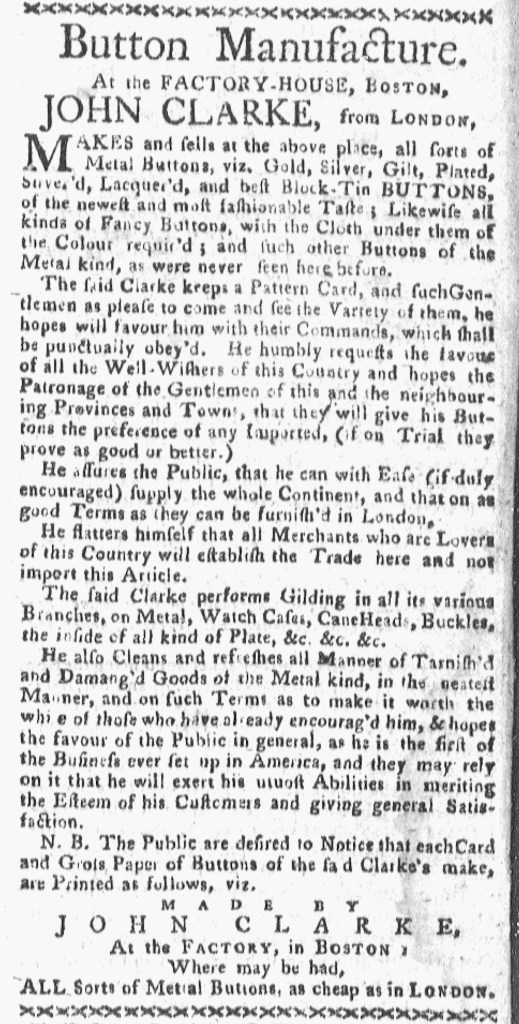
Boston-Gazette (December 13, 1773).

“He flatters himself that all Merchants who are Lovers of this Country will establish the Trade here and not import this Article.”

John Clarke made and sold “all sorts of Metal Buttons” at the “FACTORY-HOUSE” in Boston.  His advertisement in the December 13, 1773, edition of the Boston-Gazette testified to the many ways that he marketed his buttons, both within and beyond newspaper notices.  For instance, Clarke did more than describe his “Gold, Silver, Gilt, Plated, Silver’d, Lacquer’d, and best Block-Tin BUTTONS, of the newest and most fashionable Taste” and “Fancy Buttons with the Cloth under them of the Colour requir’d.”  He also provided samples on “a Pattern Card,” inviting prospective customers to “come and see the Variety of them.”  Clarke hoped that after examining those specimens they would place orders.  He also devised a means of identifying his buttons once they left his manufactory, advising that “each Card and Gross Paper of Buttons of the said Clarke’s make, are printed as follows, viz. MADE BY JOHN CLARKE, At the FACTORY, in Boston: Where may be had, ALL Sorts of Metal Buttons, as cheap as in London.”  His newspaper advertisement reproduced a shorter advertisement that appeared on the packaging of his products.

Clarke also made an appeal to support domestic manufactures, echoing the sentiments that John Keating so often published in advertisements for his “PAPER MANUFACTORY” in New York and others who wished to support local economies rather than importing so many goods from Great Britain.  He presented his buttons to “all the Well-Wishers of this Country and hopes the Patronage of the Gentlemen of this and the neighbouring Provinces and Towns, that they will give his Buttons the preference of any imported.”  Clarke made this appeal as tensions mounted in Boston over the arrival of ships carrying tea that Parliament intended to tax under the new Tea Act.  Within a week, colonizers would board those ships and throw the tea into the harbor.  Clarke likely expected that his message would resonate with readers of theBoston-Gazette, one of the newspapers that most often decried the abuses of Parliament and the colonial officials that attempted to implement its policies.  Those readers (and his prospective customers) included “Merchants who are Lovers of this Country” who had a duty, Clarke asserted, to “establish the Trade here and not import this Article.”  He did not, however, expect merchants, shopkeepers, tailors, and consumers to accept an inferior product as an alternative to the buttons imported from London.  He asked customers to try his buttons, determine “if on Trial they prove as good or better,” and only then place orders for larger quantities “on as good Terms as they can be furnish’d in London.”

At a time when the imperial crisis intensified, Clarke encouraged colonizers to “Buy American” and support his “FACTORY HOUSE” for making buttons, “the first of the Business ever set up in America.”  In addition to his extensive appeal that ran in the Boston-Gazette, the packaging for his buttons included an abbreviated version that promoted his “FACTORY, in BOSTON,” and compared its output, “ALL Sorts of Metal Buttons,” to those imported from London.