June 8

What was advertised in a revolutionary American newspaper 250 years ago today?

New-England Chronicle (June 8, 1775).

“I am ready to assist them in their Struggles for Liberty and Freedom.”

A year later, John Prentice of Londonderry, New Hampshire, had second thoughts about having signed an address lauding Governor Thomas Hutchinson when he left office and departed Massachusetts for England.  On June 6, 1775, Prentice wrote about the mistake he made, acknowledged that he misjudged the governor’s motives, vowed his support for the American cause, and submitted his missive for publication in the New-England Chronicle.  “I the Subscriber was so unfortunate (some Time since),” he explained, “as to sign an Address to the late Governor Hutchinson, so universally and so justly deemed an Enemy to American Liberty and Freedom.”  Prentice claimed he had not understood that in the spring of 1774 – “at the Time I signed the said Address, I intended the Good of my Country” – but now understood his error.  He lamented that to his “Sorrow” signing the address had “a quite contrary Effect.”

Some of the “contrary Effect” that Prentice regretted, however, may have been the reception that he received from his neighbors and others in his community who refused to associate with him socially or to conduct business with him.  Such treatment had previously prompted others who signed the address to the governor to recant and to beg for forgiveness.  Yet Prentice did not mention how others treated him, nor did he apologize, though he did “hope that my injured and affronted Fellow Countrymen will overlook my past Misconduct.”  Perhaps the battles at Lexington and Concord and the ensuing siege of Boston inspired a sincere change of heart, inspiring Prentice to “renounce the same Address in every Part” and proclaim that he was “ready to assist [his countrymen] in their Struggles for Liberty and Freedom, in whatever Way I shall be called upon by them.”

How did Prentice really feel about the address?  Did it matter to readers of the New-England Chronicle?  William Huntting Howell argues that the authenticity of such a conversion was not nearly as important as the ability of a local Committee of Safety or similar panel of Patriots to induce those who signed the address to make public declarations – in print – that they renounced their past actions and now supported the American cause.[1]  The June 8, 1775, edition of the New-England Chronicle carried other letters similar to the one submitted by Prentice, though an adjudication accompanied each of those.  The Committee of Safety in Salem, for instance, absolved thirteen signers of the address who “now to our Sorrow find ourselves mistaken” and “Wish to live in Harmony with our Neighbours” and “to promote to the utmost of our Power the Liberty, the Welfare and Happiness of our country, which is inseparably connected with our own.”  The same committee accepted a more succinct petition from Alexander Walker, while the Committee of Correspondence for Groton accepted Samuel Dana’s apology for “adopt[ing] Principles in Politics different from the Generality of my Countrymen” that contributed to “the Injury of my Country.”

No such endorsement appeared with Prentice’s letter.  In addition, the layout of the issue that carried it suggests that it could have been a letter to the editor that the printers, Samuel Hall and Ebenezer Hall, chose to publish because it matched their political principles or an advertisement that Prentice paid to insert because he considered it so important to place before the public.  Either way, it buttressed the narrative that more and more colonizers recognized the tyranny perpetrated against them once fighting commenced in Massachusetts in the spring of 1775.

**********

[1] William Huntting Howell, “Entering the Lists: The Politics of Ephemera in Eastern Massachusetts, 1774,” Early American Studies 9, no. 1 (Winter 2011): 208-215.
November 1

What was advertised in a colonial American newspaper 250 years ago today?

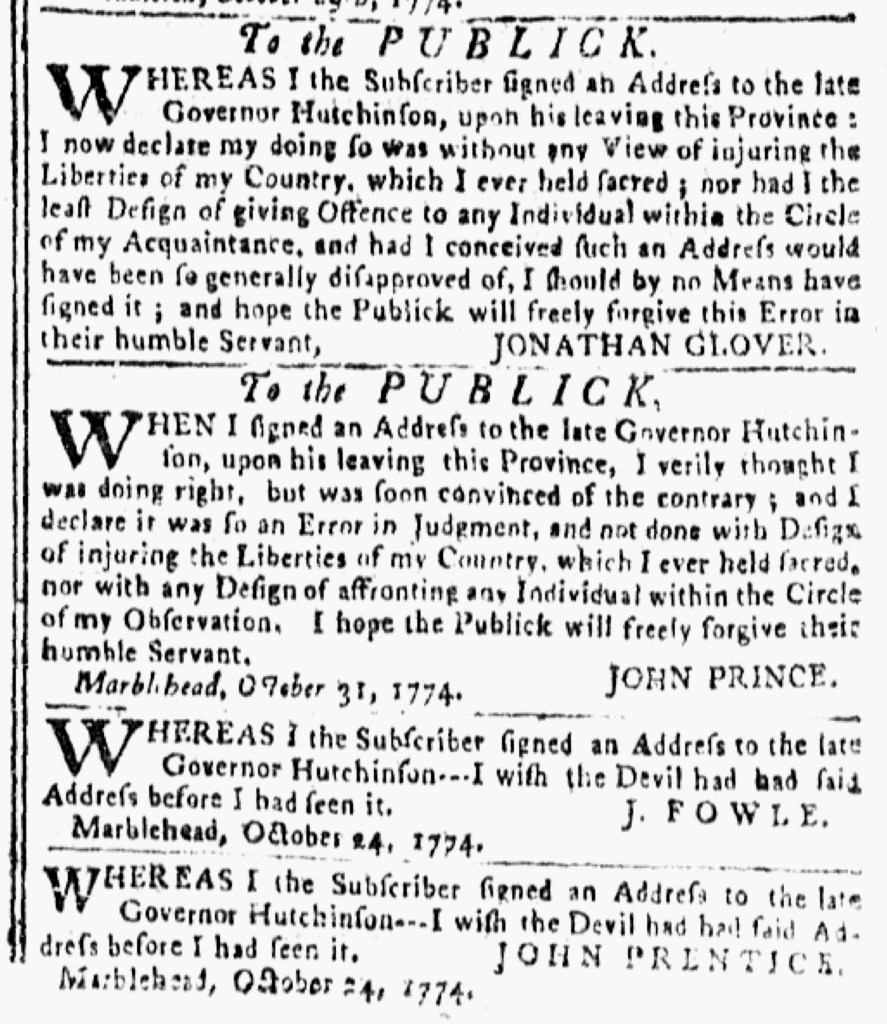
Essex Gazette (November 1, 1774).

“WHEREAS I the Subscriber signed an Address to the late Governor Hutchinson — I wish the devil had had said Address before I had seen it.”

More advertisements from men who wished to recant after signing “an Address to the late Governor Hutchinson, upon his leaving the Province” appeared in the November 1, 1774, edition of the Essex GazetteJohn Stimpson’s letter to that effect ran as an advertisement a week earlier, joined now by letters from Jonathan Glover, John Prince, J. Fowle, and John Prentice.  The printers, Samuel Hall and Ebenezer Hall, positioned them one after another at the end of a column, following an advertisement about a stray cow.  Their position on the page indicated that the Halls considered these letters to be advertisements.  In that case, they would have charged to run them in their newspaper.

Other printers, however, treated some of these same letters differently.  The short missives from Fowle and Prentice each appeared in the Boston Evening-Post, the Boston-Gazette, and the Massachusetts Gazette and Boston Post-Boy the previous day.  In two of those newspapers, they ran with local news, while in the Boston-Gazette the printers placed them between news and advertisements.  They could have been the final news items or the first advertisements in that column.  Even if the printers considered them advertisements, they delivered news to readers.

In the Boston Evening-Post, Thomas Fleet and John Fleet, the printers, provided commentary, reporting that they “have received the Declarations and Acknowledgments of several Deputy Sheriffs, and other Persons, who by signing an Address to Governor Hutchinson had rendered themselves obnoxious to the People.”  They did not have room to publish all of them in that issue, but considered two of them “so concise we can’t omit obliging our Readers with them, as they may serve for a Specimen to other Addressers whose Principles are such as not to incline them to make long Confessions, even when they know they were to blame.”  Samuel Flagg had offered one of those “long Confessions” in the Essex Gazette a month earlier.

Fowle’s letter-advertisement succinctly stated, “WHEREAS I the Subscriber signed an Address to the late Governor Hutchinson — I wish the devil had had said Address before I had seen it.”  Prentice’s letter-advertisement contained an identical message.  Among the others that ran in the Essex Gazette, Glover asserted that he signed the address “without any View of injuring the Liberties of my Country, which I ever held sacred.”  Prince declared that he made “an Error in Judgment” without any “Design of injuring the Liberties of my Country, which I ever held sacred.”  Those two letter-advertisements had variations in wording yet had a similar structure.  For instance, Glover concluded with expressing his “hope the Publick will freely forgive this Error in their humble Servant,” while Prince stated, “I hope the Publick will freely forgive their humble Servant.”

In “Entering the Lists: The Politics of Ephemera in Eastern Massachusetts, 1774,” William Huntting Howell examines other recantations that were either similar or identical.  He questions whether any of them expressed sincerely held beliefs given that they seemed to be “performing by rote.”[1]  That aspect of Fowle’s letter-advertisement calls into question Glover’s invocations of “the Liberties of my Country, which I ever held sacred” and Flagg’s much more extensive reflection on his role in what had transpired. Furthermore, Howell argues, “recantations like these might have kept the Committee of Safety away from one’s house, or signaled to one’s neighbors that one no longer wished to disagree, but they cannot possibly have represented a legitimate conversion or deeply held belief.”[2]  That being the case, the signatories made public apologies in hopes of getting along with others.  By offering the identical letter-advertisements by Fowle and Prentice as prescriptive models for others to copy when ready to make their own “Declarations and Acknowledgments,” the Fleets also signaled that they also believed, as Howell puts it, that “the rote expression of allegiance is not the antithesis of ‘true patriotism,’ but rather its very essence.  The public spectacle of apology or ‘patriotic’ conversion – especially one that follows a pattern – better serves the larger cause than a private change of heart.”[3]

**********

[1] William Huntting Howell, “Entering the Lists: The Politics of Ephemera in Eastern Massachusetts, 1774,” Early American Studies 9, no. 1 (Winter 2011): 214.

[2] Howell, “Entering the Lists,” 215.

[3] Howell, “Entering the Lists, 215-6.

September 18

What was advertised in a colonial American newspaper 250 years ago today?

New-Hampshire Gazette (September 18, 1772).

“A Considerable Quantity of Goods were stoped … upon Supposition of their being stolen.”

As they participated in a transatlantic consumer revolution, colonizers acquired goods in a variety of ways in the eighteenth century.  Colonial newspapers carried many advertisements for both new goods and secondhand goods for sale in shops and auction rooms and at estate sales.  In addition, some colonizers took advantage of what Serena Zabin has termed an “informal economy” that included purchasing stolen goods.  Buyers were not necessarily aware that they bought stolen goods, but a variety of circumstances, including the prices, should have at least made them suspicious that was the case.

Newspaper advertisements document some attempts to supply the informal economy with new wares, including notices about shops “broke open” during the night and others about goods “stopped” or seized when offered for sale.  An advertisement in the September 18, 1772, edition of the New-Hampshire Gazette, for instance, told one such story.  It announced that a “Considerable Quantity of Goods were stoped by Mr. John Prentice at Londonderry upon Supposition of their being stolen.”  Apparently, the prices seemed too good to be true.  Prentice explained that he became suspicious because the “Person on whom the Goods were found offered them for Sale at less than half their Value.”  That person may have stolen them himself or he may have acquired them from the person who had.

Prentice offered a means for the owner to recover the goods, instructing that the “Owner may have them [by] telling the Marks and paying Charges.”  In other words, anyone claiming to be the legitimate owner needed to describe the items, including distinguishing features intended for easy identification, and pay for the advertisement and other expenses incurred in recovering and publicizing the goods.  Unfortunately for the victim of the theft, the person who offered them for sale “made his Escape from the Officer” after being apprehended.  He could not be prosecuted or further questioned about how those goods came into his possession or other stolen merchandise.  Other colonizers did not have the same scruples as Prentice.  Many goods circulated as the result of buyers and sellers alike not asking too many questions or reaching uncomfortable conclusions about the origins of those goods.