October 9

What was advertised in a revolutionary American newspaper 250 year ago today?

Dunlap’s Pennsylvania Packet (October 9, 1775).

“ON July last, twenty-first day, / My servant, JOHN SMITH, ran away.”

Advertisements about indentured servants who ran away before completing their contracts appeared regularly in Dunlap’s Pennsylvania Packet in the 1770s.  In “Reading the Runaways,” David Waldstreicher demonstrates that similar advertisements ran in newspapers throughout the Middle Atlantic colonies during the era of the American Revolution.[1]  As I have examined newspapers from New England to Georgia for the Adverts 250 Project, I have encountered advertisements describing runaway servants and offering rewards for detaining and returning them in newspapers in every region.  They were so common that many issues featured multiple advertisements, some of them concerning two or more indentured servants that made a getaway together.

Given the ubiquity of those advertisements, John Whitehill wanted to increase the chances that readers noticed, read, and remembered his advertisement.  Rather than write formulaic copy, he composed a poem of more than a dozen rhyming couplets.  “ON July last, twenty-first day,” the first two lines read, “My servant, JOHN SMITH, ran away.”  The poem was easy to spot on the page of the October 9, 1775, edition of Dunlap’s Pennsylvania Packet.  The compositor indented each line, creating white space that distinguished the advertisement from other content.  The irregular lengths of each line of the poem meant even more white space on the right.  On a page of news and advertisements printed in orderly columns, justified on the left and on the right, the significant amount of white space in Whitehill’s advertisement made it easy to spot.

Once readers looked more closely, the opening couplet may have inspired even more curiosity.  “Age twenty-five years, and no more,” Whitehill’s poem continued, “I think his heighth is five feet four; / Black curled hair, and slender made, / And is a weaver by his trade.”  Additional couplets described Smith’s clothing, the items he took with him to set up trade somewhere else, and his arrival from Newry on the Renown the previous fall.  One couplet warned others not to aid Smith: “Should any persons him conceal, / No doubt with them I think to deal.”  The final couplets offered a reward and named the aggrieved master: “SIX LAWFUL DOLLARS I will pay; / I live in Salsbury, Pequea, / And further to oblige you still, / My name is junior JOHN WHITEHILL.”  The reward and the names of the servant and the advertiser were the only part of the poem in all capitals, likely intended to draw attention to the incentive for reading the advertisement and assisting Whitehill.

The poem certainly was not Milton nor Shakespeare, but the format of Whitehill’s runaway advertisement made it different (and more entertaining) than any of the other five notices placed for the same purposes in that issue of Dunlap’s Pennsylvania Packet.  The attention it garnered may very well have been worth the time and effort that Whitehill invested in writing the poem.  For other examples of masters adopting this strategy, see James Gibbons’s advertisement about Catherine Waterson in the December 21, 1769, issue of the Pennsylvania Gazette and John McGoun’s advertisement about John Hunter in the October 26, 1774, issue of the Pennsylvania Gazette.

**********

[1] David Waldstreicher, “Reading the Runaways: Self-Fashioning, Print Culture, and Confidence in Slavery in the Eighteenth-Century Mid-Atlantic,” William and Mary Quarterly, 3rd ser., 56, no. 2 (April 1999): 243-272.
December 22

What was advertised in a colonial American newspaper 250 years ago today?

Pennsylvania Gazette (December 22, 1773).

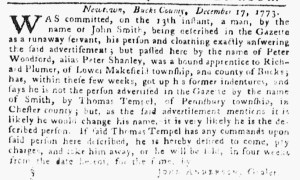
“WAS committed … a man, by the name of John Smith, being described in the Gazette as a runaway servant.”

John Anderson, the jailer in Newtown in Bucks County, placed an advertisement in the December 22, 1773, edition of the Pennsylvania Gazette in hopes that it would come to the attention of Thomas Tempel of Pennsbury Township in Chester County, though he likely desired that other readers might supply additional information to help him sort out a situation at his jail.  Anderson reported that on December 13 he detained a man named John Smith,” being described in the Gazette as a runaway servant, his person and cloathing exactly answering the said advertisement.”  At least some colonizers closely read newspaper advertisements that described runaway indentured servants, convict servants, and apprentices or enslaved people who liberated themselves, making it worth the investment for masters and enslavers to place those notices.

Anderson stated that the man he believed was Smith “passed [in Newtown] by the name of Peter Woodford, alias Peter Shanley” and produced “former indentures” when he claimed he had been “a bound apprentice to Richard Plumer” in Lower Makefield Township in Bucks County.  The jailer doubted this story and even the documents that Smith presented because the advertisement that previously ran in the Pennsylvania Gazette “mentions it is likely he would change his name.”  Runaway servants and others often utilized that strategy to increase their chances of making good on their escapes.  Accordingly, Anderson considered it “very likely he is the described person.”  He did not mention any efforts to contact Plumer to determine whether the alleged Smith was actually his former apprentice.  Instead, he advised that if Temple “has any commands upon the said person here described” that he should “come, pay charges, and take him away.”  Otherwise, Anderson would sell Smith (or whoever he was) into a new indenture “in four weeks,” apparently unconvinced by his insistence that he was Peter Woodford or the documents he carried.  A man of low status, unknown to the jailer in Newtown, did not seem to have much recourse to avoid this fate, though perhaps someone that Anderson considered trustworthy would see the advertisement and intervene on the detained man’s behalf.  The prisoner also faced the possibility that Tempel would indeed go the Newtown and positively identify him.  The power of the press had the potential to negate or, perhaps more likely in this instance, to strengthen the authority exercised by the jailer.

February 1

What was advertised in a colonial American newspaper 250 years ago today?

Feb 1 - 2:1:1768 Boston-Gazette
Boston-Gazette (February 1, 1768).

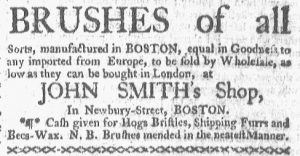
“BRUSHES of all Sorts, manufactured in BOSTON.”

In an advertisement on the front page of the February 1, 1768, edition of the Boston-Gazette, John Smith announced that he sold “BRUSHES of all Sorts” at his shop on Newbury Street. Rather than peddling imports from England, Smith emphasized that his brushes had been “manufactured in BOSTON.” In so doing, he situated his advertisement within ongoing public debates about transatlantic commerce and politics. The colonies suffered from a trade deficit that benefited England. To add insult to injury, Parliament imposed new duties on certain imported goods, especially paper, in the Townshend Act that had gone into effect in late November 1767. In response, Bostonians voted at a town meeting to launch new nonimportation pacts. To that end, they also pledged to purchase goods produced in the North American colonies and to encourage domestic manufactures of all kinds in order to reduce their reliance on imported wares.

Smith did not need to offer extensive or explicit commentary on recent events in his advertisement. He knew that prospective customers were well aware of the commercial and political circumstances. After all, the publishers of the Boston-Gazette and most other colonial newspapers consistently inserted news and editorial items that addressed the imperial crisis that continued to unfold. But such problems did not circulate only in print: they were the subjects of daily conversation throughout the colonies. As a result, Smith did not need to purchase a significant amount of advertising space in order to explain why colonists should purchase his brushes rather than any other. He likely believed that simply proclaiming that his brushes had been “manufactured in BOSTON” encapsulated the entire debate and justified selecting his wares over any others. He did offer brief reassurances that they were “equal in Goodness to any imported from Europe” and priced “as low as they can be bought in London,” but the weight of his marketing efforts rested on the place of production.  Smith even solicited “Hogs Bristles,” necessary for continuing to make brushes.

In the 1760s, first in response to the Stamp and later in response to the Townshend Act, colonists launched “Buy American” advertising campaigns. Certainly a staple of modern marketing, “Buy American” campaigns have a history that extends back before the first shots were fired during the American Revolution.

January 13

What was advertised in a colonial newspaper 250 years ago today?

Jan 13 - 1:13:1766 Boston Evening-Post
Boston Evening-Post (January 13, 1776).

“To be sold at the STORE of John Smith … A general Assortment of GOODS.”

Advertisements like this one from John Smith make me reassess (or, at least, temper) one of the central arguments of my work on advertising in eighteenth-century America.  I contend that the consumer revolution that took place in the late colonial period, during the American Revolution, and into the era of the Early Republic was supply driven, whereas others argue that it was generated by consumer demand.  I have spent a lot of time and spilled a lot of ink making the case that newspaper advertisements and other marketing media were developed to incite demand among potential customers, that producers, suppliers, and retailers invoked a variety of appeals and devised incentives to encourage potential customers that they wanted and needed to purchase their goods and services.

Smith’s rather simple advertisement is certainly not the best example offering support for such claims.  At first glance, it seems to amount to little more than an announcement.  However, I am not willing to abandon my argument concerning the significance of supply (rather than demand) in the consumer revolution.  Consider other advertisements that appeared in the same issue.  Many make appeals to price or quality or fashion.  Some provide extensive lists to underscore the choices available to potential customers.  Indeed, even the relatively banal reference to “A general Assortment of GOODS” does make an appeal by hinting at the possibility of many choices among Smith’s merchandise.  Smith’s advertisement may not be flashy by modern standards — or the standards of the nineteenth century or even the final decades of the eighteenth century — but it does suggest that even many of the most rudimentary advertisements used language meant to engage readers and encourage them to make purchases.

Jan 13 - Boston Evening-Post - Full Page
Final Page of the Boston Evening-Post (January 13, 1766).