December 21

What was advertised in a revolutionary American newspaper 250 years ago today?

New-York Journal (December 21, 1775).

“WILL BE PUBLISHED … A JOURNAL OF THE PROCEEDINGS OF THE CONTINENTAL CONGRESS.”

On Thursday, December 21, 1775, John Anderson, the printer of the Constitutional Gazette, ran an advertisement in the New-York Journal to stimulate interest in one of his forthcoming projects.  “On SATURDAY NEXT,” he announced, “will be published, by JOHN ANDERSON … A JOURNAL OF THE PROCEEDINGS OF THE CONTINENTAL CONGRESS.”  Just two weeks earlier, William Bradford and Thomas Bradford, the printers of the Pennsylvania Journal, advertised that they would soon publish the “JOURNAL OF THE PROCEEDINGS OF THE CONGRESS, HELD AT PHILADELPHIA, May 10, 1775.”  It appears that Anderson quickly acquired a copy and set about printing a local edition for the New York market, making him the first printer outside of Philadelphia to publish an overview of the Second Continental Congress when it convened after the battles at Lexington and Concord.  The volume that Anderson published had a slightly different title than what appeared in the advertisement: Extracts from the Votes and Proceedings of the American Continental Congress: Held at Philadelphia, 10th May, 1775.  In the rush to take it to press, the compositor introduced several errors in the page numbers, according to the American Antiquarian Society’s catalog.

Neither the Bradfords nor Anderson merely printed these collections of records of the Second Continental Congress and then advertised them.  Instead, both encouraged readers to anticipate their publication, making the eventual announcements that they were available for purchase even more enticing and persuasive.  On Saturday, December 23, Anderson’s own newspaper featured an advertisement promising that “This Day will be published by the Printer.  A Journal of the Proceedings of the Continental Congress.”  Eager customers could visit his printing office “at Beekman’s-Slip” to see if copies were ready for purchase.  By December 27, they were certainly available.  In the issue of the Constitutional Gazette distributed that day, Anderson described the volume as “Just published by the Printer” and listed three local agents who also sold it.  An updated advertisement also appeared in the New-York Journal on December 28, nearly identical to the one from the previous issue with the first two lines replaced with a single line.  Anderson’s advertisement began, “Just published, and to be sold by” instead of “On SATURDAY NEXT / WILL BE PUBLISHED, by.”  Using a series of advertisements in two of New York’s newspapers, Anderson announced the forthcoming publication of a local edition of “THE PROCEEDINGS OF THE CONTINENTAL CONGRESS” and kept the public informed of its progress and availability.

December 10

What was advertised in a revolutionary American newspaper 250 years ago this week?

Pennsylvania Evening Post (December 9, 1775).

“JUST published, and may be had of the printer hereof, JOURNAL of the PROCEEDINGS of the CONGRESS.”

Like other printers, Benjamin Towne sold books to supplement the revenue he generated from newspaper subscriptions, advertisements, and job printing.  In a brief advertisement in the December 9, 1775, edition of the Pennsylvania Evening Post he announced, “JUST published, and may be had of the printer hereof, JOURNAL of the PROCEEDINGS of the CONGRESS, held at Philadelphia May 10, 1775.  Also that new and interesting work, of great merit and integrity, BURGH’s POLITICAL DISQUISITIONS.”

Three days earlier, on a Wednesday, William Bradford and Thomas Bradford, the printers of the Pennsylvania Journal, advertised that they would publish and sell the journal of the proceedings of the Second Continental Congress from May through August starting “On FRIDAY Next.”  On Saturday, Towne became the first bookseller other than the Bradfords to announce that he had copies for sale.  In this instance, as in so many other advertisements for books and pamphlets that appeared in early American newspapers, the phrases “JUST published” and “may be had of the printer hereof” did not both apply to the printer who placed the notice.  Instead, “JUST published” merely informed readers that a work was now available.  Such was the case for the journal of the proceedings of the Second Continental Congress as well as for the American edition of James Burgh’s Political Disquisitions, published by Robert Bell.  Towne did not take up Bell’s invitation to “All the Printers on the continent to insert “the whole” of a lengthy advertisement with an address from “The American Editor to his Countrymen” in his newspaper even though Bell promised to pay for such consideration with cash or books.  Towne may have expected that prospective customers were already familiar with Bell’s marketing efforts from other newspapers printed in Philadelphia.  Towne likely sold other books at his printing office, yet he did not choose to include any others in his advertisement.  Instead, the printer opted to promote books that resonated with current events, believing that they would draw customers to his shop.  He could hawk other books once readers arrived to examine the volumes that he advertised.

December 6

What was advertised in a revolutionary American newspaper 250 years ago today?

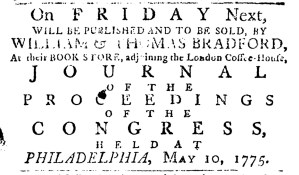
Pennsylvania Journal (December 6, 1775).

“JOURNAL OF THE PROCEEDINGS OF THE CONGRESS, HELD AT PHILADELPHIA, MAY 10, 1775.”

On Wednesday, December 6, 1775, William Bradford and Thomas Bradford, printers of the Pennsylvania Journal, announced that “On FRIDAY Next, WILL BE PUBLISHED … [the] JOURNAL OF THE PROCEEDINGS OF THE CONGRESS, HELD AT PHILADELPHIA, MAY 10, 1775.”  The contents of that volume covered the period from May 10 through August 1.  Throughout the colonies, readers had been able to follow news from the Second Continental Congress reprinted from newspaper to newspaper.  Local printers made editorial decisions about which items to include.  With this volume, however, readers gained access to the entire proceedings.  It supplemented the news they previously read or heard.  It also provided a convenient means of collecting the information in a single place, though some colonizers did save newspapers and one, Harbottle Dorr, even created an extensive index to aid him as he reviewed news of the imperial crisis that eventually became a revolution.

The Bradfords announced publication of the Journal of the Proceedings of the Congress in advance in hopes that the anticipation would incite demand.  They gave their advertisement a privileged place in their newspaper, placing it immediately after the news.  The “ARTICLES of CAPITULATION made and entered into between Richard Montgomery, Esq; Brigadier General of the Continental army, and the citizens and inhabitants of Montreal” on November 12 appeared in the column to the left of the Bradfords’ advertisement.  They may have hoped that news of an American victory in the two-pronged invasion of Canada that targeted Montreal and Quebec City would help to sell copies of the Journal of the Proceedings of the Congress.  In addition to publishing the journal documenting the first months of the Second Continental Congress, the Bradfords previously printed and advertised a complete journal of the proceedings of the First Continental Congress held in Philadelphia in September and October 1774.  Nearly as soon as that body adjourned, the Bradfords published and advertised a collection of Extracts that included “a List of Grievances” and the Continental Association, a nonimportation and nonconsumption agreement intended to use commercial leverage to achieve political goals.  Within a month of marketing the Extracts, the Bradfords made the complete journal available to the public.  These publications supplemented and expanded newspaper coverage of the debates and decisions made by delegates meeting in Philadelphia.