April 19

What was advertised in a revolutionary American newspaper 250 years ago today?
Essex Journal (April 19, 1776).

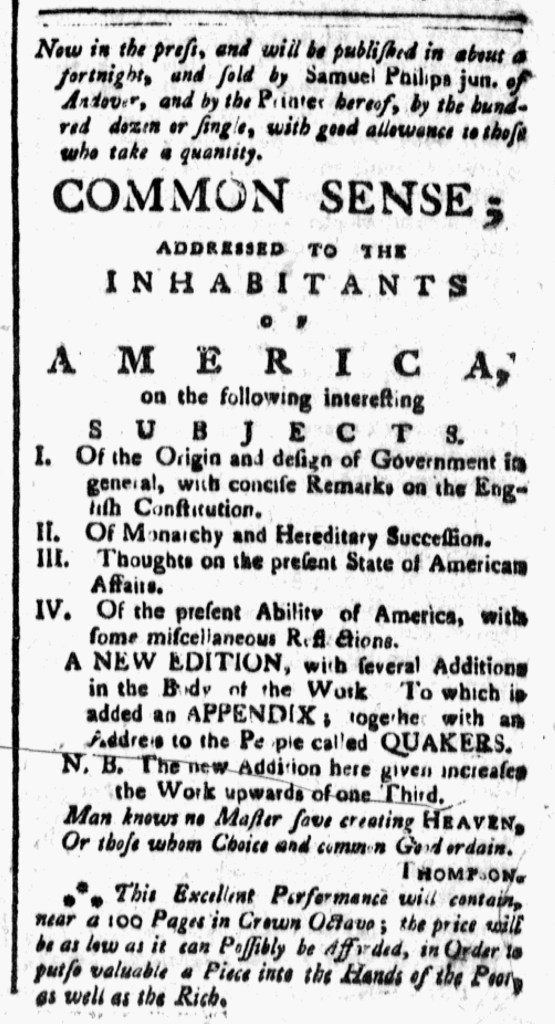
By the hundred[,] dozen or single, with good allowance to those who take a quantity.  COMMON SENSE.”

One year after the battles at Lexington and Concord that started the Revolutionary War, the first advertisement for Thomas Paine’s Common Sense appeared in the Essex Journal and New-Hampshire Packet.  John Mycall, the printer of that newspaper, prepared a local edition in Newburyport, Massachusetts, just as printers in many other cities and towns in Pennsylvania, New York, and New England had done in the three months since Robert Bell made the first edition available in Philadelphia.

This newest edition was not yet ready for sale.  Instead, Mycall announced that it was “Now in the press, and will be published in about a fortnight.”  He encouraged readers to anticipate its publication, priming the pump for distributing the popular political pamphlet within the next couple of weeks.  His advertisement replicated many that appeared in other newspapers.  He gave the title of the pamphlet, provided an overview of its contents by listing the subject headings, and gave two lines from the poem “Liberty” by Scottish poet James Thompson.  He also described his edition as “A NEW EDITION, with several Additions in the Body of the Work To which is added an APPENDIX; together with an Address to the People called QUAKERS.”  That suggested that Mycall drew the Newburyport edition from one of the expanded editions that Paine collaborated with William Bradford and Thomas Bradford in publishing in Philadelphia after the author parted ways with Bell, though the printer of the first edition pirated that bonus content when he published unauthorized subsequent editions.  A nota bene in Mycall’s advertisement, “The new Addition here given increases the Work upwards of one Third,” echoed the Bradfords’ advertisements.

To increase sales and disseminate the pamphlet widely, Mycall enlisted a local agent in Andover, and both of them sold copies “by the hundred[,] dozen or single, with good allowance to those who take a quantity.”  In other words, he gave a discount to customers who bought multiple copies.  Those who purchased a dozen may have distributed them to friends, while those who purchased “by the hundred” likely planned to sell them retail in their own shops.  The discount for volume allowed them to set competitive prices while turning a profit.  In addition, Mycall proclaimed that “the price will be as low as it can Possibly be Afforded, in Order to put so valuable a Piece into the Hands of the Poor, as well as the Rich.”  Such efforts likely helped Common Sense become the most widely read political pamphlet published in the colonies during the era of the American Revolution.
April 8

What was advertised in a revolutionary American newspaper 250 years ago today?

Boston-Gazette (April 8, 1776).

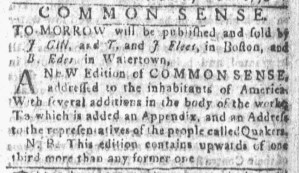
“TO-MORROW will be published … A NEW Edition of COMMON SENSE.”

The April 8, 1776, edition of the Boston-Gazette featured an update about the local edition of Thomas Paine’s Common Sense announced in the New-England Chronicle four days earlier.  On a Thursday, readers learned that “Next week will be PUBLISHED, and to be SOLD … in BOSTON, A New Edition of COMMON SENSE.”  The following Monday, an advertisement with a headline that proclaimed “COMMON SENSE” informed the public that “TO-MORROW will be published and sold … A NEW Edition of COMMON SENSE.”  In less than a week, the Boston edition went from in the press to in stock and for sale.

The new advertisement included a clarification about where readers could acquire copies: from “J. Gill, and T. and J. Fleet, in Boston, and B. Edes in Watertown.”  The previous version listed only Boston locations, though Benjamin Edes had relocated to Watertown to print the Boston-Gazette there throughout the siege of Boston.  Although the British departed on March 17, Edes and the Boston-Gazette remained in Watertown until the end of October.  Customers could purchase Common Sense from Edes in Watertown or from John Gill, his former partner in publishing the newspaper, in Boston.  In addition, Thomas Fleet and John Fleet, who had printed the Boston Evening-Post before it folded soon after the battles at Lexington and Concord, also sold Common Sense in Boston.

As the number of local editions of Common Sense proliferated in 1776, so did the number of advertisements promoting the popular political pamphlet and the number of newspapers disseminating advertisements about it.  The number of retailers who sold Common Sense also increased.  Although the printers in Boston and Watertown did not do so, others listed the price for a single copy and offered discounts for buying a dozen or more, encouraging booksellers, shopkeepers, and others to purchase copies to sell far and wide.  Counting the number of local editions of Common Sense demonstrates the popularity of the pamphlet compared to other political tracts published during the era of the American Revolution, yet that does not reveal the timing of their publication and sale to readers.  Advertisements for Common Sense, on the other hand, demonstrate when local editions became available to readers.

April 4

What was advertised in a revolutionary American newspaper 250 years ago today?

New-England Chronicle (April 4, 1776).

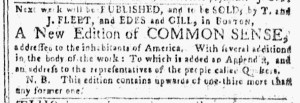
“Will be PUBLISHED … in BOSTON, A New Edition of COMMON SENSE.”

It did not take long after the siege of Boston ended with the evacuation of British troops on March 17, 1776, for printers in that town to set about publishing a local edition of Thomas Paine’s Common Sense.  An advertisement in the April 4 edition of the New-England Chronicle, published in Cambridge, announced that “Next week will be PUBLISHED, and to be SOLD, by T. and J. FLEET, and EDES and GILL, in BOSTON, A New Edition of COMMON SENSE.”  This edition would include “several additions in the body of the work: To which is added an Appendix, and an address to the representatives of the people called Quakers.”  That the printers described it as a “New Edition” suggested that they followed the second edition that Paine collaborated with William Bradford and Thomas Bradford in publishing rather than unauthorized editions that Robert Bell, the publisher of the first edition, marketed after having a falling out with the author.  The Bradfords described their edition as the “NEW EDITION” in their advertisements.  They also inserted a nota bene that declared, “This Edition contains upwards of one-third more than any former one.”  The Fleets and Edes and Gill replicated that nota bene in their own advertisement.

It likely came as no surprise to local readers that Benjamin Edes and John Gill got involved in publishing an edition of Common Sense.  For many years, they printed the Boston-Gazette, a newspaper known for its strident advocacy for the American cause.  After publishing the April 17, 1775, edition of the Boston-Gazette, they suspended the newspapers and dissolved their partnership following the battles at Lexington and Concord on April 19.  Edes removed to Watertown, where the Massachusetts Provincial Congress met, and resumed publication in early June 1775.  The Boston-Gazette remained there until the end of October 1776 and then returned to port city.  Thomas Fleet and John Fleet, the former printers of the Boston Evening-Post, had previously collaborated with Edes and Gill and other local printers on other projects, especially almanacs.  They published the final issue of the Boston Evening-Post on April 24, 1775, announcing that they “shall desist publishing their Papers … till Matters are in a more settled State.”  They never resumed publishing their newspaper, but they joined with Edes and Gill in publishing a Boston edition of Common Sense shortly after the British left the city.  Samuel Hall, the printer of the New-England Chronicle, may have attempted to give the enterprise a boost.  The news updates in the column to the left of the advertisement for the popular political pamphlet reported that a “favourite toast, in the best companies, is, ‘May the INDEPENDENT principles of COMMON SENSE be confirmed throughout the United Colonies.’”  The publication and dissemination of a Boston edition of Common Sense helped in spreading those “INDEPENDENT principles in New England.

March 28

What was advertised in a revolutionary American newspaper 250 years ago today?

New-England Chronicle (March 28, 1776).

“THE 2d Salem Edition of the celebrated Pamphlet, intitled COMMON SENSE.”

A brief advertisement in the March 28, 1776, edition of the New-England Chronicle alerted readers that “THE 2d Salem Edition of the celebrated Pamphlet, intitled, COMMON SENSE, is just published, and to be sold by EZEKIEL RUSSELL of that place.”  It was the fourth advertisement for Thomas Paine’s influential political pamphlet that appeared in a newspaper published in Massachusetts and perhaps the first one that promoted an edition of Common Sense printed in that colony.

On March 4, the Boston-Gazette, printed in Watertown during the siege of Boston, carried a notice offering “A few of those celebrated Pamphlets … to be Sold (if applied for soon) at Mr. Samuel Wait’s … in Cambridge; and at the Printing Office in Watertown.”  Benjamin Edes, the printer of the Boston-Gazette, did not indicate which edition he stocked.  The copies he had on hand may have come from the press of Judah P. Spooner in Norwich, Connecticut, or from the press of John Carter in Providence, Rhode Island.  Alternately, Edes may have acquired copies published in New York or Philadelphia.  Perhaps Russell had published a local edition in Salem by early March, doing so without fanfare in the public prints.  Edes ran the same advertisement again three weeks later.

In the time between the appearances of those advertisements in the Boston-Gazette, Samuel Hall offered for sale at his printing office in Cambridge “A few copies of that valuable pamphlet, intitled COMMON SENSE” in an advertisement in the March 14, 1776, edition of the New-England Chronicle.  Which edition did he sell?  Could it have been the first edition printed in Salem by Russell?  If so, why did the advertisement published on March 28 indicate that Russell sold the “2d Salem Edition” in that town but Edes did not have copies in Cambridge?

Whatever the answer to that question, this reference to a “2d Salem Edition” seems to suggest an edition published there but not listed in Richard Gimbel’s Bibliographical Check List of Common Sense.  Gimbel identifies only one edition published in Salem in 1776.[1]  Its title page identified it as the “Third Edition,” though that did not necessarily mean that Russell printed three editions.  Instead, it likely indicated that he knew of two previous editions.  When John Carter published local editions in Providence, he identified them as the “Sixth Edition” and the “Tenth Edition,” presumably taking into account editions printed in Philadelphia, New York, and other towns that came to his attention via newspaper advertisements, correspondence, and exchanges with fellow printers.[2]  That being the case, Russell almost certainly knew that any Salem edition he published was not the third edition printed in the colonies, but perhaps the disruptions caused by the war had an impact on his networks for collecting information at the time he first took a Salem edition to press.  That the advertisement in the New-England Chronicle cites a “2d Salem Edition” yet Gimbel lists only one edition of Common Sense printed there might indicate that yet another edition circulated in 1776 even though no known copies have survived in historical societies, research libraries, and private collections.  Paine’s pamphlet went through more editions than any other published during the era of American Revolution.  Perhaps it had one more edition than scholars previously realized.

**********

[1] Richard Gimbel, Thomas Paine: A Bibliographical Check List of Common Sense with an Account of Its Publication (New Haven: Yale University Press, 1956), 91.

[2] Gimbel, Thomas Paine, 90-91.

March 1

What was advertised in a revolutionary American newspaper 250 years ago today?

Connecticut Gazette (March 1, 1776).

“Such has been the Demand for this Pamphlet, that eight Editions of it have been printed.”

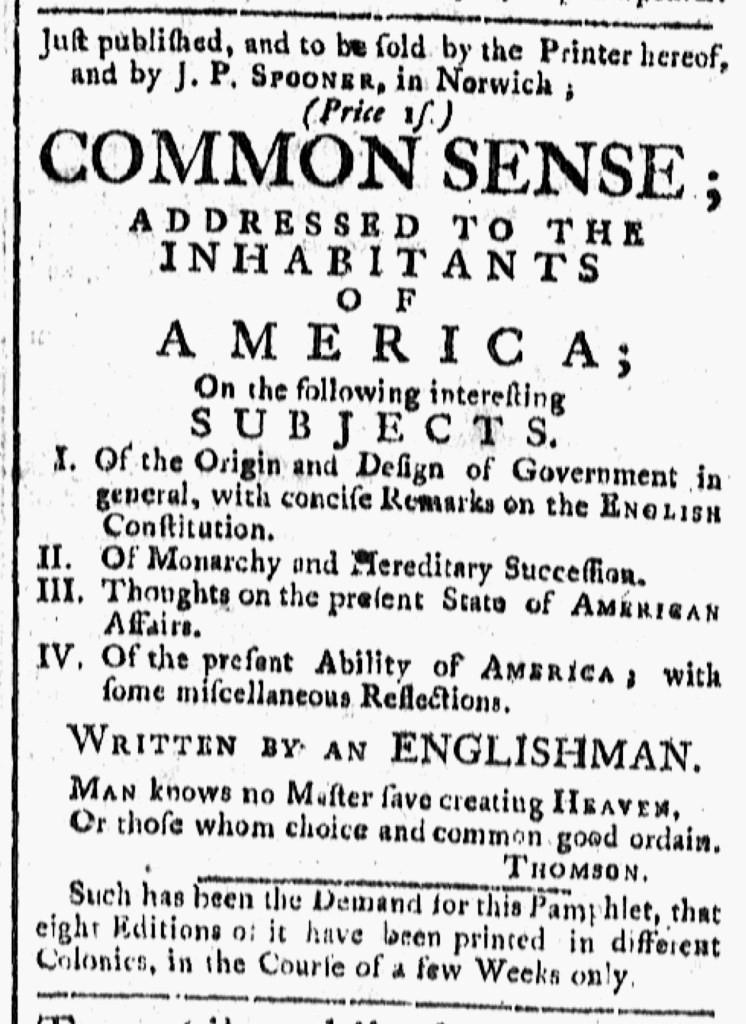
Timothy Green, the printer of the Connecticut Gazette in New London, updated his advertisement for a local edition of Thomas Paine’s Common Sense that he jointly published with Judah P. Spooner, his brother-in-law and former apprentice who ran a printing office in Norwich.  A week earlier, Green announced the imminent publication of the pamphlet in short advertisement: “To-morrow will be published, and sold by the Printer hereof, and by J.P. Spooner in Norwich; COMMON SENSE; ADDRESSED TO THE INHABITANTS OF AMERICA.”  Green hoped to incite a sense of anticipation among prospective customers.

Once he had copies available for sale at his printing office in New London, Green ran a more extensive advertisement, one that resembled advertisements in other newspapers placed by publishers and booksellers who sold editions published in Philadelphia, New York, and Providence.  In addition to the title of the pamphlet, the advertisement listed the “following interesting SUBJECTS” that Paine covered, replicating section headings that included “Of Monarchy and Hereditary Succession” and “Thoughts on the present State of AMERICAN Affairs.”  Since Paine remained anonymous at that time, the advertisement stated that the pamphlet was “WRITTEN BY AN ENGLISHMAN.”  Green also included the epigraph, two lines of “Liberty,” a poem by James Thomson, that appeared on the title page of the first edition and in advertisements for that and other editions.

In general, Green did not generate new copy for his advertisement for this edition of Common Sense, but he did add an original note at the end: “Such has been the Demand for this Pamphlet, that eight Editions of it have been printed in different Colonies, in the Course of a few Weeks only.”  For those who had not heard about the incendiary pamphlet and the bold ideas that Paine presented, Green hoped that its popularity in other places would convince them not to miss reading it for themselves by purchasing a local edition.  His tabulation of “eight Editions” suggested that he closely examined the advertisements in newspapers printed in other cities and towns delivered to his printing office as part of a network for sharing information and reprinting content from newspaper to newspaper to newspaper.  Green did not peruse just the news accounts and editorials.  He apparently took note of the competing editions published in Philadelphia and local editions advertised in other places.  Bringing attention to such demand, he reasoned, would spur sales of a local edition of Common Sense in New London.

February 28

What was advertised in a revolutionary American newspaper 250 years ago today?

Pennsylvania Gazette (February 28, 1776).

Lancaster … JUST PUBLISHED … by FRANCIS BAILEY … COMMON SENSE.”

Readers encountered advertisements for Thomas Paine’s Common Sense on the first and final pages of the February 28, 1776, edition of the Pennsylvania Gazette.  Two of those advertisements looked familiar to anyone who had been perusing the public prints in recent weeks.  One of them promoted the “NEW EDITION OF COMMON SENSE: With Additions and Improvements in the Body of the Work.”  Paine penned that material as well as “an APPENDIX, and an ADDRESS to the People called QUAKERS” for an edition that he worked with William Bradford and Thomas Bradford to publish.  The Bradfords and other members of the book trades in Philadelphia stocked and sold Paine’s approved edition.  Meanwhile, Robert Bell, the publisher of the first edition, continued hawking “Large Additions to COMMON SENSE,” a collection of essays drawn from newspapers, none of them by Paine, to accompany his unauthorized second edition of Common Sense.  The compositor conveniently placed the advertisements one after the other on the final page, seemingly not taking a side in the dispute.

Another advertisement for Common Sense appeared on the first page of that issue of the Pennsylvania Gazette.  It announced the publication of a local edition published by Francis Bailey in Lancaster, Pennsylvania.  It was the first time that an advertisement for Bailey’s edition appeared in any newspaper.  Bearing the dateline, “Lancaster, February 24, 1776,” it informed readers that Bailey sold “COMMON SENSE; Addressed to the INHABITANTS of AMERICA.  With the Additions, APPENDIX, and Address to the People called QUAKERS” at his “Printing and Post-Offices, in King-street.”  Although other publishers of Common Sense provided a preview by listing the pamphlet’s section headings the first time they ran advertisements, Bailey did not do so.  Perhaps he did not consider it necessary considering that the Pennsylvania Gazette and other newspapers printed in Philadelphia that already carried advertisements for the various editions by Bell and the Bradfords circulated in Lancaster and served that town as local and regional newspapers.  Lancaster would not have its own newspaper until John Dunlap temporarily relocated his Pennsylvania Packet during the British occupation of Philadelphia in 1777.  Bailey’s advertisement and his edition of Common Sense were for residents of Lancaster and nearby towns, not readers in Philadelphia who had ready access to other editions, but since they shared local-regional newspapers that already carried many advertisements that included the contents of the pamphlet Bailey did not need to incorporate that information into his own advertisement.  He saved money on advertising by publishing a streamlined notice.

February 23

What was advertised in a revolutionary American newspaper 250 years ago today?

Connecticut Gazette (February 23, 1776).

“Sold by the Printer hereof … COMMON SENSE.”

On February 23, 1776, Timothy Green, the printer of the Connecticut Gazette, announced the publication of yet another local edition of Thomas Paine’s Common Sense.  He joined other printers in publishing, advertising, and disseminating the incendiary political pamphlet far beyond Philadelphia, where Robert Bell published and advertised the first edition on January 9.  Since then, Bell produced an unauthorized second edition and Paine worked with William Bradford and Thomas Bradford, the printers of the Pennsylvania Journal, on an expanded new edition (and they engaged in a public argument about the competing editions in the Pennsylvania Evening Post and other newspapers published in Philadelphia).  The Bradfords also informed readers that a German edition was in the works.  In addition, they indicated that they would fill an order from Virginia for one thousand copies.  It did not take long for William Green, a bookseller and bookbinder in New York, to advertise copies of Bell’s first and second editions.  John Anderson, the printer of the Constitutional Gazette in New York, soon marketed the first local edition published beyond Philadelphia.  By the middle of February, John Carter, the printer of the Providence Gazette, advised readers that his local edition would hit the market within a week.

That edition went on sale at the same time that Green released a local edition in New London.  According to the advertisement, Judah P. Spooner, his brother-in-law and former apprentice who operated a printing office in Norwich, sold the pamphlet there as well.  The imprint on the title page suggested that Green and Spooner collaborated as publishers, but Spooner did the printing: “Philadelphia: Printed.  Norwich: Re-printed and sold by Judah P. Spooner, and by T. Green, in New-London.”  Green gave their advertisement a privileged place in the Connecticut Gazette, placing it immediately after updates from Hartford.  That made it difficult for readers to miss.  He did not, however, include elements that often appeared in advertisements for other editions in other newspapers, such as the list of section headers that outlined the contents or the epigraph from “Liberty,” a poem by James Thomson.  Lack of space may have prevented Green from publishing a more elaborate advertisement, though he may have considered the buzz around Common Sense sufficient to sell it once prospective customers knew where to purchase a local edition.

February 17

What was advertised in a revolutionary American newspaper 250 years ago today?

Providence Gazette (February 17, 1776).

“This Pamphlet is in such very great Demand, that … three Editions of it have been printed in Philadelphia.”

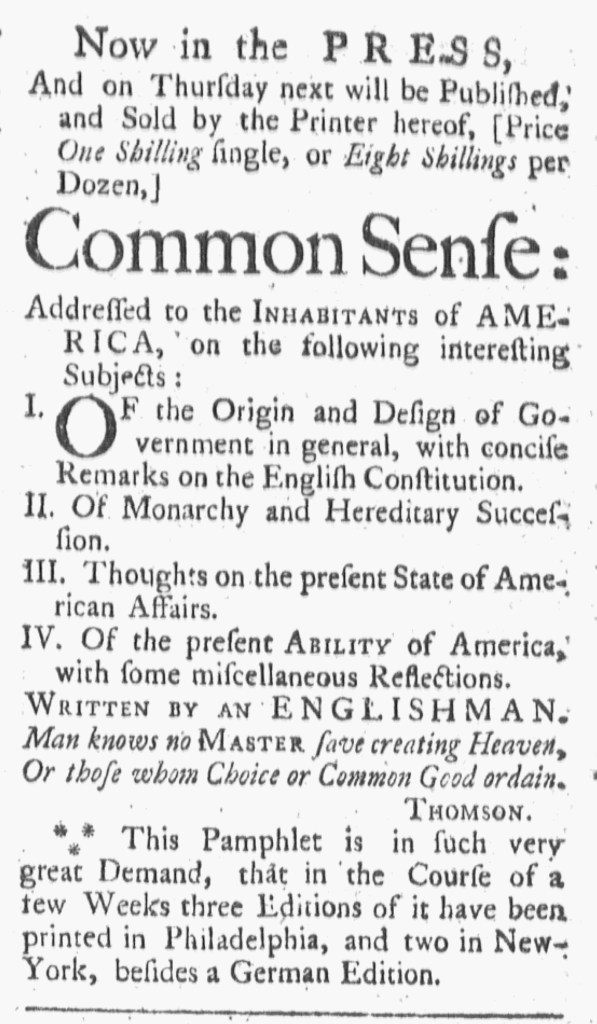
On February 17, 1776, John Carter, the printer of the Providence Gazette, became the first printer in New England to announce plans to publish a local edition of Thomas Paine’s Common Sense.  “Now in the PRESS,” he proclaimed, “And on Thursday next will be Published … Common Sense: Addressed to the INHABITANTS of AMERICA, on the following interesting Subjects.”  Carter then listed the titles of the sections of the political pamphlet, replicating many of the advertisements that previously ran in newspapers published in Philadelphia and New York.  He even included the epigraph from “Liberty,” a poem by James Thomson, that appeared on the first page of the first edition published by Robert Bell and in many of Bell’s advertisements for the pamphlet.

Carter disseminated this advertisement on a Saturday, but readers had to wait until the following Thursday for the pamphlet to go on sale.  To stoke anticipation even more, he reported, “This Pamphlet is in such very great Demand, that in the Course of a few Weeks three Editions of it have been printed in Philadelphia, and two in New-York, besides a German Edition.”  Indeed, Bell first advertised Common Sense on January 9 and soon after advertised an unauthorized second edition.  Unhappy with Bell’s failure to earn a profit on the first edition, Paine turned to William Bradford and Thomas Bradford to publish a new edition with additional content.  Before its publication on February 14, Bell and Paine engaged in bitter exchanges in advertisements in the Pennsylvania Evening Post and other newspapers.  In their advertisement, the Bradfords also indicated that a “German edition is likewise in the press.”  Meanwhile, John Anderson advertised his local edition, the first printed in New York, on February 7.  Even if readers of the Providence Gazette had not previously heard much about Paine’s incendiary political pamphlet, Carter intended for its popularity in Philadelphia and New York to encourage sales of his local edition.  He clearly intended for retailers to purchase it to sell again, offering a discount of “One Shilling single, or Eight Shillings per Dozen.”  Perhaps he expected that supporters of the American cause would also purchase by the dozen and distribute them to friends and relations.  Allowing such a steep discount likely helped the pamphlet achieve even greater circulation.

February 7

What was advertised in a revolutionary American newspaper 250 years ago today?

Constitutional Gazette (February 7, 1776).

A new and correct Edition, of that justly esteemed Pamphlet, called COMMON SENSE.”

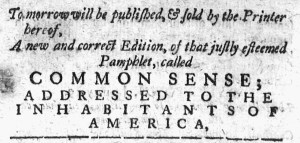
As Robert Bell, the publisher of the first edition of Thomas Paine’s Common Sense, hawked an unauthorized second edition and William Bradford and Thomas Bradford, the printers who collaborated with Paine to publish a new edition with additional content prepared that edition for press, an advertisement for the first edition of Common Sense published beyond Philadelphia appeared in the February 7, 1776, issue of the Constitutional Gazette in New York.  John Anderson, the printer of the Constitutional Gazette, ran a notice announcing, “Tomorrow will be published, & sold by the Printer hereof, A new and correct Edition, of that justly esteemed Pamphlet, called COMMON SENSE; ADDRESSED TO THE INHABITANTS OF AMERICA.”  His advertisement did not go into greater detail about the contents.  Anderson knew very well that other advertisements in the Constitutional Gazette and other newspapers published in New York provided an overview of the sections in Bell’s first edition.  The “justly esteemed Pamphlet” required no further introduction.

Only four weeks passed between Bell’s advertisement promoting the publication of Common Sense in the January 9, 1776, edition of the Pennsylvania Evening Post and Anderson informing readers in New York that they could purchase a local edition.  His newspaper carried the first advertisement for Common Sense in New York, listing William Green, a bookseller, as Bell’s local agent for distributing the pamphlet.  Anderson likely acquired a copy from Green, either purchasing it or accepting it in lieu of payment for the advertisement.  His advertisement for his “new and correct Edition” did not mention the dispute and controversy around the publication of Bell’s unauthorized edition that unfolded in Philadelphia in newspaper advertisements there, though he had likely seen some of those notices.  After all, printers carefully perused newspapers printed in other cities to select content to reprint in their own newspapers.  Anderson focused solely on giving the public greater access to Common Sense (and generating revenue in his printing office).  His local edition met with sufficient success that he eventually published a second edition.

December 21

What was advertised in a revolutionary American newspaper 250 years ago today?

New-York Journal (December 21, 1775).

“WILL BE PUBLISHED … A JOURNAL OF THE PROCEEDINGS OF THE CONTINENTAL CONGRESS.”

On Thursday, December 21, 1775, John Anderson, the printer of the Constitutional Gazette, ran an advertisement in the New-York Journal to stimulate interest in one of his forthcoming projects.  “On SATURDAY NEXT,” he announced, “will be published, by JOHN ANDERSON … A JOURNAL OF THE PROCEEDINGS OF THE CONTINENTAL CONGRESS.”  Just two weeks earlier, William Bradford and Thomas Bradford, the printers of the Pennsylvania Journal, advertised that they would soon publish the “JOURNAL OF THE PROCEEDINGS OF THE CONGRESS, HELD AT PHILADELPHIA, May 10, 1775.”  It appears that Anderson quickly acquired a copy and set about printing a local edition for the New York market, making him the first printer outside of Philadelphia to publish an overview of the Second Continental Congress when it convened after the battles at Lexington and Concord.  The volume that Anderson published had a slightly different title than what appeared in the advertisement: Extracts from the Votes and Proceedings of the American Continental Congress: Held at Philadelphia, 10th May, 1775.  In the rush to take it to press, the compositor introduced several errors in the page numbers, according to the American Antiquarian Society’s catalog.

Neither the Bradfords nor Anderson merely printed these collections of records of the Second Continental Congress and then advertised them.  Instead, both encouraged readers to anticipate their publication, making the eventual announcements that they were available for purchase even more enticing and persuasive.  On Saturday, December 23, Anderson’s own newspaper featured an advertisement promising that “This Day will be published by the Printer.  A Journal of the Proceedings of the Continental Congress.”  Eager customers could visit his printing office “at Beekman’s-Slip” to see if copies were ready for purchase.  By December 27, they were certainly available.  In the issue of the Constitutional Gazette distributed that day, Anderson described the volume as “Just published by the Printer” and listed three local agents who also sold it.  An updated advertisement also appeared in the New-York Journal on December 28, nearly identical to the one from the previous issue with the first two lines replaced with a single line.  Anderson’s advertisement began, “Just published, and to be sold by” instead of “On SATURDAY NEXT / WILL BE PUBLISHED, by.”  Using a series of advertisements in two of New York’s newspapers, Anderson announced the forthcoming publication of a local edition of “THE PROCEEDINGS OF THE CONTINENTAL CONGRESS” and kept the public informed of its progress and availability.