June 10

What was advertised in a colonial American newspaper 250 years ago today?
New-Hampshire Gazette (June 10, 1774).

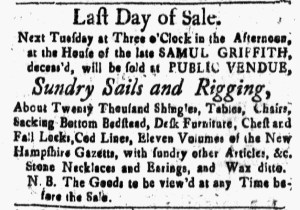
“Last Day of Sale.”

The executors for Samuel Griffith’s estate held a sale in Portsmouth on June 14, 1774, advertising a “PUBLIC VENDUE” in the June 10, 1774, edition of the New-Hampshire Gazette.  The sale included “Sundry Sails and Rigging” as well as “About Twenty Thousand Shingles, Tables, Chairs, [a] Sacking Bottom Bedstead, Desk Furniture, …with sundry other Articles” that prospective buyers could view prior to the sale.

Griffith had apparently kept abreast of the news.  His estate included “Eleven Volumes of the New Hampshire Gazette,” a “HISTORICAL CHRONICLE” (according to the masthead) of events in the colony and throughout the Atlantic world.  The executors considered Griffith’s collection of newspapers of significant enough interest to merit mention in the sale notice.  Griffith had not treated his copies of the New-Hampshire Gazette as ephemeral.  If those “Eleven Volumes” corresponded with the past eleven years, then buyers could acquire an account of the imperial crisis as it had unfolded with the Royal Proclamation of 1763, the passage and repeal of the Stamp Act in 1765 and 1766, the Townshend Acts and nonimportation agreements in the late 1760s, the Boston Massacre in 1770, and the Boston Tea Party in 1773.  Some colonizers, like Harbottle Dorr, revisited news and editorials to inform their understanding of current events.

To incite interest and increase the number of people in attendance, the executors included a headline that proclaimed, “Last Day of Sale.”  That alerted readers that they had limited opportunity to acquire any of the items from the estate, likely at bargain prices for secondhand wares compared to what they would pay retail for new items.  Those interested in the sails, rigging, and shingles for their own businesses also had the potential for lower prices than purchasing them elsewhere on the market, but not if they hesitated.  They needed to be present the following Tuesday when the sale commenced.  Many advertisements in the New-Hampshire Gazette did not feature headlines at all, so one announcing “Last Day of Sale” likely helped draw attention to an event soon to take place.
May 23

What was advertised in a colonial American newspaper 250 years ago today?

Newport Mercury (May 23, 1774).

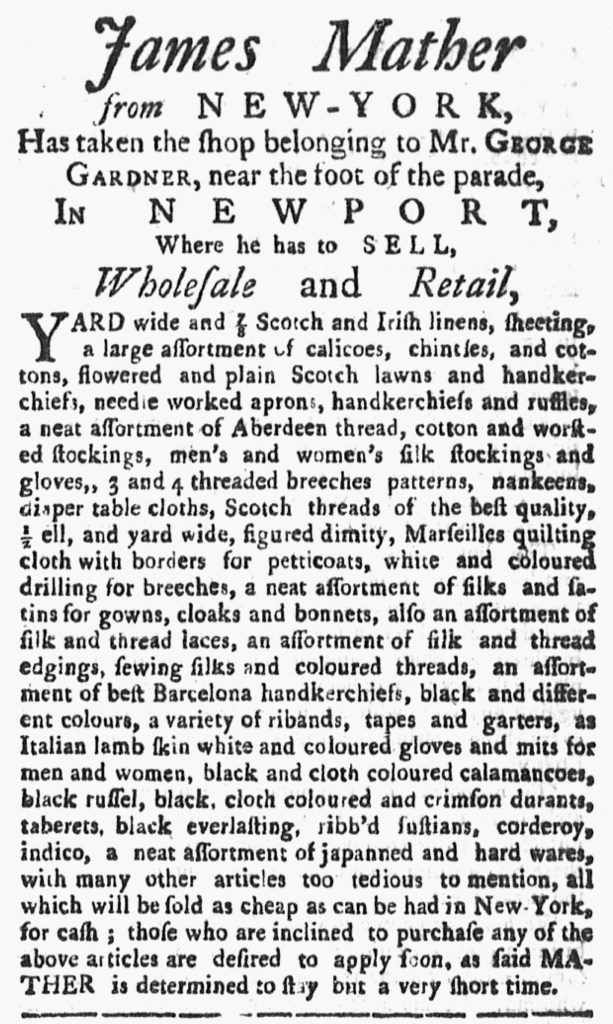
“MATHER is determined to stay but a very short time.”

A new purveyor of goods arrived in Newport in the spring of 1774, but he did not have plans to remain in Rhode Island for long, at least not according to the advertisement he placed in the May 23 edition of the Newport Mercury.  James Mather “from NEW-YORK” introduced himself to the public with an announcement that he occupied “the shop belonging to Mr. GEORGE GARDNER, near the foot of the parade.”  Presumably, many readers were familiar with the location and the proprietor if not the entrepreneur who now did business in that space.

Mather offered his wares “Wholesale and Retail,” giving an extensive list of items in stock at his shop.  He carried “a large assortment of calicoes, chintses, and cottons,” “men’s and women’s silk stockings and gloves,” “a neat assortment of silks and satins for gowns, cloaks and bonnets,” and “a neat assortment of japanned and hard wares.”  Yet his newspaper advertisement could not contain the variety of merchandise he had on hand.  Mather exclaimed that he had “many other articles too tedious to mention.”  Prospective customers could depend on an array of choices when they visited the shop “near the foot of the parade.”

They could also expect bargain prices.  Mather declared that he set prices “as cheap as can be had in New-York,” suggesting that competition in the larger port yielded deals for consumers and retailers who bought to sell again.  Being “from NEW-YORK,” Mather had firsthand knowledge of the prices there.  He made them available in Newport, but for a limited time only.  He recommended that “those who are inclined to purchase any of the above articles” should “apply soon” because he “is determined to stay but a very short time.”  Shop soon or miss out, he warned.  It was not the first time that Mather deployed this strategy for moving merchandise.  The previous fall he undertook a similar enterprise in Providence, renting space near a familiar landmark and promoting prices “as cheap as can be bought in New-York.” Mather apparently found it more lucrative to pursue short-term endeavors in smaller ports than maintain a permanent location in New York.

July 3

What was advertised in a colonial American newspaper 250 years ago today?

New-Hampshire Gazette (July 3, 1772).

The Printers will not Promise to exchange after the first of August next.”

Daniel Fowle and Robert Fowle, printers of the New-Hampshire Gazette, gave one of their advertisements a privileged place in the July 3, 1772, edition of their newspaper.  They positioned their notice about “Compleat Sets of the new and correct Law-Book, for the Province of New-Hampshire” at the top of the first full column of advertising, increasing the likelihood that readers would take note of it as they finished the news items even if they only quickly glanced at the advertisements.

To encourage sales of the new edition, the Fowles offered a deal to customers who owned copies of the previous edition.  They stated that they “will take the old ones of such Persons, as were subscribers for that Edition, and allow them one Dollar for the same.”  In other words, those customers received a discount when they traded in the outdated edition.  To convince customers that this was a good deal, the Fowles proclaimed that the previous edition was “not worth a Farthing” now that they published a “new and correct” edition, so customers might as well take advantage of their generosity in allowing “one Dollar” for it.

The Fowles also attempted to create a sense of urgency by making clear that this was a limited time offer.  They asserted that customers who wished to return the previous edition must “purchase a new Book now.”  They warned that “the Printers will not Promise to exchange after the first of August next.”  Customers had only four weeks to contemplate this offer before the Fowles potentially rescinded it.  In addition, the printers had “but few to dispose of in this Way,” or so they claimed.  That meant that interested readers needed to make the exchange while supplies lasted.

The Fowles deployed several savvy marketing strategies when they published a new and updated edition of the laws of the colony.  They offered discounts to former customers who traded in the old edition, simultaneously pressuring them to purchase the new volume soon by cautioning that they had limited supply and the offer expired soon.  Prospective customers needed to act quickly or risk missing out!

September 6

What was advertised in a colonial American newspaper 250 years ago today?

Connecticut Journal (September 6, 1771).

Shoes sold cheap.”

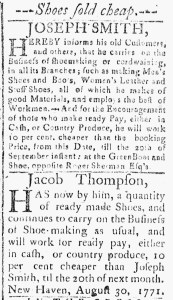
Joseph Smith and Jacob Thompson competed for customers.  Both placed advertisements in the September 6, 1771, edition of the Connecticut Journal to promote the shoes they made and sold in New Haven.  Smith’s notice appeared first, informing prospective customers that “he carries on the Business of shoemaking or cordwaining, in all its Branches” at his shop located at “the Green Boot and Shoe.”  He used “good Materials” and hired “the best of Workmen.”  In case that was not enough to attract the attention of local consumers, Smith also described a limited-time offer for those ready to pay (or barter for “Country Produce”) immediately rather than purchase their shoes and boots on credit.  Until September 20, he would “work 10 per cent. cheaper than the booking price.”  Customers could take advantage of this bargain, but only if they acted quickly.

Thompson’s advertisement ran immediately below Smith’s notice.  He declared that he “continues to carry on the Business of Shoe-making as usual” and already had “a quantity of ready made Shoes” in stock.  Rather than allow Smith to get the upper hand by setting lower prices, Thompson made an offer of his own.  For customers prepared to pay (or, again, barter) rather than buy on credit, he sold his shoes “10 per cent cheaper than Joseph Smith.”  This offer also concluded on September 20.  Only on rare occasions did advertisers mention competitors by name in eighteenth-century America, making Thompson’s notice exceptional.  Merchants, shopkeepers, and artisans frequently proclaimed that they had the lowest prices in town (or sometimes the entire colony).  Some offered to match the prices of their competitors, but they usually did not seek to undercut other purveyors of goods and services as blatantly as Thompson attempted to do with Smith.

The publication history of these advertisements added another layer to the competition.  Smith first inserted his notice in the Connecticut Journal on August 23, giving prospective customers four weeks to respond to his offer.  The following week, Thompson placed his advertisement as a response, but the two notices appeared on different pages.  On September 6, the printers decided to place the two advertisements together and added a headline that trumpeted, “Shoes sold cheap.” Neither Smith nor Thompson had previously included that headline in their advertisements.  A line separated it from Smith’s advertisement, making clear that the headline was an addition rather than part of either notice.  Why did the printers intervene?  Were they having some fun with the competition between two local shoemakers?  Whatever their intention, the new headline enhanced the advertisements, calling greater attention to them and benefitting consumers with cash (or country produce) on hand to respond to the limited-time offer.

May 30

What was advertised in a colonial newspaper 250 years ago today?

May 30 - 5:30:1766 New-Hampshire Gazette
New-Hampshire Gazette (May 30, 1766).

“If not disposed of in 10 Days will be repacked.”

This advertisement announced the eighteenth-century version of a “limited time only” sale, a tactic meant to generate interest and prompt potential customers to make a purchase as soon as possible or else miss out on an opportunity.

Today’s advertisement played on scarcity in more than one way. It claimed that the “Beautiful variety of Chinces” that had just arrived from London were “never before exposed to Sale.” This appeal served more than one purpose. It reassured buyers that these printed textiles were not castoffs that did not sell in other markets, but it also made clear that colonists who bought from this shipment would gain something unique. They would be able to make garments and other items that were distinctive. They would be able to set themselves apart from other consumers participating in the same marketplace.

To maintain this sense of uniqueness and scarcity, the seller promised to sell these chintzes for a limited time. Any overstock would not linger; instead, it would be “repacked” and not available for sale. Don’t hesitate, this advertisement warned, or else risk missing out. The sense of urgency may have helped to get potential customers through the door just to see the patterns on the textiles that merited this special treatment.