June 14

What was advertised in a colonial American newspaper 250 years ago today?
South-Carolina Gazette and Country Journal (June 14, 1774).

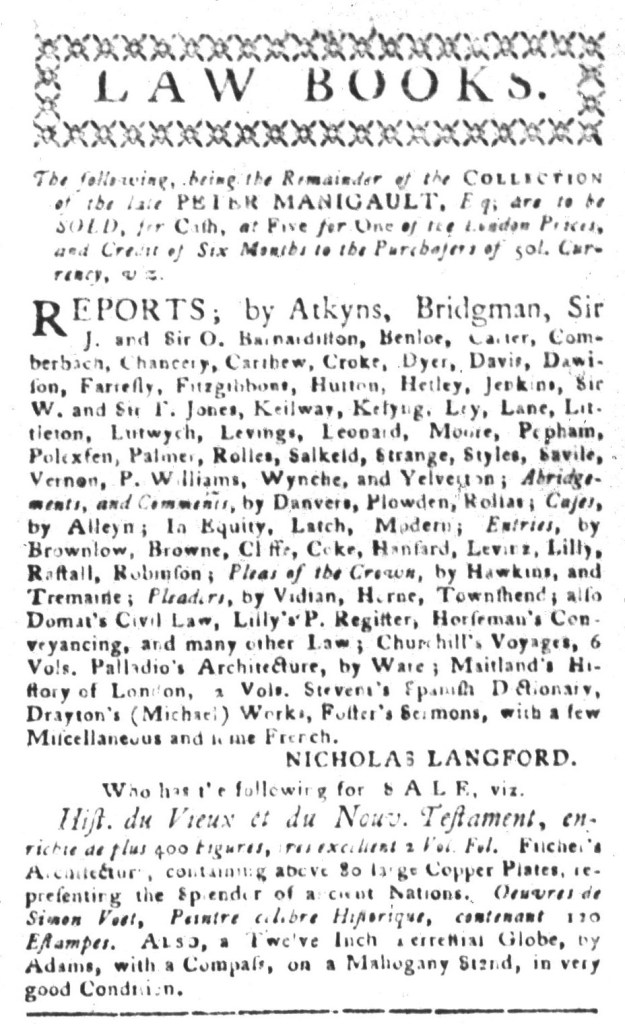
“LAW BOOKS … being the Remainder of the COLLECTION of the late PETER MANIGAULT, Esq.”

Nicholas Langford advertised dozens of law books for sale in the June 14, 1774, edition of the South-Carolina Gazette and Country Journal.  In addition to listing the authors and titles, his advertisement featured a headline, “LAW BOOKS,” enclosed within a border composed of decorative type.  It was the only notice in that issue that received such treatment.  Langford also advertised in the June 10 edition of the South-Carolina and American General Gazette, deploying the same headline with the list of books.  In that instance, the headline did not receive special treatment, suggesting that the printing office was responsible for the enhancement to the version in the South-Carolina Gazette and Country Journal instead of Langford issuing instructions or making a request.

Why might Charles Crouch, the printer of that newspaper, have decided that this advertisement merited such a headline?  Perhaps it was an act of deference.  Langford advertised “the Remainder of the COLLECTION of the late PETER MANIGAULT, Esq.”  Crouch and readers would have been familiar with the prominent lawyer, legislator, and plantation owner.  “Because of his large land and slave holdings,” Michelle Brown notes, Manigault “became one of the wealthiest men in eighteenth-century British North America.”  He owned thousands of acres and enslaved hundreds of men, women, and children.  Manigault served in the Commons House of Assembly from 1755 to 1772, elected as Speaker during the time that South Carolina and other colonies protested the Stamp Act and reelected seven times.  His political career began shortly after he returned from London, where he studied law at the Inner Temple from 1750 to 1754.  He resigned in 1772 due to ill health, returning to England in hopes of recuperating, but died there on November 12, 1773.  Brown reports that “his body was returned to Charleston for burial in the family vault of the Huguenot Church.”  His estate entrusted Langford, a bookseller, with selling his library of law books.  Given Manigault’s influence in the colony, Crouch may have decided that this advertisement deserved a more elaborate headline than others published in his newspaper.

July 3

What was advertised in a colonial American newspaper 250 years ago today?

New-Hampshire Gazette (July 3, 1772).

The Printers will not Promise to exchange after the first of August next.”

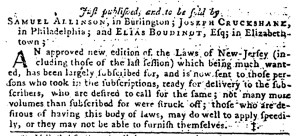
Daniel Fowle and Robert Fowle, printers of the New-Hampshire Gazette, gave one of their advertisements a privileged place in the July 3, 1772, edition of their newspaper.  They positioned their notice about “Compleat Sets of the new and correct Law-Book, for the Province of New-Hampshire” at the top of the first full column of advertising, increasing the likelihood that readers would take note of it as they finished the news items even if they only quickly glanced at the advertisements.

To encourage sales of the new edition, the Fowles offered a deal to customers who owned copies of the previous edition.  They stated that they “will take the old ones of such Persons, as were subscribers for that Edition, and allow them one Dollar for the same.”  In other words, those customers received a discount when they traded in the outdated edition.  To convince customers that this was a good deal, the Fowles proclaimed that the previous edition was “not worth a Farthing” now that they published a “new and correct” edition, so customers might as well take advantage of their generosity in allowing “one Dollar” for it.

The Fowles also attempted to create a sense of urgency by making clear that this was a limited time offer.  They asserted that customers who wished to return the previous edition must “purchase a new Book now.”  They warned that “the Printers will not Promise to exchange after the first of August next.”  Customers had only four weeks to contemplate this offer before the Fowles potentially rescinded it.  In addition, the printers had “but few to dispose of in this Way,” or so they claimed.  That meant that interested readers needed to make the exchange while supplies lasted.

The Fowles deployed several savvy marketing strategies when they published a new and updated edition of the laws of the colony.  They offered discounts to former customers who traded in the old edition, simultaneously pressuring them to purchase the new volume soon by cautioning that they had limited supply and the offer expired soon.  Prospective customers needed to act quickly or risk missing out!

December 30

What was advertised in a colonial American newspaper 250 years ago this week?

Maryland Gazette (December 27, 1770).

“Catalogues may be had at Mr. Thomas Williams and Company’s Store in Annapolis.”

Newspaper advertisements were the most common form of marketing media in eighteenth-century America, but they were not the only means of advertising.  Entrepreneurs also produced and distributed broadsides, handbills, trade cards, billheads, furniture labels, subscription papers, circular letters, and catalogs.  Given the ephemeral quality of those genres, they have not survived in the same numbers as newspaper advertisements, but those that have been identified in research libraries, historical societies, and private collections suggest that various forms of advertising circulated widely.

Sometimes newspaper advertisements from the period made reference to other advertising materials that consumers discarded after the served their purpose, especially subscription papers for books and other publications, auction catalogs for an array of goods, and book catalogs that often also included stationery wares.  Such was the case in an advertisement for “LAW BOOKS” in the December 27, 1770, edition of the Maryland Gazette.  Thomas Brereton advertised that he sold law books in Baltimore.  Seeking to serve prospective customers beyond that town, he advised readers that they could acquire catalogs “at Mr. Thomas Williams and Company’s Store in Annapolis.”  Consumers could shop from the catalog and place orders via the post, the eighteenth-century version of mail order.

Brereton likely recognized benefits of simultaneously distributing two forms of marketing.  The newspaper advertisements went into widespread circulation throughout the colony and beyond, enlarging his market beyond Baltimore.  Yet the rates for publishing lengthy newspaper advertisements, such as a list of titles from a book catalog, may have been prohibitively expensive.  Instead, resorting to job printing for a specified number of catalogs may have been the more economical choice.  In addition, doing so created an item devoted exclusively to the sale of Brereton’s law books without extraneous materials.  Interested parties who encountered Brereton’s advertisement in newspapers they read in coffeehouse or taverns or borrowed from friends or acquaintances could request their own copies of the catalog to carry with them, mark up, and otherwise treat as they pleased.

Compared to the frequency that newspapers advertisements promoted book catalogs as ancillary marketing materials, relatively few have survived.  Some historians suspect that advertisers did not produce all of the catalogs they mentioned in their newspaper notices, especially those that advertisers promised would soon become available.  Despite that possibility, it did not serve Brereton to direct prospective customers to a catalog that did not exist.  In this instance, he noted that the catalogs were already available, increasing the likelihood that he did indeed produce and circulate them.