
GUEST CURATOR: Madison Kenney
What was advertised in a colonial American newspaper 250 years ago today?

“The best Price given for ALL SORTS OF LINEN RAGS.”
John Keating, the owner of a “PAPER MANUFACTORY” in New York, uses politics as an advertising strategy. In 1774, “The demand for paper in America, is of late so greatly increased, that very large sums are continually sent abroad, for the purchase of it.” Keating attempted to take advantage of the political tension with Britain by connecting the donation of spare rags to make into paper with patriotism. He argued, “All those who really wish to promote the interest of America … will contribute their aid to the success of the paper manufactory in this place.”
Advertisements asking families to save linen rags to support American printing were not uncommon during the era of the American Revolution. An advertisement printed on the back of Thomas’s Massachusetts, New-Hampshire, and Connecticut Almanack for the Year of our Lord Christ 1779 claims “ fair daughters of Liberty…would not neglect to serve their country, by saving for the paper mill in Sutton, all linen and cotton and linen rags.” Again, entrepreneurs who made paper or printed on it used patriotism to pressure households to support American industry by donating rags. Kayla Haveles argues that printing was “as vital to revolution as guns and gunpowder” because the colonists used it to spread ideology and attack the British.
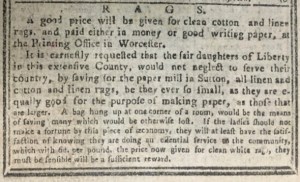
Additionally, the frequency of these advertisements highlights the contributions of women in the Revolution. Both advertisements focus on saving rags in the home. Keating’s advertisement asked every family to save spare rags in their household. Women were responsible for the housework so Keating’s call to action targeted women. The advertisement on the back of the almanac asked “daughters of Liberty” to save rags. Both advertisements are examples of how women contributed to the Revolution by supporting the American economy.
**********
ADDITIONAL COMMENTARY: Carl Robert Keyes
John Keating had been placing similar advertisements for the “NEW-YORK Paper MANUFACTORY” for years by the time this advertisement appeared in the March 24, 1774, edition of the New-York Journal. The Adverts 250 Project first featured one of his advertisements that offered “Ready Money for clean Rags” that ran in that newspaper on February 18, 1768. During the six years in between, Keating maintained an almost constant presence in the public prints, encouraging colonizers, especially women, to collect rags for paper production and explaining the patriotic benefits of their efforts. He advertised at times when relationships with Parliament deteriorated, including when nonimportation agreements went into effect to protest various legislation, as well as when the situation cooled and most merchants, shopkeepers, and consumers returned to business as usual. Keating remained a steady voice in favor of “domestic manufactures” or goods produced in the colonies.
In this instance, Keating ran his advertisement at a time of crisis. Throughout the colonies, the destruction of the tea in Boston the previous December remained a topic of conversation, including in New York. The Sons of Liberty anticipated the arrival of the Nancy with a cargo of tea that they did not want landed in their city. Keating’s advertisement, which had been running since before the Boston Tea Party, appeared on the last page of the March 24 issue, interspersed among other advertisements. A notice that the Sons of Liberty would meet every Thursday evening “till the Arrival and Departure of the TEA SHIP,” on the other hand, made its second appearance, this time in the first column on the first page. Only tables showing prices current and sunrise, sunset, and high tide preceded the announcement. Its placement made it more likely that readers would see it, while also framing how they read other advertisements in the issue. Most readers likely did not need that notice from the Sons of Liberty to influence their reaction to Keating’s advertisement calling on “all those who really wish to promote the interest of America” to do their part, considering how widely colonizers discussed the politics of tea at the time. Still, the combination of print culture and public discourse occurring everywhere from the town common to taverns made Keating’s appeals to patriotism even more urgent.