
What was advertised in a revolutionary American newspaper 250 years ago today?
“The sign of Kouli Khan.”
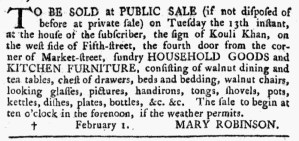
Mary Robinson had a variety of “HOUSEHOLD GOODS and KITCHEN FURNITURE” that she wished to sell, either at an upcoming auction or, if possible, via private sales before the auction. She listed some of those items in an advertisement in the February 6, 1776, edition of the Pennsylvania Evening Post, including “walnut dining and tea tables, chest of drawers, beds and bedding, walnut chairs, looking glasses, pictures, handirons, tongs, shovels, pots, kettles, dishes, plates, [and] bottles.” She did not give a reason for the sale, whether it was an estate sale, she intended to move, she needed money to pay bills, or she wished to clean out a cluttered house, but the reason likely did not matter to most prospective buyers who saw an opportunity to acquire all sorts of items at bargain prices. Purchasing secondhand goods made the consumer revolution accessible to many colonizers.
In an era before standardized street numbers, Robinson gave her address as “the sign of Kouli Khan, on the west side of Fifth-street, the fourth door from the corner of Market-street,” in Philadelphia. That a sign marked the location suggested that Robinson operated a shop or a tavern at her house. The sign certainly distinguished Robinson’s house from other places that displayed signs in Philadelphia, including “the Sign of the SCYTHE and SICKLE” displayed by Goucher and Wylie, cutlers on Fourth Street, and “the sign of the Sugar-loaf, Pound of Chocolate, and Tea Canister,” where Robert Levers sold “GROCERY GOODS” on Second Street. For those entrepreneurs, their signs corresponded with the items they made or sold. Isaac Bartram, a “Chymist and Druggist,” chose a more fanciful device for his “Medicine Store” at “the Sign of the Unicorn’s Head” on Third Street, while the sign at Robinson’s house depicted a real person, Nader Shah Afshar. Kouli Khan (as he was known to Europeans in the eighteenth century), the powerful emperor of Persia, invaded India in the late 1730s, seizing the treasury and the Peacock Throne before withdrawing. Colonizers in Philadelphia likely considered the powerful leader of a place they considered exotic a proper symbol to mark the location of a shop that sold imported goods, especially the textiles imported from India so often advertised in the Pennsylvania Evening Post and other newspapers. Robinson likely intended for the combination of military might and connections to global commerce to resonate with customers who shopped or drank at “the sign of Kouli Khan.”