
What was advertised in a revolutionary American newspaper 250 years ago this week?
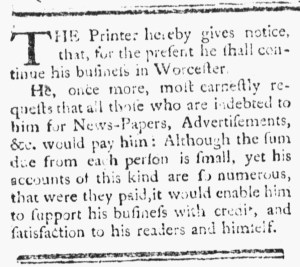
“He … most earnestly requests that all who are indebted to him for News-Papers, Advertisements, &c. would pay him.”
The April 26, 1776, edition of Thomas’s Massachusetts Spy opened with a notice from the printer, Isaiah Thomas. “THE Printer hereby gives notice,” he declared, “that, for the present he shall continue his business in Worcester.” Thomas had arrived in town a year earlier. In the spring of 1775, he advertised his intention to establish Worcester’s first printing office and newspaper and entrust both to a junior partner. As the imperial crisis intensified, however, he departed Boston just before the battles at Lexington and Concord, relocated to Worcester beyond the reach of the British, and set himself up as the town’s new printer. On May 3, 1775, he published the first issue of the Massachusetts Spy printed in Worcester. A year later, he considered whether he wished to remain following the British evacuation of Boston. Although he announced that “for the present he shall continue his business in Worcester,” a month later he leased the newspaper to William Stearns and Daniel Bigelow. Thomas moved to Salem “with an intention to commence business in that place; but many obstructions to the plan arising in consequence of the war, he sold the printing materials which he carried to that town, and, in 1778, returned to Worcester, took into possession the press which he had left there, and resumed publication of the Spy.”[1]
In late April 1776, Thomas had not yet decided to leave Worcester. In hopes of maintaining he business he pursued there, he issued a call for customers to pay their bills. Throughout the colonies, printers (and other entrepreneurs) frequently ran similar notices. Thomas did so occasionally and “once more, earnestly requests that all those who are indebted to him for News-Papers, Advertisements, &c. would pay him.” Like other printers, he extended generous credit to subscribers and other customers. Doing so put his business in a difficult position: “Although the sum due from each person is small, yet his accounts of this kind are so numerous, they were they paid, it would enable him to support his business with credit, and satisfaction to his readers and himself.” Thomas emphasized the benefits to readers and the public – the quality of the newspaper – rather than taking a more common approach, threatening legal action against those who disregarded his notice. In the era of the American revolution, printers often proclaimed that their communities should give them credit for publishing newspapers as a public service.
Thomas indicated that customers owed him for both newspapers and advertisements. Historians of the early American press sometimes assert that printers allowed credit for subscriptions but insisted that advertisers pay for notice in advance. Thomas’s notice may suggest that he took a different approach, but it depends on what he meant by “Advertisements.” He could have referred to newspaper notices, though not necessarily. He might have meant broadsides, handbills, and other advertising materials printed separately. Thomas’s account books and correspondence may clarify which kinds of advertisements qualified for credit and which had to be paid before they went to press.
**********
[1] Isaiah Thomas, The History of Printing in America: With a Biography of Printers and an Account of Newspapers (1810; New York: Weathervane Books, 1970), 181.
[…] Massachusetts Spy with issue “NUMB. 269” on June 21, 1776. Two months earlier, Isaiah Thomas informed readers that he intended to remain in Worcester “for the present,” but since then he decided to pursue […]