May 2

What was advertised in a colonial American newspaper 250 years ago today?

Boston-Gazette (May 2, 1774).

{ Blue }
Rich { Black and } Sattins
{ White }

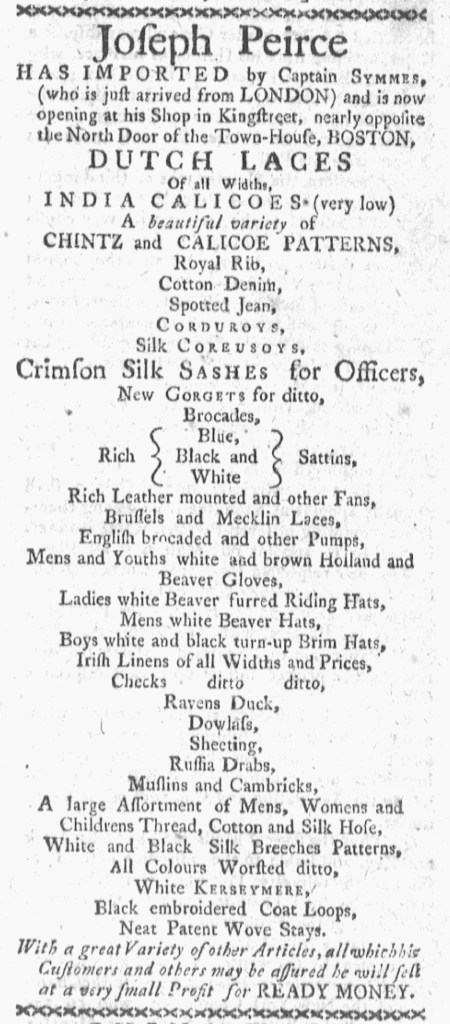
Joseph Peirce’s advertisement on the front page of the May 2, 1774, edition of the Boston-Gazette stood out thanks to its unique graphic design.  The shopkeeper provided a list of merchandise that he recently imported from London, but rather than arrange it in a dense paragraph, as in most advertisements, or create columns with one item per line, as in some advertisements, this one featured one item per line with each line centered.  As a result, the text created an irregular shape with a lot of white space on either side.  That certainly distinguished the advertisement from the news in the column to the right, justified on both sides.

Advertisers usually generated copy, while compositors made most decisions about format.  When merchants and shopkeepers ran advertisements with identical copy in multiple newspapers, variations in fonts, capitalization, italics, font size, and other design elements testified to the creative work done by the compositors in each printing office.  Advertisers likely submitted general instructions with the copy for advertisements that arranged goods in columns, but that may not have always been the case.  M.B. Goldthwait’s advertisement for “DRUGS and MEDICINES” in the April 28, 1774, edition of the Massachusetts Spy, for instance, listed a variety of patent medicines in a paragraph, while his advertisement in the May 2 edition of the Massachusetts Gazette and Boston Post-Boy separated them into side-by-side columns.

Peirce seems to have submitted specific instructions with the copy for his advertisement.  It had the same format in the May 2 editions of the Boston Evening-Post and the Massachusetts Gazette and Boston Post-Boy and the May 5 edition of the Massachusetts Gazette and Boston Weekly News-Letter.  They even gave the same treatment to three lines for:

{ Blue }
Rich { Black and } Sattins
{ White }

That indicates that the compositors incorporated the format that Peirce sketched when he composed the copy.  Curiously, the advertisements in the Boston-Gazette, the Boston Evening-Post and the Massachusetts Gazette and Boston Weekly News-Letter appear identical, as though the printing offices shared type set in one and transferred to the others.  If that was indeed the case, it raises questions about day-to-day operating practices and collaboration among printers in Boston. Even if some printing office shared type, Pierce’s advertisements in the Boston-Gazette and the Massachusetts Gazette and Boston Post-Boy had minor variations while retaining the same format.  That suggests that Peirce provided his vision for his advertisement to at least two printing offices, taking an active role in designing as well as writing his notice.

Left to right: Boston-Gazette (May 2, 1774); Boston Evening-Post (May 2, 1774); Massachusetts Gazette and Boston Weekly News-Letter (May 5, 1774).

March 17

GUEST CURATOR:  Adam Ide

What was advertised in a colonial American newspaper 250 years ago today?

Massachusetts Gazette and Boston Weekly News-Letter (March 17, 1774).

“Will be Sold by PUBLIC VENDUE, at the Auction-Room in Queen-Street.”

In this advertisement, the auctioneer Joseph Russell was advertising an auction that he was running in which the property of “a Gentleman lately deceased” would be sold off. The practice of auctioning made its way into the colonies through its popularity in England in the seventeenth and eighteenth centuries.

This advertisement originally caught my eye because they were selling off the property of a dead man. I wondered it that could be seen as disrespectful to the family and the memory of whoever’s items were being auctioned off. However, upon further research, I learned that “for most residents [of the British colonies], it was at local auctions—estate auctions, sheriffs’ sales, and discount vendues—that bidders, sellers, and observers created a body of knowledge that established a link between price and value.”[1]

Ellen Hartigan-O’Connor writes about the ways in which colonists interacted with each other and took part in consumer culture by participating in public auctions. Hartigan-O’Connor claims that “[w]ith each exchange, people reflected on what goods were worth” since there was no easy-to-come-by comparative price information.[2] Many were left “to wonder how much they should pay for tools, teapots, or thread if the prices fluctuated with market availability.”[3]

Thankfully for colonists, auctions or “vendues” or “public sales” offered a solution. Unlike regular retail, which relied on the fluctuation of the markets and the importation of new goods, auctions allowed the price that someone was willing to pay to determine the value. Through this method, “it was only at the end, when the hammer strike closed the bidding at a final price, that the assembled community learned what they really considered to be the value of an object.”[4] So despite my initial hesitance toward an estate sale, having one’s items sold at “PUBLIC VENDUE” after one died not only gave people an opportunity to purchase goods outside of the fluctuating markets of the time, but it also allowed the community to determine for themselves the value of the items being sold.

**********

ADDITIONAL COMMENTARY:  Carl Robert Keyes

Adam chose one of many auction notices that appeared in Boston’s newspapers during the week in March 1774 that he examined for his duties as guest curator of the Adverts 250 Project and the Slavery Adverts 250 Project.  As he notes in his examination of Joseph Russell’s advertisement for an upcoming “PUBLIC VENDUE,” auctions were a popular means of buying and selling goods in eighteenth-century America.  Russell’s notice in the Massachusetts Gazette and Boston Weekly News-Letter appeared immediately below another one about a sale the following day “At GOULD’S Auction-Office.”

The compositor for that newspaper often placed auction notices, with sales that took place at a particular time on a particular date, first among advertisements, following the shipping news from the custom house.  Sales in shops, stores, and warehouses did not operate on such regimented schedules, so the printing office, readers, and, especially, auctioneers likely considered it less important to have a dedicated place to find other advertisements.  In contrast, Gould’s auction would happen “TO-MORROW” and at no other time and Russell’s auction was scheduled for “Wednesday next.”

Not every compositor in every printing office took that approach, demonstrating that early American printers did not devise universal methods of classifying and organizing the contents of their newspapers.  When Russell’s advertisement ran in the Boston-Gazette later in the week, it appeared among notices placed for a variety of purposes.  It did not have a privileged place on the page, nor did Benjamin Church’s advertisement, one column over, for a “PUBLICK AUCTION … On THURSDAY NEXT.”  M. Deshon, “AUCTIONEER,” placed his own notice that appeared further down the column.

The Boston Evening-Post and the Massachusetts Gazette and Boston Post-Boy each carried advertisements about auctions that week.  Among the newspapers published in Boston, only the Massachusetts Spy did not disseminate notices about public vendues, though several appeared in its pages the following week.  Merchants and shopkeepers certainly competed with auctioneers when it came to finding buyers in Boston on the eve of the American Revolution.

**********

[1] Ellen Hartigan-O’Connor, “Public Sales and Public Values in Eighteenth-Century North America,” Early American Studies 13, no. 4 (Fall 2015): 749.

[2] Hartigan-O’Connor, “Public Sales and Public Values,” 751.

[3] Hartigan-O’Connor, “Public Sales and Public Values,” 751.

[4] Hartigan-O’Connor, “Public Sales and Public Values,” 752.

March 3

What was advertised in a colonial American newspaper 250 years ago today?

FRENCH SCHOOL.”

Massachusetts Gazette and Boston Weekly News-Letter (March 3, 1774).

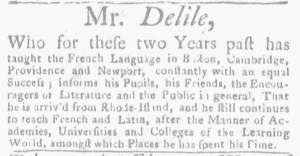
In late February 1774, Mr. Delile, a French tutor, returned to the pages of Boston’s newspapers to alert readers that he had returned to the area and “continues to teach French and Latin.”  In an advertisement in the February 24 edition of the Massachusetts Gazette and Boston Weekly News-Letter, he reminded residents that “for these two Years past [he] has taught the French language in Boston, Cambridge, Providence and Newport.”  He had previously taken to the public prints in two colonies to keep current and prospective pupils advised to his whereabouts, explaining to students in Massachusetts, some of them presumably enrolled at Harvard College, that the “Present Vacation at Cambridge” meant “he can be absent without an Injury to his Pupils.”  He pledged to return to the area to guide them in their studies.  His new advertisement underscored his previous affiliation with Harvard students and his desire to once again teach them and their peers.  He declared that he provided lessons “after the Manner of Academies, Universities and Colleges of the Learning World, amongst which Places he has spent his Time.”  Delile offered a proper curriculum, drawing on his own experience and familiarity with educational institutions of the era.

Massachusetts Gazette and Boston Weekly News-Letter (March 3, 1774).

A week after Delile’s notice appeared, Francis Vandale published his own advertisement for a “FRENCH SCHOOL” in the March 3 edition of the Massachusetts Gazette and Boston Weekly News-Letter.  Although they competed for some of the same clients, Vandale took a different approach than Delile.  Rather than targeting young men studying at Harvard, Vandale sought “Gentlemen or Ladies” as pupils.  Instead of promoting his method of instruction, he emphasized the genteel qualities of the French language and the social standing his students could achieve under his direction.  He conjured an image of how “the French Language when taught agreeable to its native Purity & Elegance, is acquired with that becoming Ease and Gracefulness, as renders it truly Ornamental.”  His pupils, through the “Ease and Gracefulness” that Vandale’s tutelage instilled in them, took on the qualities of the language itself.  He did not mention any prior affiliations with academies or colleges, instead “profess[ing] to be a compleat Master of [French] in all its original Beauty and Propriety, entirely free from any false Mixture or bad Pronunciation.”  For Vandale, speaking French was not an academic exercise but rather a means of artistic expression.

Residents of Boston, Cambridge, and nearby towns who wished to learn or improve their French encountered more than one option when they perused the pages of the Massachusetts Gazette and Boston Weekly News-Letter.  They could take into account both the reputations and methods of Delile and Vandale when deciding if they wished to hire the services of either French tutor.

February 6

What was advertised in a colonial American newspaper 250 years ago this week?

Massachusetts Gazette and Boston Weekly News-Letter (February 3, 1774).

“The largest & compleatest Collection of Books, that ever was sold at this Office.”

A note at the end of auctioneer Robert Gould’s advertisement in the February 3, 1774, edition of the Massachusetts Gazette and Boston Weekly News-Letter seemed incongruous with the content of the rest of the notice.  Gould announced that he would auction a “Variety of genteel House-Furniture” the next morning “At TEN o’Clock.”  He listed many of the items going up for bids, including “Mahogany dining Tea & Bureau Tables,” “Looking-Glasses,” and “a few Sets genteel Pictures.”  In addition, the sale would include “a great Variety of English GOODS.”

The note that followed his signature, however, stated, “No Catalogues will be published, and as this is by far the largest & compleatest Collection of Books, that ever was sold at this Office, therefore they will be exposed to View on Saturday and Monday next.”  That reference made little sense since the auction of the furniture, housewares, and other goods was scheduled for the next day, a Friday.  In addition, a coy aside directed readers, “Pray Remember the Sale begins half past 9 Precisely,” a different time than the auction discussed earlier in the advertisement would begin.

Massachusetts Gazette and Boston Weekly News-Letter (January 27, 1774).

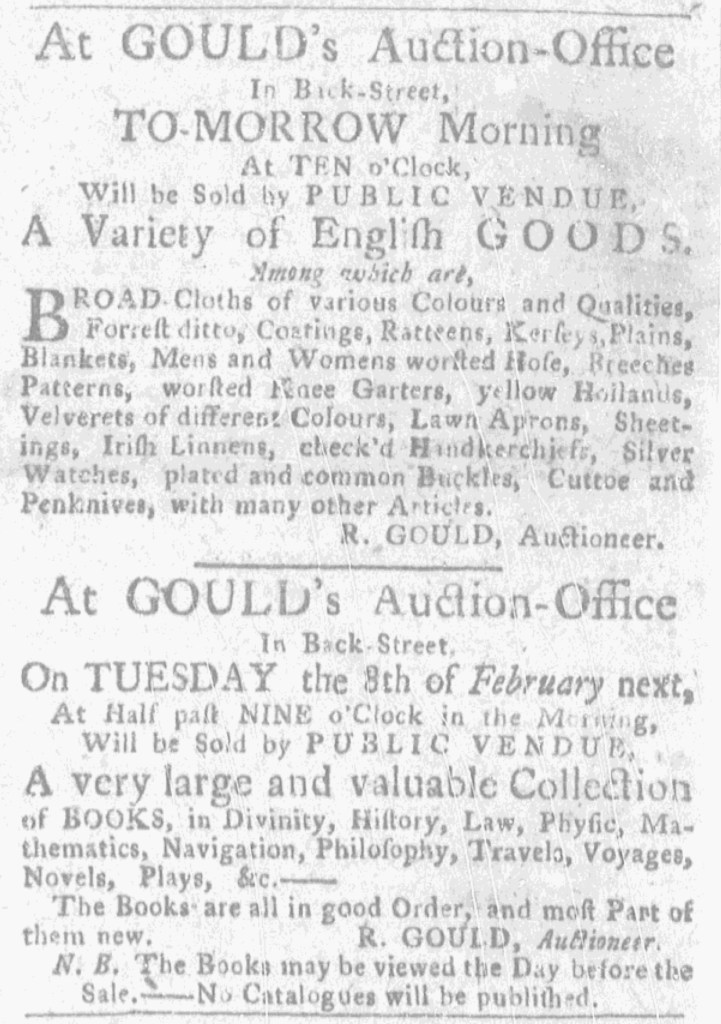
It appears that these inconsistencies resulted from a miscommunication between the auctioneer and the printing office or an error in the printing office.  In the previous issue of the Massachusetts Gazette and Boston Weekly News-Letter, Gould ran an advertisement in two parts, both of which could have appeared separately.  The first part included an introduction identical to the one in the notice published on February 3.  The compositor likely did not even reset type for the introduction, instead updating the headline from “A Variety of English GOODS” to “A Variety of genteel House-Furniture” and inserting a new list of items for sale.  The second part described an auction for a “very large and valuable Collection of BOOKS” that would take place “On TUESDAY the 8th of February next, At Half past NINE o’Clock in the Morning.”  Gould explained that the books “are all in good Order, and most Part of them new.”  In addition, he appended a nota bene advising that the books “may be viewed the Day before the Sale.—No Catalogues will be published.”

Gould probably attempted to update both parts of the advertisement, providing new information about the weekly sale at his auction office and an update about an upcoming special auction for books, but some confusion ensued.  Gould may not have been clear about how much of the previous advertisement should carry over to the new one.  Alternately, the compositor may not have paid sufficient attention to the instructions submitted to the printing office.  Either way, the strange note at the end of the advertisement could have piqued interest among readers.  After all, proclaiming the sale featured “by far the largest and compleatest Collection of Books, that was ever sold at this Office” was intended to attract attention.  To learn more, they only had to contact Gould or take note of advertisements he already published in the Boston-Gazette and the Massachusetts Gazette and Boston Weekly News-Letter.

February 3

What was advertised in a colonial American newspaper 250 years ago today?

Massachusetts Gazette and Weekly News-Letter (February 3, 1774).

“In the Advertisement in the last Page … the Sale is to be at the House of Capt. Chase, Innholder in Freetown.”

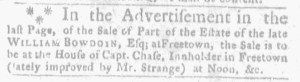
A correction to an advertisement that appeared on the final page of the February 3, 1774, edition of the Massachusetts Gazette and Boston Weekly News-Letter appeared on the second page.  It advised, “In the Advertisement in the last Page, of Part of the Estate of the late WILLIAM BOWDOIN, Esq; at Freetown, the Sale is to be at the House of Capt. Chase, Innholder in Freetown (lately improved by Mr. Strange) at Noon, &c.”  The original advertisement stated that a tract of land “is to be Sold at the House of Mr. Strange, Innholder in Freetown.”  The revision correctly acknowledged that Chase now occupied and operated the inn formerly belonging to Strange.  Bowdoin’s executors likely also hoped that it prevented prospective bidders from missing the sale if they went to Strange’s current establishment instead of Chase’s house.

Why not avoid that confusion by updating the advertisement itself?  The answer to that question requires knowing more about the process of producing newspapers on manual presses in the eighteenth century.  Weekly newspapers usually consisted of four pages created by printing two pages on each side of a broadsheet and then folding it in half.  Printers typically printed the first and fourth pages first.  As the ink dried, they set type for the second and third pages.  That meant that the newest or more significant content did not necessarily appear on the front page!  Instead, advertisements sometimes filled the first and last page, with news items and editorials on the center pages.

For the February 3 edition, advertisements ran in the first column of the first pages and news received from New York in the other two columns.  The estate notice appeared on the final page.  On January 27, the first time the executors inserted it in the Massachusetts Gazette and Boston Weekly News-Letter, the advertisement ran on the first page.  From one issue to the next, the compositor transferred type already set from one page to another.  By the time the executors contacted the printing office about the error, it had already been replicated once again.  Presumably the first and fourth pages for the new issue had been printed, leaving Richard Draper, the printer, to resort to a separate notice on another page to offer the clarification.

The same advertisement, with the same error, ran in the Boston Evening-Post on January 24.  Bowdoin’s executors did not spot the error in time to submit a correction before the January 31 edition, so it appeared once again.  That correlates with a correction for the February 3 edition of the Massachusetts Gazette and Boston Weekly News-Letter arriving at the last minute to make it into that issue.  In the next issue of the Boston Evening-Post, published February 7, the estate notice ran with revised copy.  Similarly, the February 10 edition of the Massachusetts Gazette and Boston Weekly News-Lettercarried the advertisement once again, this time with revised copy.  Given sufficient time, printers and compositors did revise advertisements when their customers made such requests.  When they did not have time, they deployed other strategies for updating their readers.

January 16

What was advertised in a colonial American newspaper 250 years ago this week?

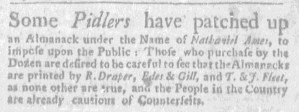
Massachusetts Gazette and Boston Weekly News-Letter (January 13, 1774).

“People in the Country are already cautious of Counterfeits.”

On behalf of his partners, Richard Draper, printer of the Massachusetts Gazette and Boston Weekly News-Letter, placed an advertisement in the January 6, 1774, edition to inform the public that “Ames’s Almanack For the Year 1774, Is now in the Press, and will be ready for Sale” two days later, “on Saturday next.”  Customers could acquire copies from Draper, Thomas Fleet and John Fleet, and Benjamin Edes and John Gill.  On the following Monday, the Fleets, printers of the Boston Evening-Post, ran an updated version in the January 10 edition of their newspaper, announcing “THIS DAY PUBLISHED. Ames’s Almanack For the Year 1774.”  That advertisement also listed all three printing offices.  Edes and Gill, printers of the Boston-Gazette, ran a similar advertisement on the same day.  Often competitors, those printers collaborated in publishing, advertising, and distributing the popular almanac.

Just a few days later, however, Draper published a very different notice in the January 13 edition of the Massachusetts Gazette and Boston Weekly News-Letter.  “Some Pidlers,” he warned, “have patched up an Almanack under the Name of Nathaniel Ames, to impose upon the Public.”  Someone not affiliated with those printing offices produced and disseminated counterfeit almanacs!  Draper was especially concerned about the impact that would have on sales to retailers who purchased in volume to stock in their shops.  “Those who purchase by the dozen,” he cautioned, “are desired to be careful to see that the Almanacks are printed by R. Draper, Edes & Gill, and T. & J. Fleet, as none other are true.” To encourage such vigilance, Draper asserted that “the People in the Country are already cautious of Counterfeits.”  In other words, retailers better not think they could pass off the false almanacs to their customers because, according to Draper, those consumers knew which printers produced the authentic version and would not accept any other.

Although the notice did not indicate who printed the “Counterfeits” sold by the peddlers, Draper, the Fleets, and Edes and Gill faced competition for almanacs supposedly authored by Nathaniel Ames from printers in Boston (“Printed and Sold by E[zekiel] Russell”), Hartford (“Reprinted and Sold by Ebenezer Watson”), New Haven (“Reprinted and Sold by Thomas & Samuel Green”), and New London (“Printed and Sold by T[imothy] Green”).  It was not the first time the partners encountered other printers attempting to infringe on what they considered their product to market exclusively.  A year earlier, they advertised widely that they printed the “only true and correct ALMANACKS” by Ames, inserting a testimonial to that effect into their newspaper notices.  The partners showed a similar concern for the effect on sales to retailers, directing “Purchasers, especially by the Quantity, … to be particular in enquiring whether they are printed by” Draper, the Fleets, and Edes and Gill.  Several years earlier, on the other hand, they had been the counterfeiters.  Almanacs generated significant revenue for early American printers, prompting them to print, to reprint, and to counterfeit the most popular titles.

December 9

What was advertised in a colonial American newspaper 250 years ago today?

Massachusetts Gazette and Boston Weekly News-Letter (December 9, 1773).

“She will engage to sell as Cheap as can be bought in Town.”

Mrs. Sheaffe sold “GROCERIES of all Kinds, and of the best Qualities,” at her shop in Boston in 1773.  In an advertisement in the December 9 edition of the Massachusetts Gazette and Boston Weekly News-Letter, she listed many of the items she stocked, including “Superfine and common Philadelphia Flour by the Barrel or less,” “Fresh Jar and Cask Raisins,” “Choice Hyson, Souchong and Bohea Tea,” “Spanish and French Olives,” “single, middling and double refin’d Loaf-Sugar,” anchovies, oatmeal, coffee, “split Peas,” and “Fresh Spices.”  In addition, she sold corks, “Choice Frontineac WINE,” “crown & hard Soap,” “Playing-Cards,” and two different kinds of snuff.

An enterprising entrepreneur, Sheaffe stated that she would not be undersold by any of the merchants in Boston.  Her name served as the primary headline, preceded by a note declaring, “TO BE SOLD CHEAP.”  That sentiment framed Sheaffe’s entire advertisement, setting up expectations for prospective customers before they encountered the list of groceries available at her shop.  She concluded her notice with a nota bene, promising that she “will engage to sell as Cheap as can be bought in Town.”  Sheaffe faced competition on that front.  Immediately below her advertisement, Penuel Brown’s notice listed several of the items that Sheaffe enumerated, including “Choice New FLOUR per Barrel,” “RAISINS per Cask nearly equal to Jarr,” “SPICES fresh and good, by all Quantities,” and “all other GROCERIES.”  Bowen also pledged to sell his wares “As Cheap as any in Boston.”  As prospective customers did their comparison shopping to find the best deals, Sheaffe and Bowen both wanted to increase the chances that they would consult with them about their prices.

Unlike Bowen, Sheaffe also made clear that she sold her groceries “by WHOLESALE AND RETAIL.”  She welcomed customers seeking to buy in large or small quantities, whether shopkeepers looking to replenish their own inventory or consumers acquiring essentials for their households.  Matching the best bargains in town did not require purchasing in large volumes.  Sheaffe intended to win her share of the market by making appeals concerning low prices that demonstrated to prospective customers that they should choose to shop with her rather than any of her competitors.

November 18

What was advertised in a colonial American newspaper 250 years ago today?

Massachusetts Gazette and Boston Weekly News-Letter (November 18, 1773).

“[The Particulars we have not Time nor Room to insert.]”

Robert Gould, an auctioneer in Boston, planned to hold an auction of a “valuable Assortment of English Goods” on the morning of November 19, 1773.  Like many other auctioneers in the busy port, he attempted to drum up interest by placing advertisements in the local newspapers, including the Massachusetts Gazette and Boston Weekly News-Letter.  His advertisement that appeared in that newspaper on the day before the sale, however, featured an unusual note from the printer or compositor.  Gould apparently submitted a lengthy list of items going up for bid, but someone in the printing office inserted this comment instead: “[The Particulars we have not Time nor Room to insert.]”  A truncated list that included several textiles and “Silver Watches” followed that note, concluding with “&c. &c. &c.”  Repeating the abbreviation for et cetera three times suggested how many other items Gould planned to auction that would not fit in that edition of the newspaper.

The auctioneer may have been a victim of his own negligence in submitting his advertising copy to the printing office too late to include all of it.  The November 18 edition of the Massachusetts Gazette and Boston Weekly News-Letteroverflowed with content, so much so that Richard Draper, the printer, distributed a two-page supplement for news and advertisements that did not otherwise fit.  Draper may have anticipated needing to publish a supplement and set about printing it even as he worked on the standard four-page issue.  Like other printers, he printed the first and fourth pages on one side of a broadsheet and, while they dried, set type for the second and third pages, reserving that space for the latest news as it arrived at the printing office and new advertisements.  Gould’s advertisement appeared on the third page, indicating it was among the last of the type set for that issue.  Printers sometimes inserted instructions for advertisers to submit their notices by a particular time if they wanted them to appear in the next edition of the newspaper.  Perhaps if Gould had budgeted more time in delivering his advertising copy to the printing office, Draper and the compositor would have had the time to accommodate him by making room to include it in its entirety.  If Gould habitually made late submissions, the unusual note in the middle of his advertisement may have been an attempt to modify that behavior.  Two weeks later, the Massachusetts Gazette and Boston Weekly News-Letter carried another advertisement from Gould, that one apparently received early enough to print in its entirety.

October 7

What was advertised in a colonial American newspaper 250 years ago today?

Massachusetts Gazette and Boston Weekly News-Letter (October 7, 1773).

“Positively the last Time here.”

Mr. Bates’s brief time in Boston would soon come to an end.  In advance of his last exhibition of his feats of horsemanship, the itinerant performer placed an advertisement in the October 7, 1773, edition of the Massachusetts Gazette and Boston Weekly News-Letter.  Three days later, on the eve of what Bates billed as “Positively the last Time here,” he placed the same advertisement in the Boston-Gazette and the Massachusetts Gazette and Boston Post-Boy.  By this time, he did not need to describe his act.  He assumed that prospective audiences in Boston had already seen, heard about, or read about his daring exhibitions.

The performer certainly made his presence known while he was in the city.  He arrived in Boston after spending a couple of months in New York.  He ran his first newspaper notices in the Boston Evening-Post and the Massachusetts Gazette and Post-Boy on September 6, deploying much of the same copy he used in his advertisements in New York.  Some sort of disruption apparently occurred at his first performance in Boston on September 8, prompting him to apologize “that the Ladies and Gentlemen were so much disturbed by a Number of unruly People” in an advertisement in Massachusetts Gazette and Boston Weekly News-Letter the next day.  That did not prevent him from simultaneously marketing his next show and announcing that he reduced the prices for tickets.    Bates also distributed at least one handbill for his show on September 28, though he may have commissioned broadsides and other handbills that have not survived.  He continued placing advertisements in various local newspapers, including in the Boston Evening-Post, the Boston-Gazette, and the Massachusetts Gazette and Boston Post-Boy on September 20.  He advertised in all three of those newspapers again a week later, though this time two of those publications carried an advertisement that denigrated the performer.  Bates did not encounter universal accolades.  Instead, a forthcoming pamphlet would demonstrate “that his Exhibitions in Boston are impoverishing, disgraceful to human Nature, and down-right Breaches of the Sixth Commandment.”

Did such critiques prompt Bates to finish up his performances in Boston?  Or did he already have plans to move along to another town?  Either way, he did not shy away from promoting his performances in the public prints, proclaiming “Positively the last Time here.”  That may have been welcome news to his detractors, yet that was not Bates’s intention.  Instead, he aimed to incite demand among prospective audiences by making clear that they had one last opportunity to witness the spectacle responsible for so much chatter around town.  He previously used a similar “limited time only” strategy in New York in his efforts to turn out audiences for his final performances there.  Whatever his shortcomings, the itinerant performer was a savvy marketer.  Bates repeatedly proclaimed himself an unexcelled master of horsemanship, harnessing the power of the press with both newspaper notices and handbills to reach the public.

September 30

What was advertised in a colonial American newspaper 250 years ago today?

Supplement to the Massachusetts Gazette and Boston Weekly News-Letter (September 30, 1773).

“At such Rates as may encourage all Retailers in Town and Country … to complete their Assortments.”

Smith and Atkinson encouraged shopkeepers in and near Boston to augment their inventories for the fall season.  In an advertisement that appeared in several newspapers in September 1773, the merchants announced that they carried a “large and general Assortment of Piece GOODS, suitable for the FALL TRADE” that they “Imported in sundry Vessels lately arrived from England.”  These were not leftovers from last year, Smith and Atkinson suggested, but instead new merchandise to enhance the offerings of “all Retailers in Town and Country.”  Those prospective customers needed such items “to complete their Assortments” and attract the attention of consumers.  They knew that shopkeepers emphasized providing choices for consumers in their own advertisements.

For their part, Smith and Atkinson did not deal with shoppers directly.  The merchants confined their business to wholesale purchases only, supplying shopkeepers with goods at advantageous prices.  Smith and Atkinson proclaimed that they acquired their shipments “on the very best Terms” and planned to pass along the bargains “at such Rates as may encourage” shopkeepers to do business with them rather than their competitors.  As further inducement, the merchants declared that they gave “Due Encouragement … to those who pay ready Money.”  In other words, cash purchases qualified for additional discounts.

Smith and Atkinson competed with other merchants who made similar appeals while also attempting to distinguish themselves in the marketplace.  In the September 30, 1773, edition of the Massachusetts Gazette and Boston Weekly News-Letter, James and Patrick McMasters and Company similarly advertised a “large and general Assortment of English, India, and Scotch GOODS, suitable for the Season” that they “imported in the last Ships from LONDON.”  While they did not specify that they sold “by Wholesale only” like Smith and Atkinson, McMasters and Company did assert that “Town and Country Merchants and others who are pleased to favour them with their Custom, may depend on the best Usage, and handsome Allowance to those who buy by the Quantity.”  They offered discounts for purchasing in volume rather than discounts for cash.  Some retailers may have found that marketing strategy more appealing.

In another advertisement, Amorys, Taylor, and Rogers declared that they sold a “general Assortment of GOODS Suited to the Season … at the lowest Rates, by Wholesale or Retail.”  Other merchants inserted advertisements with their own variations in their efforts to move their merchandise.  They did not expect that they could merely announce that they had goods for sale and then expect retailers to purchase them.  Instead, merchants devised marketing strategies to entice shopkeepers to acquire merchandise from them.  In turn, shopkeepers crafted strategies for inciting demand among consumers rather than relying on incipient demand.