March 2

What was advertised in a colonial American newspaper 250 years ago today?

South-Carolina Gazette and Country Journal (March 2, 1773).

“She carries on the MILLINARY BUSINESS in all its branches, and will be much obliged to her FRIENDS for a continuance of their favours.”

The Bowers continued their advertising efforts in the South-Carolina Gazette and Country Journal in March 1773. William gave directions to the new location for his shop and advised readers that he “continues to carry on the CLOCK and WATCH-MAKING BUSINESS in all its branches.”  Katharine, a milliner and shopkeeper, promoted the “very neat ASSORTMENT of MILLINARY GOODS” she recently imported and sold at the same location that William made and repaired clocks and watches.

The two previously placed a joint advertisement with the primary purpose of informing current customers and the general public of their new location.  William’s portion of the original notice was a little longer than Katharine’s portion, mostly as a result of providing more extensive directions to the new shop at “the fourth corner of Tradd-street and the Bay, lately possessed by Messrs. Mackenzie & Tunno, and next door to The Great Stationary and Book Store.”  In terms of describing the goods and services they provided, William and Katharine occupied similar amounts of space in that earlier notice.

Such was not the case with the new notice.  William’s portion of the advertisement repeated, the type still set from the previous iteration, but Katharine submitted entirely new copy that required twice as much space as William’s portion.  That made her business the focal point of the shared advertisement, especially since her headline for “MILLINARY GOODS,” in a larger font than anything else in the notice (including their names), appeared in the center of the advertisement.  In addition, Katharine adopted a strategy deployed by many merchants and shopkeepers.  She listed a “Neat assortment of fashionable CAPS, … a great variety of sash and other RIBBONS, fashionable FANS, women and girls white and coloured GLOVES,” and various other items.  In a nota bene, Katharine declared that she “carries on the MILLINARY BUSINESS in all its branches, and will be much obliged to her FRIENDS for a continuance of their favours.”  In other words, she hoped the clientele she cultivated would follow her to her new location.

Although William and his endeavors had a privileged place at the beginning of the shared advertisement, the length and format of their respective sections made Katharine’s business more prominent in this variation.  That may have been an indication that she contributed as much to the household income through her entrepreneurial activities as he did. William’s name appeared first, but not in a way that overshadowed Mary’s business.

April 7

What was advertised in a colonial American newspaper 250 years ago today?

Supplement to the South-Carolina Gazette and Country Journal (April 7, 1772).

“A variety of other articles too tedious to enumerate.”

In the spring of 1772, an advertiser who identified himself simply as “STUKES” (almost certainly William Stukes) advised readers of the South-Carolina Gazette and Country Journal that he imported and sold a “COMPLEAT assortment of millinary, haberdashery, [and] stationary” and “As compleat and large an assortment of RIBBONS as ever was imported into this province at one time.”  As further evidence of the bounty available at his shop, he listed dozens of textiles, garments, and accessories.  Stukes stocked everything from “new fashioned flowered Leghorn hats” to “Ladies Morocco pocket books … with silver French locks” to “fine white linen gloves” to “fashionable fans.”  Like many other eighteenth-century advertisers, he expected such a vast array of choices to entice consumers.

Yet he did not want to overwhelm prospective customers by committing too much to print (or he did not want to pay for additional space that a longer list would occupy in the newspaper).  He concluded his litany of goods with a note that he carried “a variety of other articles too tedious to enumerate.”  Where did Stukes draw the line?  Giving only his last name amounted to an economy of prose, but the lengthy list of goods certainly did not.  Only two other shopkeepers placed advertisements listing a similar number of items in the April 7, 1772, edition of the South-Carolina Gazette and Country Journal.  Stukes apparently did not consider the “blue satin hats” and the “wax ear-rings” and the “Barcelona cravats” and the “womens black calamanco pumps” in his notice to be “too tedious to enumerate” as he competed to attract customers by demonstrating the choices available at his shop.  Proclaiming that listing anything more would become “tedious” was a sly way of encouraging prospective customers to imagine for themselves what else they might discover in Stukes’s shop.  He gained the advantage of cataloging his wares in the public prints while simultaneously suggesting that he exercised restraint in how much he shared about his merchandise.

September 24

What was advertised in a colonial American newspaper 250 years ago today?

South-Carolina Gazette and Country Journal (September 24, 1771).

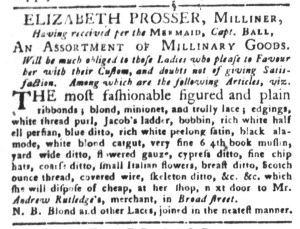
“AN ASSORTMENT OF MILLINARY GOODS.”

Elizabeth Prosser, a milliner, took to the pages of the South-Carolina Gazette and Country Journal to advertise “AN ASSORTMENT OF MILLINARY GOODS” available at her shop on Broad Street in Charleston.  She informed prospective customers that her wares recently arrived “per the MERMAID, Capt. BALL.”  Merchants, shopkeepers, and others who sold imported goods often noted the ships that transported their merchandise across the Atlantic as a means of demonstrating to consumers that they had new items among their inventory.  New also implied fashionable, but Prosser explicitly made the connection.  She proclaimed that she carried “the most fashionable” millinery goods for “those Ladies who please to Favour her with their Custom.”

At the same time that she addressed readers of the South-Carolina Gazette and Country Journal, Prosser attempted to cultivate a clientele among readers of the South-Carolina Gazette.  Her advertisement appeared in both newspapers on September 24, 1771.  Purveyors of goods and services frequently advertised in multiple newspapers, seeking to reach more prospective customers and increase their share of the market.  Prosser apparently considered it worth the expense to place the same advertisement in two newspapers simultaneously.  She did not, however, decide to insert her advertisement in the third newspaper published in Charleston at the time, the South-Carolina and American General Gazette.

If she had done so, her advertisement might have appeared alongside one placed by a competitor.  In the September 24 edition of that newspaper, Jane Thomson advertised “A fresh Supply of MILLINARY GOODS” that she “received by the Mermaid, Capt. Ball, from LONDON.”  Thomson did not advertise in the other two newspapers.  That limited the competition between the milliners, at least in the public prints, but it also meant that readers of all three newspapers encountered advertising by female entrepreneurs who joined their male counterparts in marketing a vast array of imported goods.  Prosser addressed the “Ladies” in her notice, but women did not participate in the marketplace merely as consumers.  Prosser, Thomson, and many other female entrepreneurs conducted business as “she-merchants,” shopkeepers, and artisans during the era of the American Revolution.

July 26

What was advertised in a colonial American newspaper 250 years ago this week?

Jul 26 - 7:23:1767 Massachusetts Gazette
Massachusetts Gazette (July 23, 1767).

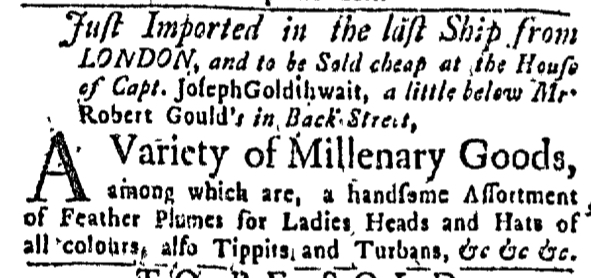
“A handsome Assortment of Feather Plumes for Ladies Heads.”

Unlike most advertisements for consumer goods published in eighteenth-century newspapers, this notice for a “Variety of Millenary Goods” did not indicate who sold the “handsome Assortment of Feather Plumes” or “Hats of all colours.” Instead, it simply stated that these items were “Sold cheap at the House of Capt. Joseph Goldthwait.”

Who placed this advertisement and ran a shop out of Goldthwait’s house? It may very well have been a female entrepreneur who did not wish to call widespread attention to her participation in the marketplace as a retailer rather than as a consumer. Women often operated small retail establishments out of their own homes or rooms they rented, especially in urban ports, but they were much less likely to advertise their commercial activities than their male counterparts. Female shopkeepers tended to be disproportionately underrepresented among the advertisements in the public prints.

That did not mean that women did not advertise at all. This advertisement for “Millenary Goods” appeared immediately below Jane Eustis’s own notice for a “Large and beautiful Assortment [of] Silks, Cap Laces,” and other millenary goods. Although she stocked “Mens and Womens silk Hose” and “Mens white silk Gloves,” Eustis promoted mostly textiles and adornments intended for female customers. Like the anonymous advertiser, she concluded by making special note of the “Tippets and Turbans” she sold “for less than the prime Cost.” The type of merchandise hawked by the anonymous advertiser increases the likelihood that a woman placed the notice and operated the shop “at the House of Capt. Joseph Goldthwait.”

This sort of anonymous advertisement was rather rare in colonial America. Certainly newspapers frequently carried notices that advised readers to “enquire of the printer,” but usually those regarded only one or a small number of commodities, not the “Variety” or “handsome Assortment” of imported goods marketed in this advertisement. It even ended with a teaser, “&c &c &c” (the eighteenth-century version of “etc. etc. etc.”), suggesting an even greater array of goods that rivaled what customers would find in the shops kept by Jane Eustis and other advertisers.

Women had a variety of reasons for not calling as much attention to their entrepreneurial activities as their male competitors, including assumptions about their appropriate roles in the household and marketplace. This advertisement may have been designed by a woman eking out a living who hoped to attract female customers yet remain shielded from other readers in colonial Boston.