What was advertised in a colonial American newspaper 250 years ago today?

“He will carry this and other papers, and the Royal American MAGAZINE.”
Following the successful launch of the Royal American Magazine a few months earlier, Isaiah Thomas continued advertising the new publication in April 1774. His marketing efforts that month, however, were not as robust as in previous months. Only twelve advertisements appeared in April, with seven of them in Thomas’s own Massachusetts Spy. The Adverts 250 Project has examined his advertising campaign, starting with an announcement, published in May 1773, that he planned to distribute subscription proposals and then the subsequent advertisements, appearing in newspapers from New Hampshire to Maryland, in June, July, August, September, October, November, and December 1773 and January, February, and March 1774.
The first advertisement for the month ran in the April 4 edition of the Massachusetts Gazette and Boston Post-Boy, the only newspaper (other than the Massachusetts Spy) that carried more than one notice about the Royal American Magazine in April. It advised that “Monday next will be published, NUMBER II. of THE ROYAL American Magazine, For MARCH, 1774.” The compositor made an error with “NUMBER II” instead of “NUMBER III.” That advertisement gave a week’s notice of publication of the March issue. Thomas had fallen behind on the intended publications dates as a result of new types for the magazine not arriving when expected. He published the January issue in early February and the February issue in early March. Accordingly, the March issue came out in April. On April 7, Thomas ran the same advertisement (correctly specifying “NUMBER III”) in the Massachusetts Spy.
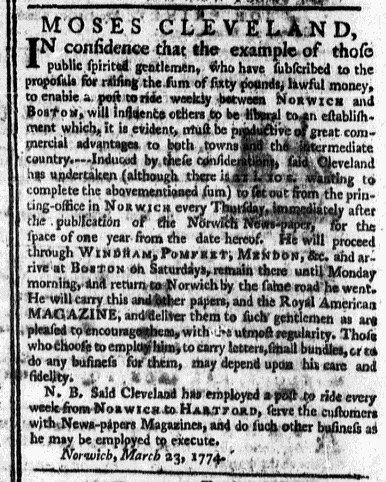
On the same day, his newspaper also ran Moses Cleveland’s notice about establishing a “post to ride weekly between NORWICH and BOSTON,” carrying the Norwich Gazette, the Massachusetts Spy, other newspapers, and the Royal American Gazette. Cleveland’s original advertisement in the Norwich Gazette and subsequent advertisement in the Massachusetts Gazette and Boston Post-Boy did not mention the Royal American Gazette, suggesting that Thomas adapted the post rider’s notice for his own purposes. He seized an opportunity to promote the magazine to prospective subscribers who lived in towns in Massachusetts and Connecticut along the proposed route. Cleveland’s advertisement ran in all four issues of the Massachusetts Spy published in April, accounting for one-third of the advertisements that month.
On April 15, the Connecticut Gazette carried a brief notice that “The Ist. And IId. Numbers Of the ROYAL AMERICAN MAGAZINE, are ready to be delivered to those who subscribed for them with T. GREEN,” the printer of that newspaper and local agent for the magazine. That was the only advertisement for the Royal American Magazinepublished in a newspaper beyond Boston in April. Timothy Green likely placed it of his own volition, rather than acting on instructions from Thomas, upon receiving copies of the magazine he was responsible for distributing to subscribers in and near his town.
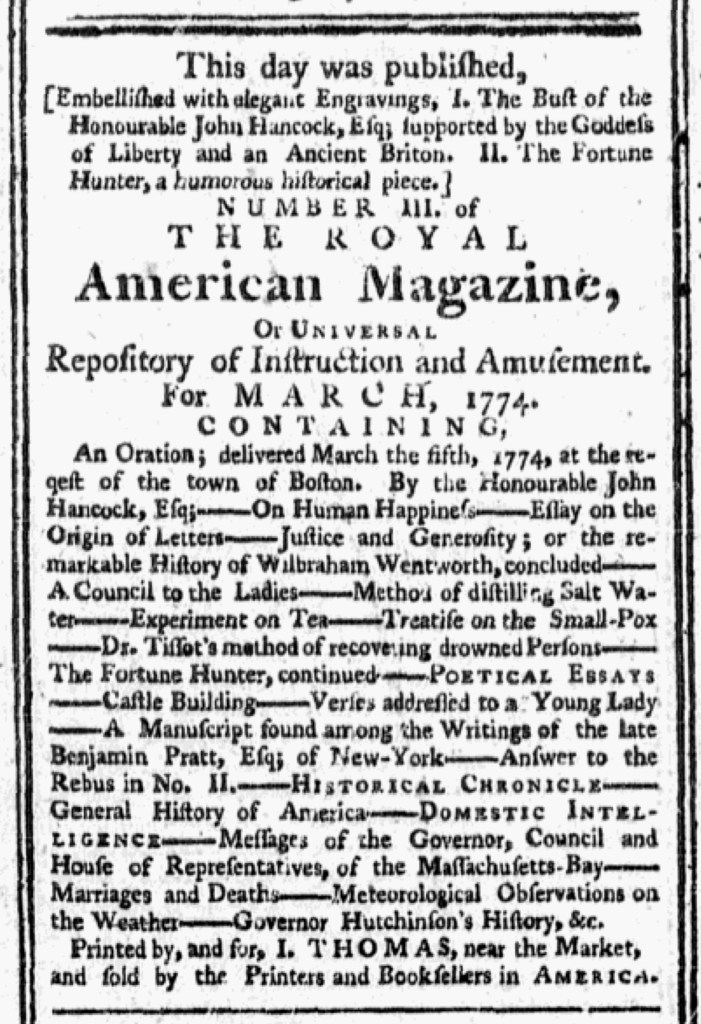
Also on April 15, Thomas announced that “NUMBER III” of the magazine “was published.” As he had done with previous issues, he listed the contents to entice readers, including essays on “Justice and Generosity” and an “Experiment on Tea,” “POETICAL ESSAYS,” a new entry for an ongoing “HISTORICAL CHRONICLE,” and “DOMESTIC INTELLIGENCE.” The March issue was “Embellished” with two copperplate engravings, one of a “Bust of the Honourable John Hancock, Esq; supported by the Goddess of Liberty and an Ancient Briton” and the other depicting “The Fortune Hunter, a humorous historical piece.” Thomas ran this advertisement once more in the Massachusetts Spy on April 22. In the time between its appearances in that newspaper, he inserted it once in the Boston Evening-Post (on April 18), the Massachusetts Gazette and Boston Post-Boy (on April 18), and the Massachusetts Gazette and Boston Weekly Newsletter (on April 21). Of the newspapers published in Boston at the time, only the Boston-Gazette, printed by Benjamin Edes and John Gill, did not carry this advertisement. Perhaps the printers objected to the inclusion of the first item in the list of contents, “An Oration; delivered March the fifth, 1774, at the reqest of the town of Boston. By the Honourable John Hancock, Esq.” Edes and Gill printed and marketed a pamphlet containing Hancock’s address commemorating the fourth anniversary of the Boston Massacre. They may not have appreciated the competition from Thomas distributing the oration via other means.
Thomas may not have considered it necessary to advertise as aggressively following the launch of the Royal American Magazine as he had in the months that he encouraged subscribers to show their support for the venture. With the assistance of local agents in many cities and towns, he may have garnered a sufficient number of subscribers that allowed him to shift his focus to producing the magazine and other responsibilities in his printing office. He continued running Moses Cleveland’s advertisement, which he first adapted in March, but did not oversee extensive announcements about the publication of the newest issue of the magazine. Maybe he learned from similar campaigns for the first and second issues that such advertisements did not attract enough new subscribers to justify the investment. The April 15 and 22 editions of the Massachusetts Spy appeared on Fridays instead of Thursdays, a day later than usual, suggesting that the printer was preoccupied with matters other than marketing the Royal American Magazine.
**********
“will be published … NUMBER III”
- April 4 – Massachusetts Gazette and Boston Post-Boy (first appearance)
- April 7 – Massachusetts Spy (first appearance)
“MOSES CLEVELAND”
- April 7 – Massachusetts Spy (second appearance)
- April 15 – Massachusetts Spy (third appearance)
- April 22 – Massachusetts Spy (fourth appearance)
- April 28 – Massachusetts Spy (fifth appearance)
“Ist. And IId. Numbers”
- April 15 – Connecticut Gazette (first appearance)
“NUMBER III” with contents
- April 15 – Massachusetts Spy (first appearance)
- April 18 – Boston Evening-Post (first appearance)
- April 18 – Massachusetts Gazette and Boston Post-Boy (first appearance)
- April 21 – Massachusetts Gazette and Boston Weekly News-Letter (first appearance)
- April 22 – Massachusetts Spy (second appearance)