March 3

What was advertised in a colonial American newspaper 250 years ago today?

FRENCH SCHOOL.”

Massachusetts Gazette and Boston Weekly News-Letter (March 3, 1774).

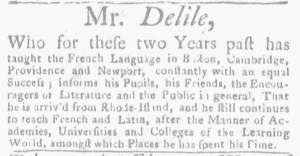
In late February 1774, Mr. Delile, a French tutor, returned to the pages of Boston’s newspapers to alert readers that he had returned to the area and “continues to teach French and Latin.”  In an advertisement in the February 24 edition of the Massachusetts Gazette and Boston Weekly News-Letter, he reminded residents that “for these two Years past [he] has taught the French language in Boston, Cambridge, Providence and Newport.”  He had previously taken to the public prints in two colonies to keep current and prospective pupils advised to his whereabouts, explaining to students in Massachusetts, some of them presumably enrolled at Harvard College, that the “Present Vacation at Cambridge” meant “he can be absent without an Injury to his Pupils.”  He pledged to return to the area to guide them in their studies.  His new advertisement underscored his previous affiliation with Harvard students and his desire to once again teach them and their peers.  He declared that he provided lessons “after the Manner of Academies, Universities and Colleges of the Learning World, amongst which Places he has spent his Time.”  Delile offered a proper curriculum, drawing on his own experience and familiarity with educational institutions of the era.

Massachusetts Gazette and Boston Weekly News-Letter (March 3, 1774).

A week after Delile’s notice appeared, Francis Vandale published his own advertisement for a “FRENCH SCHOOL” in the March 3 edition of the Massachusetts Gazette and Boston Weekly News-Letter.  Although they competed for some of the same clients, Vandale took a different approach than Delile.  Rather than targeting young men studying at Harvard, Vandale sought “Gentlemen or Ladies” as pupils.  Instead of promoting his method of instruction, he emphasized the genteel qualities of the French language and the social standing his students could achieve under his direction.  He conjured an image of how “the French Language when taught agreeable to its native Purity & Elegance, is acquired with that becoming Ease and Gracefulness, as renders it truly Ornamental.”  His pupils, through the “Ease and Gracefulness” that Vandale’s tutelage instilled in them, took on the qualities of the language itself.  He did not mention any prior affiliations with academies or colleges, instead “profess[ing] to be a compleat Master of [French] in all its original Beauty and Propriety, entirely free from any false Mixture or bad Pronunciation.”  For Vandale, speaking French was not an academic exercise but rather a means of artistic expression.

Residents of Boston, Cambridge, and nearby towns who wished to learn or improve their French encountered more than one option when they perused the pages of the Massachusetts Gazette and Boston Weekly News-Letter.  They could take into account both the reputations and methods of Delile and Vandale when deciding if they wished to hire the services of either French tutor.

August 15

What was advertised in a colonial American newspaper 250 years ago this week?

Massachusetts Gazette and Boston Weekly News-Letter (August 12, 1773).

“On Account of the present Vacation at Cambridge … he can be absent without an Injury to his Pupils.”

Mr. Delile, “Professor of the French Language in Boston and Cambridge,” spent August, September, and October in Providence and Newport in 1773.  He used newspaper advertisements in each location to advise current pupils of his departure and plans to return or his arrival and plans to offer lessons for a limited time only.

On August 7, he advised readers of the Providence Gazette that “several Gentlemen of this Town and Newport” invited him to spend three months in Rhode Island “for the Purpose of teaching said Languages in those Places.”  Rather than establish a school or academy where he would teach multiple students simultaneously, Delile confined his efforts to private lessons.  He underscored that “Gentlemen or Ladies who please to employ him” needed to do so quickly because he “is under absolute Engagements to return to Boston by the last of October.”  On August 16, he inserted a similar advertisement in the Newport Mercury, having arrived in that town.  In a slight variation, he stated that he hoped that me met with “encouragement equal to that he had in Boston for 16 months past.”

Before he left Boston and Cambridge, Delile arranged for an advertisement in the Massachusetts Gazette and Boston Weekly News-Letter.  He relayed the same story, that he had been “invited by several Gentlemen at Providence and Newport, to teach the French Language in those Places” for three months.  He also explained that “on Account of the present Vacation at Cambridge,” referring to Harvard College, “and the Season of the Year,” he believed that he “can be absent without an Injury to his Pupils.”  The French tutor vowed to return, hoping that his students would be “in the best Dispositions to pursue their Studies” when he did.

Delile’s advertisement first appeared on August 5 and repeated a week later.  He did not insert it any of the other newspapers published in Boston at the time.  With notices running in the Massachusetts Gazette and Boston Weekly News-Letter, the Providence Gazette, and the Newport Mercury, he incurred significant expense, perhaps as much as he dared risk on a stay in Rhode Island that would last only three months.  Delile may have believed that a notice in just one newspaper in Boston was sufficient to alert some of his pupils and then the news would spread to others in the course of everyday conversations.  He likely also informed many or most of his pupils before he departed, placing the newspaper advertisement as a means of informing the general public and prompting prospective students to consider engaging his services when he returned in the fall.

August 7

What was advertised in a colonial American newspaper 250 years ago today?

Providence Gazette (August 7, 1773).

“He is under absolute Engagements to return to Boston by the last of October.”

At the same time that Mr. Bates waged his limited-time-only marketing campaign for his final performances exhibiting feats of horsemanship in newspapers in New York, Mr. Delile, “Professor of the French Language,” utilized a similar advertising strategy in Providence.  On August 7, 1773, the tutor introduced himself to readers of the Providence Gazette.  He stated that he taught French in Boston and Cambridge, but planned to spend three months in Providence and Newport.  An invitation “by several Gentlemen” in the two towns convinced him to spend the late summer and early fall in Rhode Island “for the Purpose of teaching said Language.”

Most language tutors who placed advertisements in colonial newspapers did so when they opened schools or academies with set days and times for classes.  They hoped to provide instruction to multiple students simultaneously, collecting tuition from several pupils for each lesson they taught.  Most also promoted an option for private instruction, either at the school or in the homes of families who engaged their services.  Delile did not mention any sort of academy; instead, he offered private lessons exclusively.  He advised that “those Gentlemen or Ladies who please to employ him” should “send a Line to Mrs. Westran’s, when he will immediately wait on them.”  Delile scheduled tutoring sessions around the “several Appointments” or schedules of his students.

Whether they wished to start learning French, continue lessons taken at another time, or brush up on their skills, prospective pupils had only a limited time to benefit from Delile’s instruction.  In a nota bene he underscored that he “is under absolute Engagements to return to Boston by the last of October.”  He could not tarry in Providence and Rhode Island.  A couple of days earlier, he placed an advertisement in the Massachusetts Gazette and Boston Weekly News-Letter to alert his pupils in Boston and Cambridge that he planned to spend three months in Rhode Island and return after “the present Vacation at Cambridge.”  Delile apparently taught Harvard students while classes were in session there, lucrative and steady employment that explained his resolve to return to Boston after only a few months.  Colonizers in Providence and Newport had only a limited time to engage his services.

February 11

What was advertised in a colonial American newspaper 250 years ago today?

Massachusetts Gazette and Boston Weekly News-Letter (February 11, 1773).

“His French and English Rudiments, by the help of which a scholar may learn French with very little assistance from a master.”

In February 1773, Mr. Delile, a “Professor of the French Language” Boston, published an advertisement in which he confided to the public, especially the “Encouragers of LITERATURE,” that he had “always been desirous of meriting the esteem of the learned world … by the cultivation of the BELLES LETTRES.”  To that end, he issued a subscription proposal for printing several of his “performances” in the French language.  The two volumes would include the “French and English Rudiments” that he devised, an address that he delivered at “the Academy,” the school he operated, the previous December, and two “French Odes, in the manner of Pindar.”  In addition, he planned to add a “Latin discourse, on the arts and sciences, against several paradoxes of the celebrated Jean Jacques Rousseau.”

To further entice prospective subscribers to reserve copies, Delile elaborated on most of those items.  He declared that “the public favor’d him with the kindest testimony of their benevolence” after hearing his oration at the school, so much so that “many Gentlemen” had “earnestly requested a copy.”  Delile commodified that address, giving those gentlemen and others an opportunity to purchase that address.  For those not yet fluent in French, the “most eloquent fragments … will be translated into English.”  Delile also inserted two stanzas of the French odes, providing a preview for prospective subscribers and allowing them to judge the quality of the work.  In promoting the “French and English Rudiments,” he asserted that “a scholar” could consult that “performance” and “learn French with very little assistance from a master.”  Those “Rudiments” supplemented, but did not completely replace, working with a French tutor.

Delile was prepared to provide the necessary assistance to “those Gentlemen, who study under him” and others who wished to enroll in his classes.  He concluded his subscription proposal with an announcement that he “gives constant Attendance at the Academy” throughout the day and into the evenings on Mondays, Wednesdays, and Fridays.  Such an extensive schedule made it possible for pupils to attend lessons “as their business will admit of their leisure to attend.”  Even if Delile did not garner enough subscribers to make publishing his French and Latin “performances” a viable venture, he likely hoped that the enterprising spirit and commitment to belles lettres demonstrated in his subscription proposal would resonate with current and prospective pupils to convince them to make their way to “the Academy” for lessons.