May 26

What was advertised in a colonial American newspaper 250 years ago today?
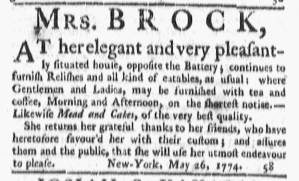
Rivington’s New-York Gazetteer (May 26, 1774).

“Gentlemen and Ladies, may be furnished with tea and coffee, Morning and Afternoon.”

Mrs. Brock invited “Gentlemen and Ladies” to gather at “her elegant and very pleasantly situated house, opposite the Battery,” in New York in the spring of 1774.  In an advertisement in the May 26 edition of Rivington’s New-York Gazetteer, she declared that she “continues to furnish Relishes and all kinds of eatables, as usual.”  She also served “Mead and Cakes, of the very best quality.”  The hostess also took the opportunity to express “her grateful thanks to her friends, who have heretofore favour’d her with their custom.”  Brock had been in business for at least five years, having previously advertised in the New-York Journal.  Given the reputation she had cultivated during that time, she assured her existing clientele and the public “that she will use her utmost endeavour to please.”

Despite such assurances, some readers may not have been pleased with Brock.  In addition to “Relishes” and “eatables,” she also served “tea and coffee, Morning and Afternoon, on the shortest notice.”  New York had recently received word of the Boston Port Act that closed that harbor of that town until residents paid for the tea destroyed the previous December.  Residents were certainly aware of efforts to turn away ships carrying tea to their own colony.  Though no prohibition on buying, selling, or drinking tea had been enacted, many colonizers looked on the commodity with suspicion.  Some merchants and shopkeepers already advertised that they stocked a variety of groceries but not tea, while others made clear that they continued business as usual.  Brock joined their ranks.  Her advertisement could not be mistaken as one merely reprinted after having run for some time, perhaps originating prior to the latest controversy; it was dated “May 26, 1774” and bore the issue number, “58,” of the current edition.  Whatever measures were coalescing around consuming tea, Brock considered it appropriate to continue serving the beverage to “Gentlemen and Ladies” and anticipated that she would meet with a ready market.  Many colonizers, she surmised, were not yet ready to dispense with tea, no matter the complicated politics swirling around it.
October 8

What was advertised in a colonial American newspaper 250 years ago this week?

Oct 8 - 10:5:1769 New-York Journal
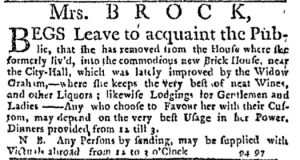
New-York Journal (October 5, 1769).

“Any Persons by sending, may be supplied with Victuals abroad.”

When she moved to a new location in the fall of 1769, Mrs. Brock ran an advertisement to inform prospective patrons that she now operated an inn and restaurant at “the commodious new Brick House, near the City-Hall” in New York. She promoted various amenities, indicating that the house “was lately improved by the Widow Graham.” In addition to the comfortable surroundings, she provided “the very best of neat Wines and other Liquors.” She also served “Dinners” between noon and three o’clock.

Yet readers did not have to stay at Brock’s inn or dine in her restaurant in order to enjoy the meals she provided. In a brief nota bene, she advised, “Any Persons by sending, may be supplied with Victuals abroad from 12 to 3 o’Clock.” In other words, Brock offered take out and perhaps even delivery. What could be more convenient for busy New Yorkers who did not have the time to prepare their own meals or dine at Brock’s “commodious new Brick House” in the middle of the day?

The advertisement does not specify the extent of Brock’s services. What did she mean with the phrase “by sending” in the nota bene? Did she mean sending a messenger with an order who would then carry the food back to the customer? That qualified as the eighteenth-century equivalent of take-out food. Or, did she mean sending an order in advance and depending on someone employed by Brock to deliver the “Victuals” later? Brock did not clearly indicate if the latter was an option, though she and her customers likely worked out the particulars as they began placing orders.

Even if Brock limited this service to take-out food, she still marketed convenience to eighteenth-century consumers. She identified an opportunity to augment the business she did in the dining room at her inn and restaurant by feeding patrons who did not visit in person. Take-out and delivery became centerpieces of business models and marketing campaigns for many in the restaurant industry in the twentieth century, but those conveniences were not inventions or innovations of that era. Such services were already in place in the colonies prior to the American Revolution.