
What was advertised in a colonial American newspaper 250 years ago today?
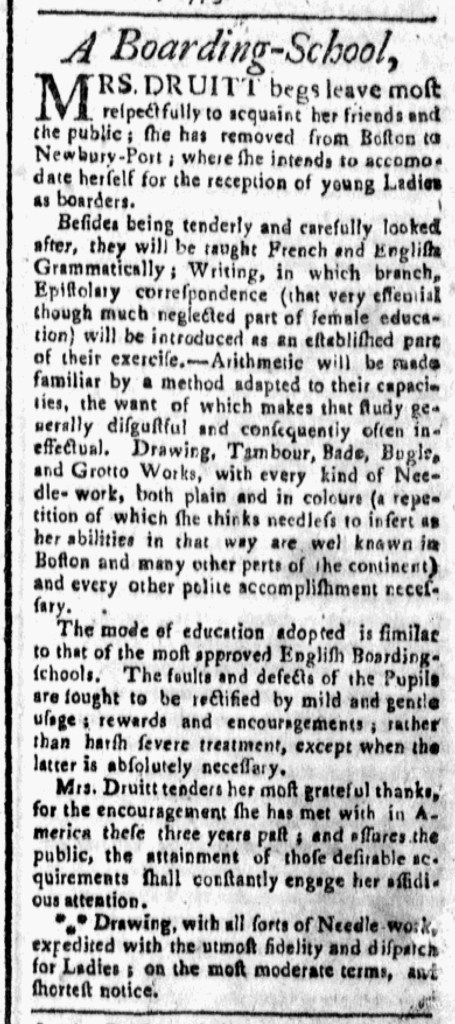
“The mode of education adopted is similar to that of the most approved English Boarding-schools.”
When Eleanor Druitt moved to Newburyport from Boston in the spring of 1775, she placed an advertisement in the local newspaper, the Essex Journal, to announce that she planned to open a boarding school for “young Ladies.” According to her notice, she had been in the colonies for just three years, yet in that time she had established a reputation for educating young women that she hoped would serve her well in her new town. Druitt provided a “mode of education … similar to that of the most approved English Boarding-schools,” offering pupils in Massachusetts the same benefits.
The schoolmistress gave an overview of the curriculum, emphasizing that students would learn “French and English Grammatically” and “Writing, in which branch, Epistolary correspondence (that very essential though much neglected part of female education) will be introduced as an established part of their exercise.” In other words, she taught young women how to write polite letters that would serve them well in maintaining relationships with family and friends in other cities and towns. Her students also learned arithmetic, “made familiar by a method adapted to their capacities, the want of which makes that study generally disgustful and consequently often ineffectual.” Druitt had a much higher estimation of young women’s aptitude for drawing, embroidery, and other kinds of decorative “Needle-work,” asserting that she “thinks needless to insert” a longer description “as her abilities in that way are well known in Boston and many other parts of the continent.” The families of prospective pupils may have seen some of the advertisements she ran in Boston’s newspapers over the past three years since those publications circulated in Newburyport and other towns in Massachusetts and New Hampshire. In general, her curriculum focused on “polite accomplishment[s]” to distinguish the “young Ladies” that she “tenderly and carefully looked after.”
To that end, Druitt declared that the “faults and defects of the pupils [will] be rectified by mild and gentle usage.” That meant “rewards and encouragement; rather than harsh severe treatment.” Parents did not need to worry about the treatment their daughters would receive when boarding with Druitt, though she did state that she would adopt some of those stricter methods as a last resort when “absolutely necessary.” The schoolmistress suggested that she established just the right balance of encouragement and discipline that allowed pupils at her boarding school to thrive. Families had a variety of concerns as the imperial crisis intensified in the spring of 1775, but they need not worry about the “reception” their daughters would experience at Druitt’s boarding school.