August 31

What was advertised in a colonial American newspaper 250 years ago today?
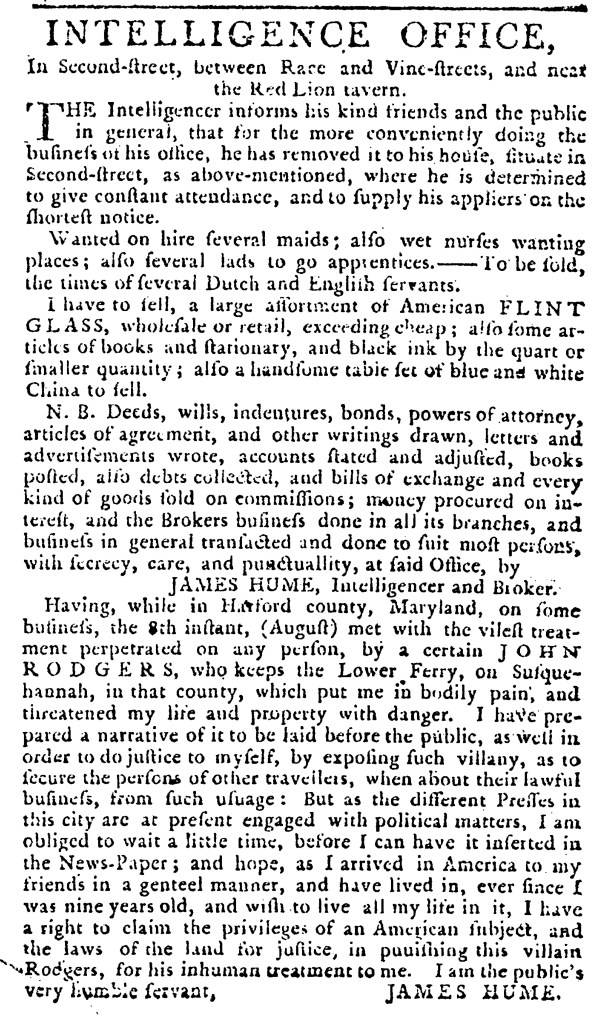
Pennsylvania Journal (August 31, 1774)

“The vilest treatment perpetrated on any person … threatened my life and property with danger.”

Eighteenth-century advertisers often used the space they purchased in newspapers to pursue multiple purchases.  Merchants and shopkeepers, for instance, frequently devoted most of their advertisements to promoting goods for sale and then pivoted to calling on former customers to settle accounts.  Sometimes the aims of the different portions of advertisements did not seem related at all.  J. Musgrave devoted half of his advertisement in the August 31, 1774, edition of the Pennsylvania Gazette to leasing his “Wet and Dry Goods Houses and Stores” to merchants and the other half to buying and selling horses.

On the same day, James Hume published a lengthy advertisement with two very different purposes in the Pennsylvania Journal.  The headline declared, “INTELLIGENCE OFFICE.”  The broker described the various services he provided, including drawing up “Deeds, wills, indentures, bonds, powers of attorney, [and] articles of agreement.”  He had “wet nurses wanting places” as well as “several lads to go apprentices.”  He recorded and settled accounts, sold goods on commission, and even wrote advertisements on behalf of his clients.  Rather than focus exclusively on his work as an “Intelligencer and Broker,” Hume used his access to the public prints to air a grievance against John Rodgers, “who keeps the Lower Ferry on Susquehannah” in Harford County, Maryland.  According to the Hume, he was the victim of “the vilest treatment perpetrated on any person … which put me in bodily pain, and threatened my life and property with danger.”  Following that ordeal, he “prepared a narrative of it to be laid before the public,” which he depicted as a service to the public.  By “exposing such villainy” and warning others about Rodgers, he hoped to “secure the persons of other travellers, when about their lawful business, from such usage.”

Yet his intentions had been thwarted so far because “the different Presses in this city are at present engaged with political matters.”  Hume had apparently shopped around to Dunlap’s Pennsylvania Packet, the Pennsylvania Gazette, and the Pennsylvania Journal, but none of the printers chose to accept his narrative for publication in their newspapers.  Whatever their reasons for rejecting it, they invoked current events as justification.  In recent months the imperial crisis intensified as the colonies received word of the Boston Port Act, the Massachusetts Government Act, and the other Coercive Acts passed as punishment for the Boston Tea Party.  Parliament sought to restore order, but many colonizers believed their liberties as English subjects were under attack.  For his part, Hume had his own concerns about his “right to claim the privileges of an American subject, and the laws of the land for justice, in punishing this villain Rodgers, for his inhuman treatment to me.”  That incident, however, did not rise to the level that printers in Philadelphia gave priority to publishing it.  Hume circumvented their editorial decisions, at least in part, by including his allegations against Rodgers in a paid notice, thus raising an alarm that others needed to be cautious when interacting with the ferry operator.
January 17

What was advertised in a colonial American newspaper 250 years ago today?

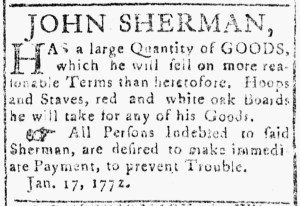
Connecticut Journal (January 17, 1772).

“All Persons Indebted to said Sherman, are desired to make immediate Payment, to prevent Trouble.”

John Sherman had two purposes in placing an advertisement in the Connecticut Journal and New-Haven Post-Boy in January 1772.  He aimed to attract customers for the “large Quantity of GOODS” available at his shop, but he also wished to collect on debts.  As was often the case in colonial newspapers, he pursued both goals in a single advertisement rather than placing multiple notices with distinct purposes.  This may have been a strategy to avoid paying for more than one notice, depending on how the printer set advertising rates, but it also suggests that advertisers expected readers to closely examine the content of advertisements as well as news articles, letters, and editorials that appeared elsewhere in newspapers.

In a slightly longer advertisement, Roger Sherman addressed three different purposes.  Like John, he marketed textiles and “a general Assortment of other GOODS.”  He also demanded that “those indebted to him by Book or Note … make immediate Payment to avoid Trouble.”  That threat of legal action echoed the language deployed in John’s advertisement. Finally, he made a much more specific request: “The Person who has his Province Law-Book is desired to return it.” Rather than place a separate advertisement solely about returning the book, he expected that readers would peruse his entire notice.

Such was the case among colonizers who placed advertisements in other newspapers.  On the same day that these advertisements ran in the Connecticut Journal and New-Haven Post-Boy, Samuel Noyes, a jeweler, ran a notice in the New-London Gazette.  He devoted the vast majority of it to listing items available at his shop, including shoe and knee buckles, rings, and lockets.  At the very end, he also announced that he “Wanted a likely Boy as an Apprentice to the Goldsmith’s Business.”  Not completely trusting readers to closely examine the conclusion of the advertisement, the compositor used a slightly larger font to draw attention, but that was not usually the case in advertisements with multiple purposes.  Neither of the notices in the Connecticut Journal and New-Haven Post-Boy featured variations in font size except for the names of the advertisers (which also served as headlines).

September 26

What was advertised in a colonial American newspaper 250 years ago today?

Sep 26 - 9:26:1767 Providence Gazette
Providence Gazette (September 26, 1767).

“WANTS to buy a Quantity of good and well clean’d FLAX-SEED.”

Advertisers typically had a single purpose for placing notices in colonial newspapers, but such was not the case for Robert Taylor when he inserted an advertisement in the Providence Gazette during the late summer and early fall of 1767. Taylor, however, did appear to have a primary goal: acquiring flaxseed. Most eighteenth-century advertisements did not include headlines as we think of them today. Taylor’s advertisement, on the other hand, offered a summary in capital letters, “HARD MONEY for FLAX-SEED,” and then reiterated the offer in more detail in the body of the notice. Taylor wished to acquire “a Quantity of good and well clean’d FLAX-SEED, for which he will give a good Price.”

Having decided to place an advertisement, Taylor determined to put the space in the local newspaper to good use. He also needed other commodities that he either planned to use in his own business or exchange with other traders, so he informed readers that he “likewise wants to buy a Quantity of RAW HIDES.”

Yet Taylor’s notice did not focus exclusively on acquiring goods. He also attempted to incite demand for the boots and shoes “He still continues to make … in the neastest and best Manner” at his shop located on the west side of the Great Bridge in Providence. Like many other artisans and shopkeepers, he promoted not only his goods for sale but also the quality of customer service they could expect to experience. He pledged to serve “Gentlemen … with Fidelity and Dispatch.” An arrangement of three small stars marked this new portion of the advertisement, both calling attention to the retail component and distinguishing it from the calls for acquisition that preceded it.

Finally, Taylor also seized an opportunity to settle accounts. In a nota bene, he issued a request for “all Persons indebted to him to make speedy Payment.” To demonstrate that he meant business, he also warned that if they paid their bills then “they would avoid being put to further Trouble.” Taylor politely threatened former customers with legal action if that was what it would take to balance his ledgers. While not a standard element of all eighteenth-century advertisements, the contents of his nota bene were not uncommon either. Advertisers regularly appended similar requests to notices about buying and selling consumer goods and other commodities. Many advertisers also placed separate notices exclusively devoted to settling accounts.

Robert Taylor sought to accomplish four distinct goals in a single advertisement: acquiring flaxseed, acquiring hides, selling boots and shoes, and settling accounts. In so doing, he offered glimpses of several different aspects of operating his business and earning a living in colonial Providence. He did not merely labor away in his shop but instead interacted with other colonists along multiple trajectories as he participated in shaping the local market.