May 9

What was advertised in a revolutionary American newspaper 250 years ago today?
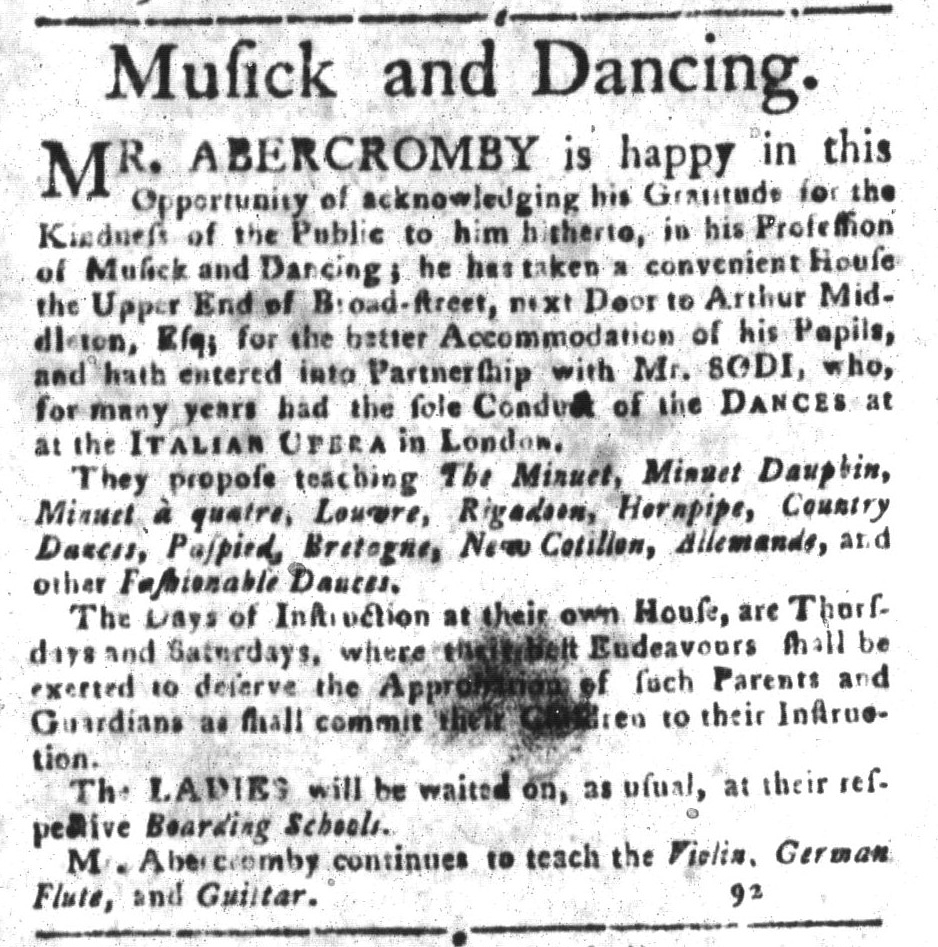
South-Carolina Gazette and Country Journal (May 9, 1775).

“Musick and Dancing.”

Among the advertisements for textiles, patent medicines, vessels preparing to depart for distant ports, and enslaved people for sale in the May 9, 1775, edition of the South-Carolina Gazette and Country Journal, Mr. Abercromby promoted lessons in “Musick and Dancing.”  He started by expressing his appreciation for the support he already received, stating that he was “happy in this Opportunity of acknowledging his Gratitude for the Kindness of the Public to him hitherto, in his Profession.”  Doing so bolstered his reputation; readers not previously familiar with Abercromby, especially genteel readers who knew that their social standing depended in part on their ability to demonstrate that they had mastered the steps of various dances or could play a musical instrument, may have asked themselves why they did not know Abercromby and whether they should make his acquaintance.

Abercromby next made two important announcements.  First, he moved to a new location, a “convenient House [in] the Upper End of Broad-street” in Charleston, that offered “better Accommodation of his Pupils.”  In addition, he “entered into Partnership with Mr. SODI, who, for many years had the sole Conduct of the DANCES at the ITALIAN OPERA in London.”  Signior Sodi, as he styled himself, previously advertised his services in the Pennsylvania Journal in the summer and fall of 1774, but by the spring of 1775 he had migrated from Philadelphia to Charleston.  Just as Sodi had done in his own advertisements, Abercromby emphasized the cachet of learning to dance from an instructor with connections to such an illustrious institution.

Abercromby listed nearly a dozen dances that he and Sodi taught, including “The Minuet, Minuet Dauphin, Minuet à quatre, Louvre, [and] Rigadoon,” as well as “other Fashionable Dances.”  Their pupils could learn new dances or refine their steps for those they already knew.  In addition to the lessons they gave at their “convenient House,” Abercromby and Sodi visited boarding schools in Charleston.  Parents and guardians could arrange to enhance the curriculum that their young “LADIES” studied, trusting that the schoolmistresses provided appropriate supervision of the dancing masters and their pupils.  Such services may have been especially attractive to the gentry in one of the largest and most cosmopolitan urban ports in the colonies.  Abercromby and Sodi did not merely teach dancing, after all, but instead sold status to those who succeeded at their lessons.

May 12

What was advertised in a colonial American newspaper 250 years ago today?

Supplement to the Pennsylvania Gazette (May 12, 1773).

“A MUSICIAN.”

When an anonymous musician offered “to teach the art of playing on the Guittar, in the best and newest taste” and “likewise teaches the German flute,” he adorned his advertisement in the May 12, 1773, edition of the Pennsylvania Gazette with an image of a guitar, a flute, and a sheet of music.  The woodcut accounted for half of the space occupied by the advertisement.  The combination of visual image and advertising copy likely drew the attention of readers, especially since most advertisements did not feature any sort of image.

Some did have a stock image in the upper left corner.  For instance, four advertisements that sought passengers and freight for ships preparing to depart for other ports incorporated woodcuts of vessels at sea, perhaps the most common image that appeared in a newspaper published in the bustling urban port of Philadelphia.  In contrast, images depicting enslaved people appeared about as often as images of ships in advertisements in newspapers published in Charleston.  The May 12 edition of the Pennsylvania Gazette did not have any images of enslaved people, even though it included advertisements about enslaved men, women, and children for sale as well as notices describing enslaved people who liberated themselves and offering rewards for their capture and return.  That issue did feature one advertisement with a woodcut depicting an indentured servant who absconded.  Two advertisements for stallions “to cover” (or breed with) mares had woodcuts of horses.

Pennsylvania Gazette (May 12, 1773).

In addition to those stock images supplied by the printers, three images commissioned by advertisers to correspond to the goods and services they marketed adorned advertisements in that issue.  A woodcut depicting a stagecoach drawn by two horses enhanced the notice for the route that connected Philadelphia and New York, operated by Charles Bessonett and Company.  An image of a sickle accompanied the advertising copy in Jacob Eckfelt’s notice.  Finally, the woodcut depicting the guitar, flute, and sheet music distinguished the anonymous musician’s advertisement from others that consisted solely of text.

To varying degrees, eighteenth-century advertisers experimented with images in their newspaper notices, sometimes opting for stock images provided by the printers and other times commissioning woodcuts for their sole use.  Although the majority of advertisers did not incorporate images into their notices, enough did so to demonstrate both curiosity about the practice and a suspicion or even a belief that images were worth the additional investment.  While these images may seem quaint or rudimentary when viewed through modern eyes, they likely resonated with eighteenth-century readers who usually encountered images in advertisements and nowhere else in newspapers, with the exception of the image that appeared in the masthead on the first page of each issue.

February 12

What was advertised in a colonial American newspaper 250 years ago today?

South-Carolina and American General Gazette (February 12, 1772).

“A SECOND-HAND SPINNET cheap, and of very fine tone.”

James Juhan offered a variety of services to colonizers in Charleston who were interested in learning to play musical instruments.  In an advertisement in the February 12, 1772, edition of the South-Carolina and American General Gazette, he informed prospective pupils that he gave lessons on the “Violin, German Flute and Guittar.”  In addition, he also sold instruments and supplies, including violins, bows, and strings.

His inventory included a “SECOND-HAND SPINNET,” a small harpsichord.  Juhan informed prospective buyers that the spinet possessed “very fine tone,” attempting to reassure them that even though it previously had been played in another home it was not defective.  In addition, Juhan described the price as “cheap,” a word that meant inexpensive in the eighteenth century but did not yet have negative associations with poor quality.  A family could acquire, play, and display the spinet in their home for a bargain price, a good investment for anyone looking for accessories to testify to their good taste, gentility, and status.  For those not yet committed to owning a spinet, even a secondhand one, Juhan also advertised “Spinnets in good order to let.”  Rather than make a major purchase, colonizers could participate in the rental market.

Whether they bought or rented their musical instruments, residents of Charleston could turn to Juhan for assistance in maintaining them.  He tuned “HARPSICHORDS, SPINNETS, FORTE-PIANOS, GUITTARS,” and other stringed instruments “with care and diligence.”  He also repaired “all kinds of Musical instruments … in the neatest manner,” setting his rates “on as reasonable terms as they can be done in this place.”  Colonizers who needed musical instruments tuned or repaired would not find better bargains than those offered by Juhan.

One of the largest urban ports in the colonies, Charleston was as cosmopolitan as New York and Philadelphia.  Merchants like Mansell and Corbett hawked a “Very neat Assortment of the most fashionable” foods imported from England, while goldsmith Philip Tidyman promoted a “Most ELEGANT ASSORTMENT” of jewelry.  In addition to acquiring and displaying garments, adornments, and housewares, colonizers had opportunities to signal their gentility and status through learning to play musical instruments and performing when guests visited their homes.  In particular, this allowed families to demonstrate that wives and daughters possessed both grace and the leisure time necessary to learn to play musical instruments.

October 7

What was advertised in a colonial America newspaper 250 years ago this week?

New-York Journal (October 4, 1770).

“There is no other Art so various perhaps and universal in its Influence, as Music.”

D. Propert and W. C. Hulett took very different approaches to promoting music lessons in the October 4, 1770, edition of the New-York Journal. Hulett, who described himself as a “DANCING-MASTER,” advertised both his “public DANCING SCHOOL” and lessons for several instruments. Like many other dancing masters, he also provided fencing lessons for gentlemen.  Most of his advertisement focused on his work as a dancing master, but he did begin and end with information about music lessons.  The headline proclaimed, “The GUITTAR, TAUGHT By W. C. HULETT, DANCING-MASTER.”  In the final paragraph, he informed prospective pupils that also gave lessons for the violin and flute as well as the small sword.  Overall, Hulett’s notice resembled most advertisements for music lessons that appeared in American newspapers in the era of the American Revolution.

Propert, on the other hand, placed a very different advertisement, starting with the headline that introduced him to prospective students as “D. PROPERT, Professor of MUSIC.”  Nearly four times the length of Hulett’s notice, this advertisement included a short essay on how music benefited “Body and Mind” for those who heard it and those who performed it.  “Music,” Propert declared, “has ever been held in the highest Esteem, by the most exalted Characters, and finest Geniuses of almost every Age and Nation.”  Music had a sublime impact; it was “capable of raising the Soul into Dispositions for the most pleasing, useful and noble purposes.”  Propert extolled the influence of music in worship services, on the battlefield, and at funerals, banquets, and balls.  Music enhanced any activity “for it has Expression for all the various Passions and Emotions of the Heart and Soul.”  Making his pitch to those who considered themselves genteel or aspired to the ranks of gentility, Propert concluded his homily on music with an assertion that “this Art has obtained the Patronage, Regard and Praises of the greatest Personages” throughout recorded history.  He instructed prospective pupils that music “hath been the Delight and Study of every polished and ingenious National in all Climates and in all Ages.”

Propert’s advertisement and Hulett’s advertisement happened to appear one after the other, Propert’s first in the October 4 edition and Hulett’s first in the next issue on October 11.  Appearing alongside a competitor may have worked to Hulett’s benefit since Propert made a case for the virtues of learning to play an instrument that applied to Hulett’s lessons as well as his own.  According to the advertising rates in the colophon, Propert paid four times as much to run his advertisement.  Not only did the printer collect those revenues, Hulett accrued benefits as well in his quest for students for this “most pleasing of the liberal Arts.”  Propert’s innovation in marketing may have worked to the advantage of all music instructors in New York.