August 9

What was advertised in a colonial American newspaper 250 years ago today?
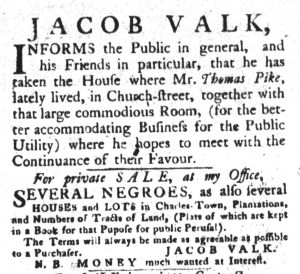
South-Carolina Gazette and Country Journal (August 9, 1774).

“That large commodious Room, (for the better accommodating Business for the Public Utility).”

Jacob Valk continued to do well as a broker for “Lands, Houses, and Negroes” in Charleston in the summer of 1774.  He attracted so many clients that the advertisements he placed on their behalf filled two of the three columns on the first page of the August 9, 1774, edition of the South-Carolina Gazette and Country Journal.  In addition to that publication, he regularly bought a significant amount of space in the South-Carolina Gazette and the South-Carolina and American General Gazette.  His investment in advertising testified to his belief in its effectiveness, while the number of advertisements demonstrated the extensive demand for his services.

Such success prompted him to move his brokerage office to a new location.  He announced that he “has taken the House where Mr. Thomas Pike, lately lived … together with that large commodious Room, (for the better accommodating Business for the Public Utility).”  Pike had recently departed the city after offering dancing and fencing lessons to its residents for a decade.  He hosted an annual ball for his students to display their talents, most recently in the “New-Assembly Room” where Valk now conducted business.  Even while he was still in town, Pike had rented the room for “Public Sales, of Estates, Negroes, [and] Dry Goods.”  With Valk on the scene, the space only occasionally used for the buying and selling of enslaved men, women, and children now became a site dedicated to perpetuating the slave trade.

Immediately below his note about his new location, Valk advertised “SEVERAL NEGROES” available “For private SALE, at my Office.”  In the subsequent advertisements that filled those two columns, he also sought buyers for “two very valuable Negro Shoemakers” and “TWO or three exceeding good SEAMSTRESSES, and some young Negro Fellows, capable of all Work.”  He also put out a call for a “good Negro CARPENTER,” seeking an enslaver interested in selling a skilled artisan.  Although most of these enslaved people did not need to appear in the “New-Assembly Room” for Valk to broker the sales, that “large commodious Room” did lend itself to putting enslaved people on display.  Colonizers who sought Valk’s services buying and selling enslaved people did conduct business in the space formerly used for dancing lessons.  Some of them had likely socialized there during Pike’s annual balls before buying and selling enslaved people in the same space after the dancing master’s departure from the city.  Valk seamlessly moved his brokerage office there, a testament to how slavery was so deeply enmeshed in daily life in colonial Charleston and other urban centers.

September 21

What was advertised in a colonial American newspaper 250 years ago today?

South-Carolina Gazette and Country Journal (September 21, 1773).

“MR. PIKE’s Dancing and Fencing SCHOOLS.”

Mr. Pike may have remained in Charleston longer than he intended … and longer than he previously announced to the public.  In an advertisement in the March 30, 1773, edition of the South-Carolina Gazette and Country Journal, the dancing master advised readers that the “BALL, for the young Ladies and Gentlemen under his Tuition” to be held on April 2 would be the “last Ball he proposes to make in Charles-Town.”  In addition to current students, he invited “former Scholars” to visit his school to brush up on their skills and then participate in an exhibition at that final ball.  This gave the impression that Pike intended to leave the city soon after the ball.

Yet six months later, he placed new advertisements in the South-Carolina Gazette and the South-Carolina Gazette and Country Journal.  In one, he announced that “MR. PIKE’s Dancing and Fencing SCHOOLS, commenced on Monday the 20th of September, as usual for the Season,” as though there had been no disruption in the schedule.  He did not, however, mention that the term would culminate in a ball, a strategy that he sometimes deployed as a means of inciting anxiety among prospective students and their parents.  In previous advertisements, Pike lectured that students needed to attend his school regularly in order to master the steps and avoid embarrassing themselves at the ball he hosted when their lessons concluded.  Perhaps Pike knew all along that he was not leaving Charleston immediately but rather had chosen not to sponsor any more balls as part of his curriculum.  However closely he followed his original plans, Pike moved to Philadelphia in 1774.  He advertised dancing and fencing lessons in the Pennsylvania Packet on October 17 and in the Pennsylvania Gazette on October 19.  He did not mention his students dancing at a ball, but he did attempt to incite anxiety among “such persons as may have forgot or had not an opportunity of learning to dance very young.”  His instruction tended to comportment more generally, including “genteel address with a proper carriage.”

South-Carolina Gazette and Country Journal (September 21, 1773).

During the time that her remained in Charleston, Pike leased or “hired the New-Assembly Room in Church-street” and sought to rent the venue for a variety of events, including “Public Sales of Estates, Negroes, [and] Dry Goods.”  The dancing master aimed to supplement the revenues he earned from giving lessons by facilitating auctions, including auctions of enslaved men, women, and children.  He also leased the space for “private Balls” on Monday and Friday evenings and meetings for “Societies” or clubs such as the Charles Town Library Society, the Saint George’s Society, and the Fellowship Society.  Pike underscored that the venue was “very airy, private, and more commodious than any one of the Kind ever built in this Province,” making it an ideal place for dancing lessons, auctions, balls, meetings, and other events.  Pike invited anyone interested in leasing the space to visit him there for “further Particulars.”

Even without promoting any balls that would take place at the end of the current season of dancing lessons, Pike maintained his status in Charleston during the time that he stayed in the city.  In addition to giving dancing and fencing lessons at the New Assembly Room, he also provided instruction at boarding schools “Four Days in the Week.”  Beyond that, he worked with local elites to schedule balls and club meetings in the venue that became synonymous with his “Dancing and Fencing SCHOOLS.”  Although not a member of the gentry, Pike positioned himself as a cultural broker whose assistance genteel Charlestonians needed to maintain their own status.