February 4

GUEST CURATOR:  Nicholas Arruda

What was advertised in a revolutionary American newspaper 250 years ago this week?
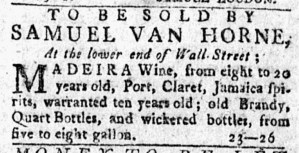
New-York Journal (February 1, 1776).

“MADEIRA Wine.”

Samuel Van Horne advertised “MADEIRA Wine, from eight to 20 years old, Port, Claret, Jamaica spirits, [and] old Brandy” in the New-York Journal on February 1, 1776.  Mentioning that the Madeira was aged between eight and twenty years might have meant that Van Horne was focusing on elite consumers who used imported wines to show their refinement since Madeira wine was not an everyday beverage.  As David Hancock explains, in the eighteenth century, Madeira was “an expensive, exotic, status-laden, and highly processed wine produced on the Portuguese island of Madeira, 500 miles west of Morocco.”[1]  Its status came from its position in Atlantic trade networks. Hancock argues that the status of the wine was created through “an Atlantic network of producers, distributors, and consumers in intense conversation with one another,” which transformed Madeira into a commodity that was recognized across the British Empire.[2]  Van Horne’s advertisement thus shows that selling aged Madeira was not just about selling alcohol but even more importantly participating in elite identity.

**********

ADDITIONAL COMMENTARY:  Carl Robert Keyes

Regular readers of the New-York Journal saw Samuel Van Horne’s advertisement for Madeira and other wines and spirits three times before they encountered it in the February 1, 1776, edition.  As the colophon at the bottom of the final page explained, “Advertisements of no more Length than Breadth are inserted for Five Shilling[s for] four Weeks, and One Shilling for each Week after, and larger Advertisements in the same Proportion.”  Many newspapers printed in the colonies solicited advertisements, but they did not always indicate the fees.  John Holt, the printer of the New-York Journal, hoped to entice advertisers by letting them know how much they would pay to insert notices in his newspaper.  The initial charge covered the space that an advertisement occupied in four consecutive issues at one shilling per week and an additional shilling for setting the type, keeping the books, and other work undertaken in the printing office.

That makes it easy to determine that Van Horne invested five shilling in running his advertisement.  Its length certainly was no more than its breadth, so the printer did not increase the fee in proportion as he did for longer advertisements.  The notation in the lower right of the advertisement, “23-26,” makes clear that Van Horne intended for the advertisement to run only for the four weeks covered by the initial expense.  “23” referred to the issue number for the first issue that carried the advertisement, “NUMBER 1723” on January 11, while “26” indicated the final issue to carry the advertisement, “NUMBER 1726” on February 1.  At a glance, the compositor knew whether to include Van Horne’s advertisement in a new issue or remove it.  The notation, intended for employees in the printing office rather than readers of the newspaper, made it unnecessary to consult a ledger, instructions from the advertiser, or other documents.  Van Horne apparently decided that he did not wish to extend the run of this advertisement.  The compositor did indeed remove it rather than publish it once again in the February 8 edition.

**********

[1] David Hancock, “Commerce and Conversation in the Eighteenth-Century Atlantic: The Invention of Madeira Wine,” Journal of Interdisciplinary History 29, no. 2 (Autumn 1998): 197.

[2] Hancock, “Commerce and Conversation,” 197.
January 11

GUEST CURATOR:  Nicholas Arruda

What was advertised in a colonial American newspaper 250 years ago today?

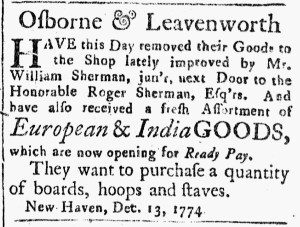
Connecticut Journal (January 11, 1775).

“A fresh Assortment of European & India GOODS.”

Osborne and Leavenworth advertised a “fresh Assortment of European & India GOODS” in the Connecticut Journalon January 11, 1775.  Their advertisement was dated December 13, 1774, very shortly after the implementation of the Continental Association on December 1.  In October 1774, the First Continental Congress organized that nonimportation agreement in response to the oppressive policies of Great Britain, especially the Coercive Acts.  Osborne and Leavenworth may have been undertaking a clearance sale on stock acquired prior to the importation ban.  In The Colonial Merchants and the American Revolution, 1763-1776, Arthur M. Schlesinger observes that merchants had to comply with boycott agreements while they had preexisting inventories to manage.  He observes that “the enforcement of non-importation agreements placed merchants in a precarious position, compelling them to balance between patriotic compliance and economic survival.”[1]  Osborne and Leavenworth probably advertised goods imported before the Continental Association went into effect and colonists refused to import British goods as a sign of unity.

**********

ADDITIONAL COMMENTARY:  Carl Robert Keyes

Osborne and Leavenworth’s advertisement does indeed raise questions about when they received their goods compared to when the Continental Association went into effect.  They placed their notice to advise prospective customers that they had moved to a new location and received a new shipment that they “are now opening.”  They did not specify when that “fresh Assortment” arrived, though they likely hoped that readers would assume they acquired their wares before December 1.  After all, it took time to unpack goods and prepare them for sale, especially when setting up shop in a new location.  Alternately, the goods may have arrived in the colonies, likely New York, prior to December 1 before merchants there dispatched them to Osborne and Leavenworth in New Haven.

The date that appeared in their advertisement made it possible to reach the conclusion that they peddled only wares imported before December 1.  Other merchants and shopkeepers who advertised in the same issue of the Connecticut Journal did not give any indication about when they received merchandise that they promoted as new arrivals.  Jeremiah Atwater, for instance, “just received a fresh Assortment of GOODS.”  Similarly, Anthony Perit “just received a large and general Assortment of English and India GOODS.”  Yet neither of them included any dates nor mentioned the Continental Association.  Josiah Burr proclaimed that he “just receiv’d a large Assortment of GOODS” and gave an extensive list of imported textiles, housewares, and groceries (including tea) in an advertisement dated “Jan. 1775,” well after the Continental Association commenced.  Perhaps each of these local retailers had received new goods from merchants in New York rather than directly from English ports.  After all, five out of six ships that the custom house in New Haven listed as “ENTERED IN” in the January 11 edition of the Connecticut Journal arrived from New York.  In that case, neither advertisers nor readers may have been concerned about breaking the prohibition on buying and selling imported goods.  Six weeks after the Continental Association went into effect, advertisements for consumer goods in the Connecticut Journal looked much the same as they had for years, unlike some advertisements in newspapers published in major ports that announced the sales of imported goods under the direction of local Committees of Inspection.

**********

[1] Arthur M. Schlesinger, The Colonial Merchants and the American Revolution, 1763-1776 (New York: Frederick Ungar Publishing Company, 1957), 240.

Welcome, Guest Curator Nicholas Arruda

Nicholas Arruda is a junior at Assumption University.  He is pursuing a major in History with a double minor in Education and Medieval and Early Modern Studies.  He attained the rank of Eagle Scout in 2021.  On campus, he is the manager of the Men’s Basketball team and a recipient of the Light the Way Scholarship.  Beyond campus, he has an internship doing archival work at the Worcester Historical Museum.  He also participated in “Living in New England in the Age of Revolutions,” the 2024 American Studies Seminar sponsored by the American Antiquarian Society.  Nicholas made his contributions to the Adverts 250 Project and the Slavery Adverts 250 Project while enrolled in HIS 359 Revolutionary America, 1763-1815, in Fall 2024.

Welcome, guest curator Nicholas Arruda!