
What was advertised in a colonial American newspaper 250 years ago today?
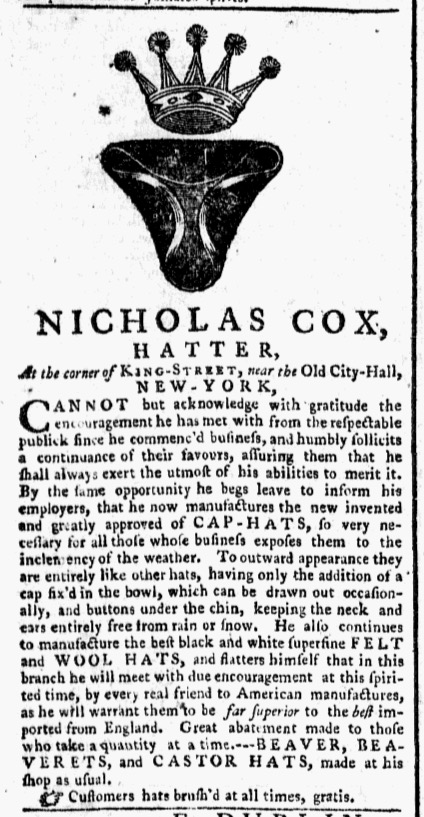
“He will meet with due encouragement … by every real friend to American manufactures.”
Nicholas Cox, a hatter, made several appeals to consumers in his advertisement in the December 12, 1774, edition of the New-York Gazette and Weekly Mercury. He commenced with a standard expression of gratitude for “the encouragement he had met with from the respectable publick since he commenc’d business.” Many purveyors of goods and services did so in their advertisements, signaling to readers that other consumers already considered them worthy of their business. It was a familiar means of bolstering an advertiser’s reputation.
The hatter also incorporated commentary specific to his trade, proclaiming that he “manufactures the new invented and greatly approved of CAP-HATS.” For those unaware of this innovation, eh explained that by “outward appearance they are entirely like other hats, having only the addition of a cap fix’d in the bowl, which can be drawn out occasionally.” In such instances, it “buttons under the chin, keeping the neck and ears entirely free from rain or snow.” Cox marketed this new style, a very practical element, as “so very necessary for all those whose business exposes them to the inclemency of the weather.” According to Kate Haulman, colonizers debated whether they should carry umbrellas, “stylistic spoils of empire hailing from India,” in the 1760s and 1770s. “Some regarded umbrellas as ridiculous and frivolous,” she notes, “serving no purpose that a good hat could not supply.”[1] Cox produced and sold such hats for men of business who sought to eschew the effeminacy and luxury associated with umbrellas.
His next appeal made an even more explicitly political argument to prospective customers. He made “the best black and white superfine FELT and WOOL HATS,” like the tricorne hat depicted in the woodcut that adorned his advertisement. Cox asserted that patriotic consumers had a duty to support his business when they made choices about where to acquire their hats. He expressed confidence that he “will meet with due encouragement at this spirited time, by every real friend to American manufactures.” The Continental Association, a boycott of British goods adopted in response to the Coercive Acts, had recently gone into effect. Cox offered an alternative to colonizers who desired to acquire hats yet wished to remain patriotically correct, either according to their own principles or at least to avoid the ire of others who observed the purchases they made. Furthermore, his customers did not have sacrifice quality for principles. The hatter pledged that “he will warrant [his hats] to be far superior to the best imported from England.” That being the case, the crown that appeared above the tricorne hat at the top of his advertisement may have testified to the superior quality of his hats, a general sense of pride in being part of the British Empire, or reverence for the monarch whom many colonizers still hoped would intervene on their behalf in their altercation with Parliament.
In addition to those appeals, Cox included two more common marketing strategies. He promised a “[g]reat abatement … to those who take a quantity at a time.” In other words, he gave discounts for buying multiple hats, both for consumers and for retailers who intended to sell them in their own shops. He also provided a free ancillary service: “Customers hats brush’d at all times, gratis.” Cox saw to the care and maintenance of the hats he made and sold long after the time of purchase. He cultivated relationships with customers by encouraging them to return to his shop for assistance in keeping their hats in good order. Overall, Cox resorted to a variety of familiar and specific appeals when advertising his hats, distinguishing him from competitors who did not put as much effort into marketing their wares.
**********
[1] Kate Haulman, “Fashion and the Culture Wars of Revolutionary Philadelphia,” William and Mary Quarterly, 3rd ser., 62, no 4 (October 2005): 632.