April 3

What was advertised in a colonial American newspaper 250 years ago today?
Newport Mercury (April 3, 1775).

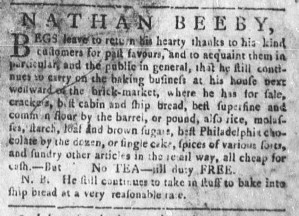
“No TEA – till duty FREE.”

When Thomas Green advertised a variety of grocery items in the April 3, 1775, edition of the Newport Mercury, he listed “SUGAR, FLOUR, COFFEE, … CHOCOLATE, … PEPPER, … NUTMEGS, CLOVES, and MACE.”  Tea, one of the commodities that so often appeared in such lists, was conspicuously absent.  Many shopkeepers had refused to stock, advertise, or sell tea in the aftermath of the Boston Tea Party in December 1773, just as many consumers refrained from purchasing tea.  Abstaining from tea was not universal, however, as some advertisers did continue to include it in their advertisements even after the colonies received word of the Boston Port Act, the Massachusetts Government Act, and the other Coercive Acts that Parliament passed in response to the destruction of the tea by colonizers who masqueraded as Indigenous Americans.  Tea even merited particular notice in the Continental Association, the nonimportation pact devised by the First Continental Congress during its meetings in Philadelphia in September and October 1774, yet Peter Oliver, a noted Loyalist judge in Boston, alleged in his Origin and Progress of the American Rebellion that colonizers, especially women, manufactured all sorts of justifications for continuing to drink tea.

Nathan Beeby, a baker in Newport, took a stand regarding tea in the same issue of the newspaper that carried Green’s advertisement.  He thanked his “kind customers for past favours” and advised the public that “he still continues to carry on the baking business at his house, where he has for sale, crackers, best cabin and ship bread, [and] best superfine and common flour by the barrel, or pound.”  He also peddled “rice, molasses, starch, loaf and brown sugars, best Philadelphia chocolate …, spices of various sorts, and sundry other articles in the retail way.”  As many retailers did at the time, he specified that he did not extended credit, accepting only cash, and then he added: “– But     No TEA – till duty FREE.”  Green left it to readers to realize that tea did not appear in his advertisement, while Beeby made a point of announcing that he did not stock or sell the problematic commodity.  The amount of space that appeared between “But” and “No TEA” amounted to a dramatic pause, further emphasizing Beeby’s commitment and perhaps serving as a reminder to readers of the pledges they made to refuse to consume that beverage.  The baker practiced politics in his advertisement, using the space he purchased in the Newport Mercury to participate in public discourse.
July 8

What was advertised in a colonial American newspaper 250 years ago today?

New-Hampshire Gazette (July 8, 1774).

“Molasses, Coffee, Chocolate; & all Sorts of Spices.”

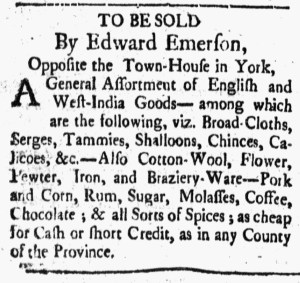
In the summer of 1774, Edward Emerson advertised that he sold a “General Assortment of English and West-India Goods” at his shop “Opposite the Town-House” in York.  At the time, his town, about ten miles northeast of Portsmouth, New Hampshire, was in that portion of Massachusetts that eventually became Maine in 1820.  When Emerson declared that he set prices “as cheap … as in any County of the Province” in the New-Hampshire Gazette, the local newspaper for York, he left it to readers to decide if he made the comparison to Massachusetts or New Hampshire or both.

Emerson likely considered current events in both colonies important in determining how to present his business in the public prints, making it notable that among the groceries he stocked he listed “Pork and Corn, Rum, Sugar, Molasses, Coffee, Chocolate: & all Sorts of Spices,” but not tea.  Merchants and shopkeepers who advertised coffee and chocolate very often promoted tea at the same time, though many had stopped doing so following the Boston Tea Party in December 1773.  Emerson had been no stranger to selling tea in the past, including “TEA by the dozen or smaller quantity” along with “Coffee, Chocolate, and all sorts of Spices” in February 1771 and “Bohea TEA, and all sorts of GROCERIES” in July 1772.  Yet tea had become a much more problematic commodity in recent months …

… so problematic that that Daniel Fowle, the printer of the New-Hampshire Gazette, devoted the entire front page of the July 8, 1774, edition to reporting on “TWENTY-SEVEN Chests of India TEA … consigned to Mr. Parry” and landed in Portsmouth “before it was in fact generally known that any Tea had arrived in the ship.”  The coverage documented the “peaceable and prudent conduct of the inhabitants of Portsmouth” in the face of this crisis, their actions almost certainly influenced by the repercussions that Boston faced following the destruction of the tea there.  At a town meeting, “a committee of eleven respectable inhabitants, were elected to treat with the consignee, and to deliberate what would be most expedient to be done in a cause of so much difficulty and intricacy.”  They also voted to establish “a watch of twenty-five men … to take care and secure the tea” and prevent disorder and disturbances until the committee could devise a method to remove the tea from Portsmouth.  Just as they sought to avoid destroying the tea, they realized that they could not allow any of it to be sold due to “the dependence state of this town and province upon our sister colonies, even for necessary supplies, which would undoubtedly and justly be denied” should they “suffer the sale and consumption of said Tea.”  Once the tea had been safely sent away, the town meeting voted to create “a committee of Inspection to examine and find out if any Tea is imported here” and another committee to draft a measure “against the importation, use, consumption or sale of all Teas, in this town while the same are subject to a duty.”

Given the circumstances, Emerson made a savvy decision not to market tea in his advertisement in the New-Hampshire Gazette.  Not all merchants and shopkeepers refrained from advertising and selling tea at the time, but many decided to discontinue trading that commodity even before boycotts officially went into effect.

May 15

What was advertised in a colonial American newspaper 250 years ago this week?

Massachusetts Spy (May 12, 1774).

“All sorts of Groceries as usual – except TEA.”

By the time that Thomas Walley’s advertisement ran in the May 12, 1774, edition of the Massachusetts Spy, it would have been a familiar sight to regular readers of that newspaper.  It previously appeared on six occasions in March, April, and May, advising the public that Walley stocked a variety of items that he sold wholesale or retail at his “Store on Dock-Square” in Boston.  He had “Dutch looking-glasses of various sizes,” “quart and pint Mugs and Chamber Pots,” and “choice junk” (or old rope) “to make into cordage of any size.”

Walley also sold “Oatmeal per bushel,” “all sorts of Spices,” “choice Rice,” “new Raisins,” and “all sorts of Groceries as usual – except TEA.”  That last entry, listing what he did not sell rather than what he wanted to put into the hands of consumers, may have the primary reason that Walley inserted his advertisement in the Massachusetts Spy so many times.  As one of the owners of the Fortune, the vessel that transported the tea involved in the second Boston Tea Party, Walley had been under suspicion, though he and his partners asserted that they did not have “any share, interest or property, directly or indirectly in any part of the Tea that came from London in said vessel.”  They made that declaration, affirmed by a justice of the peace, in an advertisement that ran in the March 10 edition of the Massachusetts Spy, just days after colonizers disguised as Indians once again dumped tea into Boston Harbor.

A week later, Walley’s advertisement listing a variety of goods “except TEA” appeared in the Massachusetts Spy for the first time.  Given the political orientation of that publication, printed by ardent patriot Isaiah Thomas, it made sense for Walley to take to the pages of that newspaper in his effort to convince the public that he was not trucking in tea.  His advertisement ran again the following week and then on April 7, 15, and 22 and May 5 and 12, missing from only the March 31 and April 28 editions.  Merchants and shopkeepers often ran notices for several months, but in this instance a desire to sell his inventory probably was not Walley’s sole consideration.  He continuously reminded the public that he wanted nothing to do with peddling tea, probably even more so on May 12 when Thomas published a two-page Postscript to the Massachusetts Spy that featured the text of the Boston Port Act that closed the harbor until the colonizers made restitution of the tea they destroyed.  As the crisis intensified, Walley sought to distance himself from tea.

March 12

What was advertised in a colonial American newspaper 250 years ago today?

Providence Gazette (March 12, 1774).

“As cheap … as can be bought at any Shop in NEW-ENGLAND.”

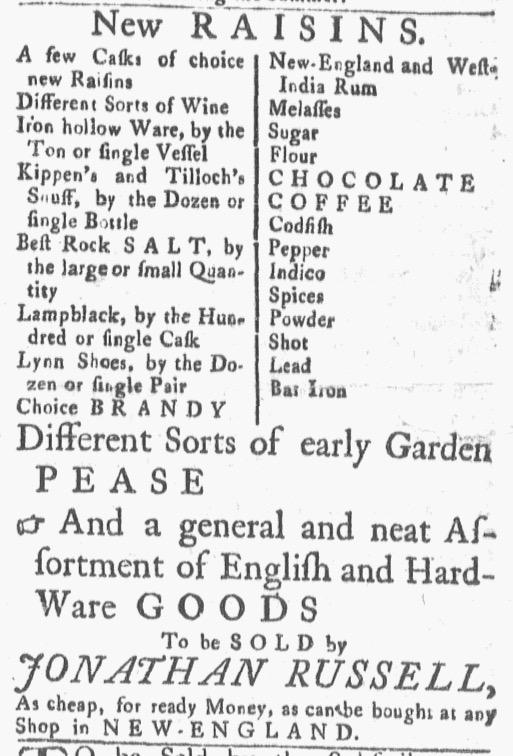
Jonathan Russell offered a variety of goods to prospective customers in his advertisement in the March 12, 1774, edition of the Providence Gazette.  The headline promised “New RAISINS.”  A list of other items appeared below the headline, followed by a note about “Different Sorts of early Garden PEASE” and another about a “general and neat Assortment of English and Hard-Ware GOODS.”  Both ran in the same size font as the headline, suggesting that Russell may have instructed the compositor to place greater emphasis on that portion of his inventory.  Although he did not enumerate the “English and Hard-Ware GOODS,” he underscored the choices available to consumers when he asserted that he stocked a “general and neat Assortment.”

Some of the items in the list of goods also attracted attention because they appeared in capital letters.  “Best Rock SALT,” “Choice BRANDY,” “CHOCOLATE,” and “COFFEE” stood out among the “Kippen’s and Tilloch’s Snuff, by the Dozen or single Bottle,” “Lampblack, by the Hundred or single Cask,” “Lynn Shoes, by the Dozen or single Pair,” flour, codfish, and other commodities.  Notably, Russell peddled “CHOCOLATE” and “COFFEE,” but did not mention tea at all. Capitalizing “CHOCOLATE” and “COFFEE” called attention to the fact that tea was absent from his inventory as colonizers continued to debate the politics of consuming that beverage just a few months after the Boston Tea Party.

Russell concluded his advertisement with an appeal to price, claiming that customers could purchase his wares “As cheap … as can be bought at any Shop in NEW-ENGLAND.”  He did not place himself in competition solely with James Green, “HILL’s ready Money Variety Store,” and other merchants and shopkeepers in Providence.  Instead, he declared that his low prices matched those in Newport, Portsmouth, and Boston.  Prospective customers did not need to visit other shops in Providence or send away to merchants and shopkeepers in other towns to get better deals.  Although not as extensive as other advertisements in the same issue of the Providence Gazette, Russell’s notice incorporated consumer choice and competitive prices and even seemed to offer political commentary for those who read carefully.