March 7

What was advertised in a colonial American newspaper 250 years ago today?
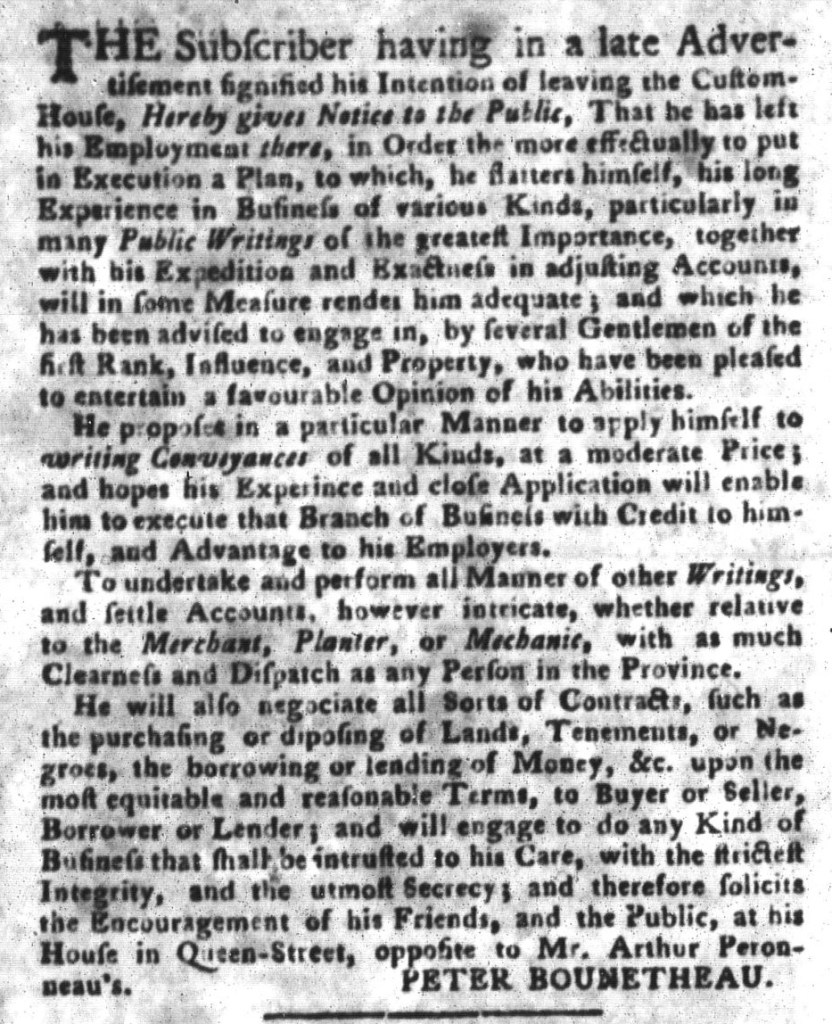
South-Carolina Gazette and Country Journal (March 7, 1775).

“He proposes … to apply himself to writing Conveyances of all Kinds.”

On the eve of the American Revolution, Peter Bounetheau left his job at the custom house in Charleston and established his own business for “writing Conveyances of all Kinds” and negotiating “all Sort of Contracts, such as the purchasing or disposing of Lands, Tenements, or Negroes [and] the borrowing or lending of Money.”  He claimed that he had done so on the advice of “several Gentlemen of the first Rank, Influence, and Property, who have been pleased to entertain a favourable Opinion of his Abilities.”  In addition to that endorsement, he emphasized “his long Experience in Business of various Kinds, particularly in many Public Writings of the greatest Importance, together with his Expedition and Exactness in adjusting Accounts.”

By the time his advertisement ran in the March 7, 1775, edition of the South-Carolina Gazette and Country Journal, Bounetheau had been in business for several months.  He had established himself well enough to attract clients that accounted for twelve other advertisements of various lengths on the same page.  A couple concerned real estate and a couple hawked commodities like mustard and olives, yet most of them offered enslaved people for sale.  Six of those advertisements enumerated three enslaved men, ten enslaved women, and six enslaved women that Bounetheau sought to sell on behalf of others.  A seventh advertisement listed “Several NEGROES,” but did not specify how many beyond “a complete boatman and jobbing carpenter” and “a complete washer and ironer.”  The others were “field slaves.”

Bounetheau’s enterprise meant good business for Charles Crouch, the printer of the South-Carolina Gazette and Country Journal.  Week after week, the broker placed multiple advertisements, representing significant revenues for the printing office.  In the March 7 edition, his notices filled an entire column and nearly half of another out of twelve total columns in a standard issue of four pages consisting of three columns each.  That meant that Bounetheau generating ten percent of the content.  Another broker, Philip Henry, inserted fifteen advertisements that occupied the same amount of space, though he focused more on real estate than enslaved people.  Still, he offered “TWENTY-TWO young and healthy NEGROES, that have been used to a Plantation” in one notice and “ELEVEN NEGROES, chiefly Country born” in another.  These brokerage firms likely increased the number of advertisements that ran in the South-Carolina Gazette and Country Journal and other newspapers published in Charleston in the 1770s.  Such endeavors included greater dissemination of advertisements that contributed to perpetuating the slave trade.
November 29

What was advertised in a colonial American newspaper 250 years ago today?

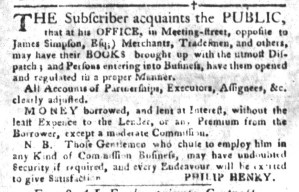
Supplement to the South-Carolina Gazette and Country Journal (November 29, 1774).

“Employ him in any Kind of Commission Business.”

Philip Henry worked as a bookkeeper and a broker in Charleston on the eve of the American Revolution.  In an advertisement in the South-Carolina Gazette and Country Journal, he advised the public that “Merchants, Tradesmen, and others, may have their BOOKS brought up with the utmost Dispatch.”  Those considering embarking on a new endeavor could engage his services to have their accounts and ledgers “opened and regulated in a proper Manner” from the start.  In addition, he assisted with “any Kind of Commission Business,” whether commodities, real estate, or enslaved laborers.

As part of that aspect of his business, Henry placed many more advertisements on behalf of his clients.  In the supplement that accompanied the November 29, 1774, edition of the South-Carolina Gazette and Country Journal, for instance, his advertisement describing the variety of services he offered at his office on Meeting Street served as an introduction for a series of advertisements that ran immediately below it.  He inserted eight additional advertisements, six of them for real estate and two offering enslaved people for sale.  His brokerage business was good business for Charles Crouch, the printer of that newspaper.

Henry was not alone as a broker or as an advertiser.  Peter Bounetheau ran a similar notice, one that also served as an introduction to a series of other advertisements.  He placed eleven on another page of the supplement that included Henry’s notices, requiring enough space to fill an entire column and spill over into another.  Those included six about enslaved people, two about real estate, one on behalf of the executor of an estate, and one about several lots in the city, a plantation in the country, and “Several NEGROES.”  Similarly, Jacob Valk, another broker, inserted advertisements that accounted for a significant amount of space in November 29 edition.  He collated most of the real estate handled by his office into a single advertisement that filled a column, yet placed five separate advertisements about enslaved people as well as an estate notice and an advertisement about horses.

Henry, Bounetheau, and Valk industriously placed their notices in the South-Carolina and American General Gazette and the South-Carolina Gazette in addition to the South-Carolina Gazette and Country Journal.  Even though brokers ran offices in other urban ports, they did not adopt a similar advertising strategy as part of their business model.  That made the rhythm of advertising in South Carolina’s newspapers distinctive compared to those published in Boston, New York, and Philadelphia.