What was advertised in a revolutionary American newspaper 250 years ago today?
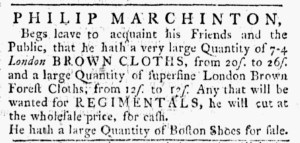
“Any that will be wanted for REGIMENTALS, he will cut at the wholesale price.”
After word of the battles at Lexington and Concord arrived in Philadelphia, Philip Marchinton took to the pages of the Pennsylvania Ledger to “acquaint his Friends and the Public, that he hath a very large Quantity of … London BROWN CLOTHS … and a large Quantity of superfine London Brown Forest Cloths” for sale at his shop. He listed the prices for each type of textile, also noting that “Any that will be wanted for REGIMENTALS, he will cut at the wholesale price.” In other words, he offered a discount to customers who purchased cloth to make uniforms.
Doing so made good business sense, but it did not necessarily reveal Marchinton’s politics at that moment or the decisions he would make once the colonies declared independence. Although he set prices that favored American patriots just after the war began, Marchinton ultimately identified as a Loyalist and migrated to Nova Scotia. According to the Dictionary of Canadian Biography, Marchinton was born in England around 1736, served a “commercial apprenticeship” before migrating to Philadelphia in 1771, and “established himself as a general merchant.” He tried to remain neutral, even “agreeing to serve in the local militia but refusing to renounce his allegiance to the crown” during the early stages of the war. Marchinton later “declared himself a loyalist during Philadelphia’s occupation by British forces” in 1777 and 1778, leaving him “no choice but to leave the city when the army abandoned it in June 1778.” He spent the rest of the war in British-occupied New York, leaving in November 1783. After spending a few months in Bermuda, he settled in Halifax, Nova Scotia, became a prosperous merchant, and held public office.
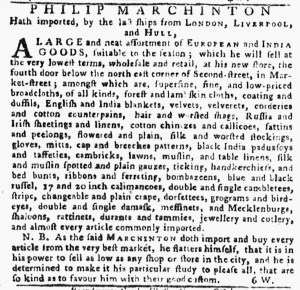
Marchinton had experience with using favorable prices as a marketing strategy. In October 1773, he placed an advertisement in the Pennsylvania Gazette and the Pennsylvania Journal, declaring that “it is in his power to sell” all sorts of textiles “as low as any shop or store in the city.” Responding to current events in the spring of 1775 provided an opportunity for the merchant to devise a promotion aimed at men who needed fabric for uniforms, a gesture that he likely expected would garner good will among the public and draw customers to his shop to make other purchases as well. Like many colonizers, Marchinton apparently supported resistance aimed at securing a redress of grievances, but over time he found that he could not endorse independence. His advertisement in the Pennsylvania Ledger testified to his entrepreneurial ingenuity rather than his deeply held political beliefs.