
What was advertised in a colonial American newspaper 250 years ago today?
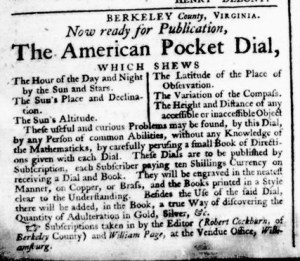
“The American Pocket Dial.”
It was an unusual publication promoted in the March 11, 1775, edition of John Dixon and William Hunter’s Virginia Gazette. Was it really a publication at all? A subscription notice proclaimed that “The American Pocket Dial” was “Now ready for Publication.” This handy device, according to “the Editor,” Robert Cockburn of Berkeley County, showed the “Hour of the Day and Night by the Sun and Stars” as well as the “Sun’s Place and Declination,” the “Sun’s Altitude,” the “Latitude of the Place of Observation,” and the “Height and Distance of any accessible or inaccessible Object.” That it also showed the “Variation of the Compass” suggests that the pocket sundial had a magnetic compass embedded in it. Each dial came with a “small Book of Directions” easily understood by “any Person of common Abilities, without any Knowledge of the Mathematicks.” In “European Pocket Sundials for Colonial Use in American Territories,” Sara H. Schechner notes that “tables of latitude, known as gazetteers” were sometimes “printed in a broadsheet, which was a sundial accessory.”[1]
Cockburn declared that the American Pocket Dials “are to be published by Subscription.” With the Continental Association in effect, colonizers were not supposed to import or purchase finished goods from Great Britain. Instead, that pact called on them to “encourage … Industry” and “promote … the Manufactures of this Country.” Schechner notes that when Anthony Lamb advertised “large Pocket Compasses, with or without Dials” in the April 7, 1760, edition of the New-York Mercury that he likely sold imported items.[2] Fifteen years later, the political turmoil of the imperial crisis presented an opportunity to market an American alternative, though Cockburn did not take the risk of producing or “publishing” the American Pocket Dial without first lining up buyers or “subscribers.” He asserted that the sundials “will be engraved in the neatest Manner, on Copper, or Brass.” Did he find “subscribers” for this project? During the American Revolution, Schechner states, “American patriots favored compass sundials” while their French allies preferred inclining dials but does not indicate that American makers like Cockburn “published” and sold such products to officers and soldiers.[3] Addressing that question falls beyond the scope of Schechner’s chapter on “European Pocket Sundials for Colonial Use in American Territories.” Having encountered Cockburn’s “subscription proposal,” I am curious to see if he published additional advertisements, especially any calling on “subscribers” to collect their pocket sundials once he “published” them. I will also be looking for other work on early American scientific instruments to learn whether Cockburn and others established an industry during the American Revolution.
**********
[1] Sara J. Schechner, “European Pocket Sundials for Colonial Use in American Territories” in How Scientific Instruments Have Changed Hands, ed. A.D. Morrison-Low, Sara J. Schechner, and Paolo Brenni (Leiden: Brill, 2017), 125.
[2] Schechner, “European Pocket Sundials,” 148.
[3] Schechner, “European Pocket Sundials,” 147.