November 28

Who was the subject of an advertisement in a colonial American newspaper 250 years ago today?

Pennsylvania Gazette (November 28, 1771).

“My boy JOHN COFFE ran away.”

Advertisements for runaway indentured servants and apprentices as well as enslaved people who liberated themselves by fleeing from their enslavers regularly appeared in colonial newspapers.  The November 28, 1771, edition of the Pennsylvania Gazette, for instance, carried several.  Peter Care informed readers that “a Dutch servant man, named George Foell” absconded a month earlier, described the runaway’s appearance and clothing, and offered a reward to whoever “apprehends and secures the said servant, so that his master may have him again.”  In another advertisement, John Anderson, the jailkeeper in Newtown in Bucks County, reported that he had in custody “a likely NEGROE man” suspected of liberating himself from George Adam Widner of Reading.  “His master,” Anderson instructed, “is desired to come and pay charges, and take him away.”

Among the many runaway advertisements that competed for the attention of readers, Andrew Moore sought to distinguish his notice by resorting to verse.  “THE ’leventh month, the sixteenth day, / My boy JOHN COFFE ran away,” the poem began.  Moore described Coffe’s age and appearance, but did so in rhyming couplets in hopes of keeping readers interested.  “His age uncertain, yet appears / To be at least full fifteen years,” Moore asserted, before providing an extensive description of Coffe’s clothing.  “A good wool hat he took away, / Quite new, just bought the other day … His jacket was, as I am told, / Too big for him, and something old.”  He commented on the fit of another garment as well.  “Old buckskin breeches too he had, / Too big I’m sure for such a lad.”  Moore may have intended this attention to the size of Coffe’s clothing to allude to his lack of experience and maturity.  As with most advertisements about runaway servants and apprentices, this one concluded with an overview of the reward.  “Whoever takes him, pray don’t fail / To lay him fast in any jail, / And then, to you I’ll freely give / Full Thirty Shillings if I live.”

Moore frequently forced the rhymes to make his poem about Coffe work, but his intention was not to write a work of literature but instead to create an advertisement that took a familiar theme and made it fresh and memorable.  Rather than a dense paragraph of text, he gave readers a breezy poem that entertained as well as informed.  It certainly took more effort to compose than typical runaway advertisements, but Moore likely that a worthy investment that would aid in recovering the recalcitrant Coffe.
June 22

What was advertised in a colonial American newspaper 250 years ago today?

Jun 22 - 6:22:1769 Pennsylvania Gazette
Pennsylvania Gazette (June 22, 1769).

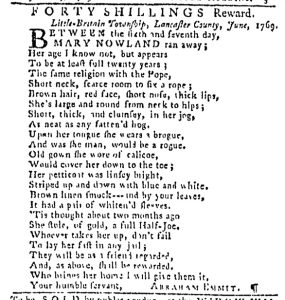
“BETWEEN the sixth and seventh day, / MARY NOWLAND ran away.”

Advertisements for runaway servants and slaves regularly appeared in the pages of the Pennsylvania Gazette in the 1760s. The June 22, 1769, edition, for instance, featured several such advertisements. To distinguish his notice from others, Abraham Emmit opted for a format other than the usual dense block of text that provided a description. Instead, he published a poem about Mary Nowland, deploying a style intended to encourage readers to give the advertisement more than a cursory glance and, as a result, better remember how to recognize this particular runaway. In addition, the novelty of his poem imbued his advertisement with greater entertainment value, further contributing to the likelihood that readers would take note.

Among the rhyming couplets, Emmit provided a physical description of Nowland. Although in verse, it simultaneously described and denigrated the runaway servant. She had “Brown hair, red face, short nose, thick lips” and was “large and round from neck to hips.” Indeed, the aggrieved Emmit suggested that Nowland was so chubby that it affected her movement – “Short, thick, and clumsy, in her jog” – so much so that he compared her to a “fatten’d hog.” Like many other advertisements for servants, this one reported Nowland’s origins as a means of helping readers identify her. Emmit did not, however, simply state that Nowland had been born in Ireland. Instead, he mentioned that she was “The same religion with the Pope” and “Upon her tongue she wears a brogue,” expecting readers to reach the conclusion that Nowland was an Irish Catholic. In presenting this puzzle, albeit not a particularly difficult one, Emmit encouraged greater participation by readers from their first encounter with the text than most runaway advertisements expected of them. This notice did not merely charge readers with reporting or capturing a runaway if they happened to spot her; it invited them first to engage with the printed page much more actively than they would have when perusing other advertisements concerning runaways.

The clever Emmit did not merely sign his verse. He incorporated his own name into the final couplet, promising a reward of forty shillings to anyone who delivered Nowland to him: for any reader “Who brings her home I will give them it, / Your humble servant, ABRAHAM EMMIT.” These last lines were just as stilted as the rest of the poem, but composing a piece of great literature had not been Emmit’s purpose. Given how many notices about runaway servants and other advertisements ran in the Pennsylvania Gazette, he sought a means to differentiate his advertisement and draw greater attention from readers. The format of the poem alone, compared to dense paragraphs of text in other advertisements, separated it from others on the page, encouraging readers to have a closer look. Emmit speculated that once they discovered the novelty he had composed that they would pay more attention to his description of the runaway Nowland. Providing this simple entertainment increased the chances that someone would recognize Nowland and either return her to Emmit’s household or send word of her whereabouts.