March 29

What was advertised in a colonial American newspaper 250 years ago today?
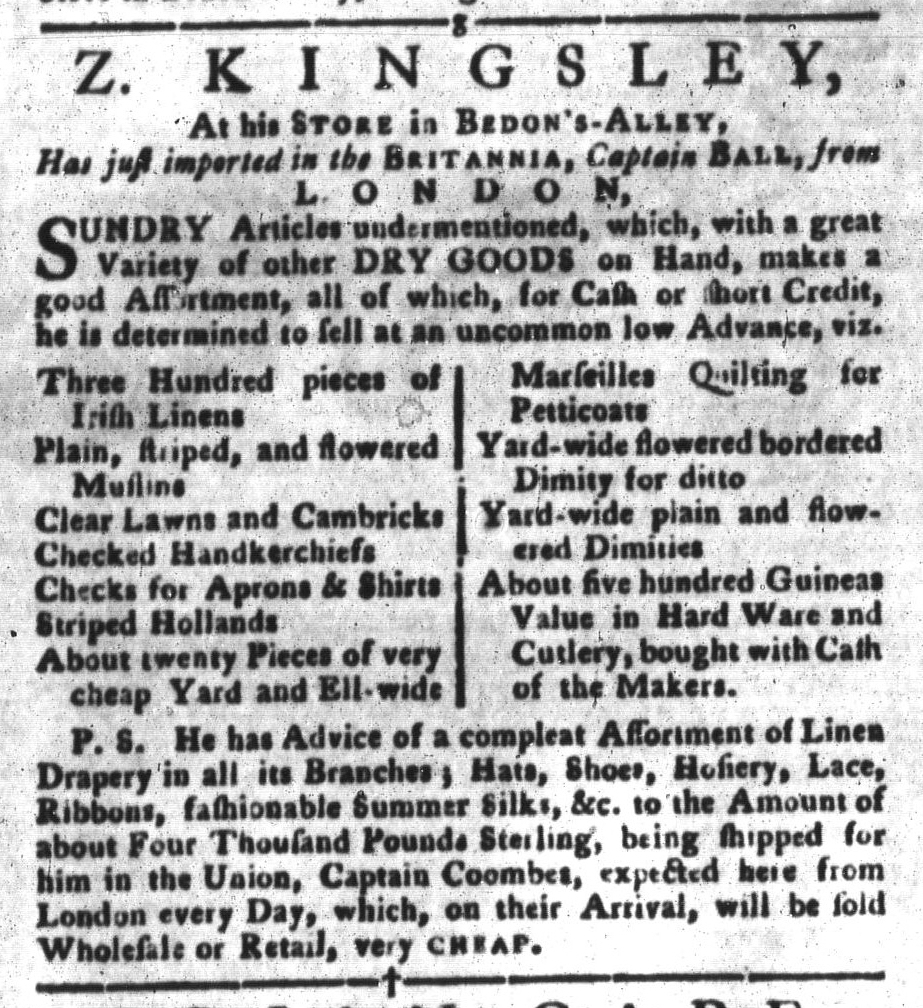
South-Carolina Gazette and Country Journal (March 29, 1774).

“He has Advice of a compleat Assortment … expected here from London every Day.”

Zephaniah Kingsley trumpeted the magnitude of the inventory “At his STORE in BEDON’S-ALLEY” in an advertisement in the March 29, 1774, edition of the South-Carolina Gazette and Country Journal.  He promoted the “SUNDRY Articles undermentioned” in a list of items “just imported … from LONDON” as well as a “great Variety of other DRY GOODS on Hand” from previous shipments.  All together, they constituted a “good Assortment” that offered a vast array of choices to consumers in Charleston.  He even took the unusual step of the total worth of some of his merchandise, declaring that he stocked “About five hundred Guineas Value in Hard Ware and Cutlery.”  That certainly signaled that he had indeed acquired a “good Assortment” of those items to satisfy the desires of just about any prospective customer.

The merchant opted for a postscript (rather than the more common nota bene) to alert readers that he “has Advice of a compleat Assortment of Linen Drapery in all its Branches; Hats, Shoes, Hosiery, Lace, Ribbons, fashionable Summer Silks,” and other goods “being shipped for him in the Union, … expected here from London every Day.”  As if his current inventory was not enough, Kingsley encouraged a sense of anticipation for new items that matched the most current fashions in London, the most cosmopolitan city in the empire.  In so doing, he once again deployed a marketing strategy that he used a couple of months earlier.  In early February, he proclaimed that he “intends having ready to open as soon as possible in the spring, an elegant assortment of Linen Drapery … with a quantity of the most fashionable summer Silks.”  The new advertisement served as an update for customers whose attention Kingsley caught with that preview.  In his effort to sell all his merchandise, including goods already “on Hand,” the merchant emphasized new items and even those that had not yet arrived but that he would make available to consumer imminently.  Curiosity about those goods, he likely reasoned, could help in moving older inventory out of his store once he got customers through the doors.

February 1

What was advertised in a colonial American newspaper 250 years ago today?

South-Carolina Gazette and Country Journal (February 1, 1774).

“He intends having ready to open as soon as possible in the spring, an elegant assortment of Linen Drapery in all its branches, with a quantity of the most fashionable summer Silks.”

Z. Kinsley inserted a lengthy advertisement promoting the “large STOCK of DRY GOODS” available at his store in Charleston in the South-Carolina Gazette and Country Journal several times in the winter of 1773 and 1774. Unlike most advertisements that ran for several consecutive weeks before being discontinued, this one appeared sporadically in December and January. Kingsley even placed it once again on February 1, perhaps in a final effort to move his current inventory before making a trip to London.  He made it known throughout his advertising campaign that “he intends going for London the beginning of February.”  With that departure in mind, he sold his wares for cash (or “ready Money”) or “short Credit.”  He set attractive prices, marking up his costs only slightly (or what he and other advertisers called “a very low Advance”).  As much as possible, he hoped to clear out his store to make room for new goods that he would acquire on his trip.

The merchant apparently did not envision staying in London for too long.  In a nota bene, he declared that he “intends having ready as soon as possible in the spring, an elegant assortment of Linen Drapery in all its branches, with a quantity of the most fashionable summer Silks” and other items.  In addition to marketing an assortment of textiles, hardware, cutlery, and ironmongery already in stock, Kingsley encouraged consumers to anticipate his summer selections well before they arrived.  Like so many other advertisers, he declared that he imported his merchandise “in the very last Ships from England,” but he devised an innovation on that popular appeal by prompting prospective customers to imagine what he would carry in his store after his trip.  Months in advance, he attempted to persuade consumers to think of his store as the place to purchase “fashionable summer Silks” and other goods appropriate for the season before his competitors began a chorus of claims about importing the newest and most fashionable items via the vessels that most recently arrived in port.  In addition, readers realized that making a trip to London meant that Kinsley could eliminate the middlemen who drove up prices.  That meant another “very low Advance” when he presented that “elegant assortment of Linen Drapery” for sale in the spring.

Most merchants and shopkeepers focused on selling the wares they already had in stock.  Kinsley devoted significant space in his advertisement to doing so, but he did not stop there.  At various points throughout the winter, he urged consumers in Charleston to anticipate the merchandise that he would select during his trip to the cosmopolitan center of the empire where he would observe the latest fashions himself.  His marketing efforts incorporated both shopping in the present and shopping in the future, priming customers to visit his store when they needed or desired to purchase from among his spring and summer selections.