November 8

What was advertised in a colonial American newspaper 250 years ago today?
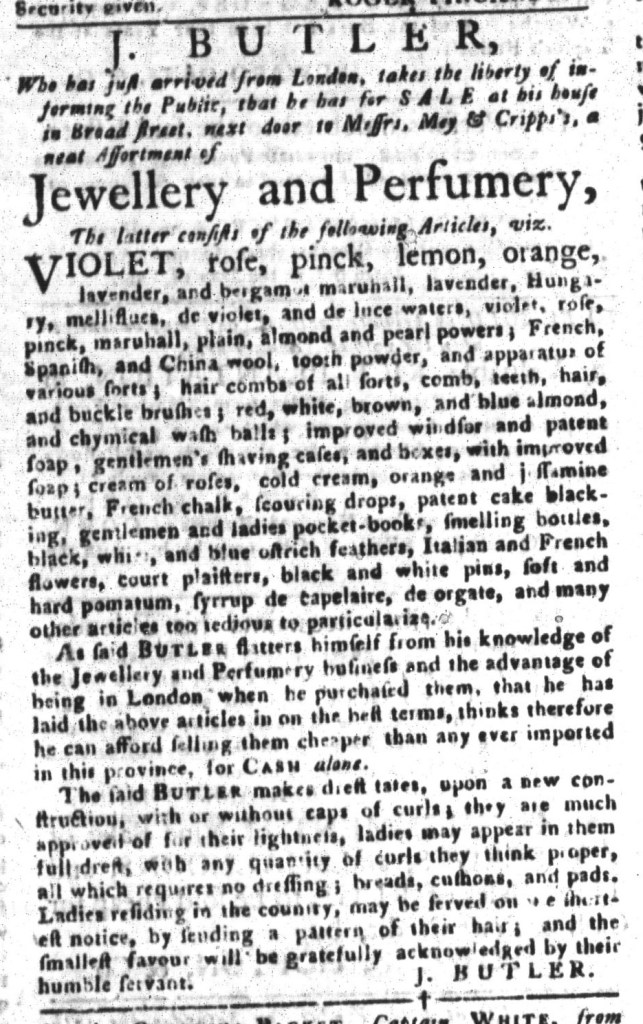
South-Carolina Gazette and Country Journal (November 8, 1774).

“He can afford selling them cheaper than any ever imported in this province.”

J. Butler’s advertisement in the November 8, 1774, edition of the South-Carolina Gazette and Country Journal proclaimed that he sold “Jewellery and Perfumery” at a shop he operated at his house on Broad Street in Charleston. Among the perfumery, he provided “VIOLET, rose, pinck, lemon, orange, lavender, and bergamot.” In addition, he listed a variety of personal hygiene products and cosmetics that he stocked, including “tooth powder, … hair combs of all sorts, … gentlemen’s shaving cases and boxes, with improved soap, … cold cream, [and] soft and hard pomatum.”  If that was not enough to attract consumers looking to pamper themselves, Butler also proclaimed that he carried “many other articles too tedious to particularize.”  Readers could cure their curiosity with a visit to Butler’s shop.

As further encouragement, he emphasized that he had “just arrived from London.”  Rather than accept merchandise shipped to him without first examining it himself, Butler had carefully examined and thoughtfully selected the wares he now advertised.  He considered that an “advantage,” especially in combination with “his knowledge of the Jewellery and Perfumery business,” that allowed him to acquire his inventory “on the best terms.”  In turn, he passed along the savings to his customers, asserting that “therefore he can afford selling [the above articles] cheaper than any ever imported in this province.”  According to Butler, he not only offered the best prices at that moment, but the best bargains for “Jewellery and Perfumery” ever seen in South Carolina thanks to savvy negotiations with suppliers when he was in London.

Butler was not alone in suggesting that his personal oversight in obtaining his wares accrued benefits to his customers.  Elsewhere in the same issue, Henry Calwell ran a short advertisement that announced he “just arrived from the Northward” and sold a “Large Quantity of Cheese, Chocolate, Potatoes, Onions,” and other groceries.  He added a note that “the Chocolate he warrants to be good, as he saw it made himself.”  Both Butler and Calwell sought to convince consumers that their personal connections to their merchandise should make those items more appealing.

February 1

What was advertised in a colonial American newspaper 250 years ago today?

South-Carolina Gazette and Country Journal (February 1, 1774).

“He intends having ready to open as soon as possible in the spring, an elegant assortment of Linen Drapery in all its branches, with a quantity of the most fashionable summer Silks.”

Z. Kinsley inserted a lengthy advertisement promoting the “large STOCK of DRY GOODS” available at his store in Charleston in the South-Carolina Gazette and Country Journal several times in the winter of 1773 and 1774. Unlike most advertisements that ran for several consecutive weeks before being discontinued, this one appeared sporadically in December and January. Kingsley even placed it once again on February 1, perhaps in a final effort to move his current inventory before making a trip to London.  He made it known throughout his advertising campaign that “he intends going for London the beginning of February.”  With that departure in mind, he sold his wares for cash (or “ready Money”) or “short Credit.”  He set attractive prices, marking up his costs only slightly (or what he and other advertisers called “a very low Advance”).  As much as possible, he hoped to clear out his store to make room for new goods that he would acquire on his trip.

The merchant apparently did not envision staying in London for too long.  In a nota bene, he declared that he “intends having ready as soon as possible in the spring, an elegant assortment of Linen Drapery in all its branches, with a quantity of the most fashionable summer Silks” and other items.  In addition to marketing an assortment of textiles, hardware, cutlery, and ironmongery already in stock, Kingsley encouraged consumers to anticipate his summer selections well before they arrived.  Like so many other advertisers, he declared that he imported his merchandise “in the very last Ships from England,” but he devised an innovation on that popular appeal by prompting prospective customers to imagine what he would carry in his store after his trip.  Months in advance, he attempted to persuade consumers to think of his store as the place to purchase “fashionable summer Silks” and other goods appropriate for the season before his competitors began a chorus of claims about importing the newest and most fashionable items via the vessels that most recently arrived in port.  In addition, readers realized that making a trip to London meant that Kinsley could eliminate the middlemen who drove up prices.  That meant another “very low Advance” when he presented that “elegant assortment of Linen Drapery” for sale in the spring.

Most merchants and shopkeepers focused on selling the wares they already had in stock.  Kinsley devoted significant space in his advertisement to doing so, but he did not stop there.  At various points throughout the winter, he urged consumers in Charleston to anticipate the merchandise that he would select during his trip to the cosmopolitan center of the empire where he would observe the latest fashions himself.  His marketing efforts incorporated both shopping in the present and shopping in the future, priming customers to visit his store when they needed or desired to purchase from among his spring and summer selections.