September 9

What was advertised in a colonial American newspaper 250 years ago today?
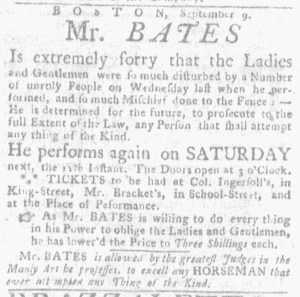
Massachusetts Gazette and Boston Weekly News-Letter (September 9, 1773).

“Mr. BATES Is extremely sorry that the Ladies and Gentlemen were so much disturbed by a Number of unruly People.”

Mr. Bates’s first performance in Boston did not go as well as he hoped.  Some sort of fracas interrupted his exhibition of feats of horsemanship, something significant enough to merit an advertisement in the Massachusetts Gazette and Boston Weekly News-Letter the day after that inaugural performance.  Bates declared that he was “extremely sorry that the Ladies and Gentlemen were so much disturbed by a Number of unruly People on Wednesday last when he performed.”  He also expressed dismay at “so much Mischief done to the Fence,” threatening “to prosecute to the full Extent of the Law, any Person that shall attempt any thing of the Kind” during subsequent performances.

Whatever disorder occurred at that performance may have worked to Bates’s advantage.  Residents of Boston likely gossiped about the disruption, spreading word about Bates’s show when they did so.  Some colonizers may have become more curious to attend the next performance, both to see Bates riding “One, Two, and Three HORSES,” as he promised in his previous advertisement, and to observe whether the crowd behaved or repeated the commotion from the first performance.  Watching the audience had the potential to provide as much entertainment as the show, a situation perhaps not lost on Bates.  After all, he collected revenue no matter what motivated Bostonians to purchase tickets.

To further encourage sales and attendance, Bates announced that he “lower’d the Price to Three Shillings each,” part of his commitment “to do every thing in his Power to oblige the Ladies and Gentlemen” of the town.  Just in case some readers had not yet heard of him and his reputation, either via newspaper advertisements or word of mouth, Bates concluded his advertisement with a summary of the introduction that he inserted in other newspapers earlier in the week.  He trumpeted, “Mr. BATES is allowed by the greatest Judges in the Manly Art he professes, to excel any HORSEMAN that ever attempted any Thing of the Kind.”  Like other itinerant performers, Bates resorted to superlatives to market his show, promising a spectacle that exceeded anything audiences could view in Boston or anywhere else.

July 9

What was advertised in a colonial American newspaper 250 years ago today?

Jul 9 - 7:9:1767 Pennsylvania Gazette
Pennsylvania Gazette (July 9, 1767).

“He finds it necessary to reduce the several Prices of his Work one third Part lower than formerly.”

Upholsterer John Mason placed an advertisement in the Pennsylvania Gazette when he significantly reduced the prices he charged for various services. His method for delivering this information, however, could have used a little refinement. Rather than focus on the deals that benefited prospective customers, Mason offered two other explanations for lowering his fees: “the Stagnation of Business and Scarcity of Cash.” While both of these factors prompted Mason to adjust his prices, neither of them placed customers at the center of Mason’s business model. Overcoming the “Stagnation of Business” was self-serving, hardly a fault for a tradesman trying to make a living but perhaps not the most artful way to frame his motivation fueling the business relationships he hoped to cultivate. He seemed to be saying that current conditions forced him to lower his fees rather than more graciously formulating this as a benefit intended specifically to advantage customers. Acknowledging the “Scarcity of Cash” made a nod toward the concerns of prospective clients. Many may have found themselves in a situation of not being able to afford to hire Mason at the former rates because they did not have access to sufficient cash. The reduced fees made the upholsterer’s services more obtainable.

Still, Mason underplayed the most important appeal in his advertisement. He noted that he had “reduce[d] the several Prices of his Work one third Part lower than formerly.” In other words, he knocked a tremendous 33% off his prices! Mason set about demonstrating this with a list of the fees he now charged for various services. He even encouraged prospective clients to compare “the above Prices with the Upholsterers Bills” (perhaps handbills distributed or posted by competitors), but this called for readers to expend additional effort to confirm a claim that he made only once rather than asserting it repeatedly and with greater force. Mason made his case, presenting a list of fees as evidence to support it, but the overarching message seems to have been overshadowed by the details. Mason may not have presented too much information, but that does not mean that he optimized the marketing potential associated with significant price reductions.

This critique may not be completely fair to an advertiser who operated within the conventions of eighteenth-century marketing practices. After all, his notice displayed a fair amount of innovation that distinguished it from others. However, it lacked other elements designed to attract attention and generate excitement. Mason opted for practical numbers instead of insistent proclamations about price reductions. He opted for substance over style, which may have better served potential customers in the end. Yet that decision demonstrates the chasm between advertising innovations in the eighteenth century and innovations that became standard practices in later centuries.