September 23

What was advertised in a revolutionary American newspaper 250 years ago today?

Virginia Gazette [Dixon and Hunter] (September 21, 1775).

“EVERY MAN HIS OWN DOCTOR.”

Like many other printers, John Dixon and William Hunter supplemented revenues from newspaper subscriptions, advertisements, and job printing by hawking patent medicines.  They ran an advertisement for “Dr. KEYS[E]R’s celebrated PILLS” in the September 23, 1775, edition of their newspaper, marketing a familiar remedy for “the Veneral Disorder.”  In addition to curing venereal diseases, the pills reportedly “restored Persons afflicted with dropsical Disorders, the Gravel [or kidney stones], Palsey, Apoplexy, White Swellings, Stiff Joints, and the Asthma.”

Yet, Dr. Keyser’s Pills were especially known for their efficacy in treating venereal disease, so much so that Dixon and Hunter offered a short history intended to assure prospective patients that they could depend on finding relief from their symptoms if they purchased the pills.  “His Majesty ordered the most rigid and nicest Examination, by twenty seven of the principal Physicians and Surgeons,” the printers reported.  They did so “not only immediately upon the Persons having been treated with the Medicine, but even for the Space of two Years afterwards, to see if the cures of all the numerous Patients were durable.”  This trail demonstrated that the pills were indeed effective: “to the eternal Honour of Dr. Keyser, there was not found a single Instance of Failure.”  Such an extraordinary outcome prompted the king to establish a hospital “where these Pills alone are administered.”  In addition, physicians on the continent had also “pronounced the Use of [Dr. Keyser’s Pills] superior in Efficacy, to all the Modes of Practice hitherto discovered.”

Beyond their effectiveness, the pills had another important advantage.  “EVERY MAN HIS OWN DOCTOR,” the headline proclaimed, echoing a similar headline, “Every One their own Physician,” that James Rivington, a printer in New York, previously used in promoting Dr. Keyser’s Pills.  Prospective customers, Dixon and Hunter suggested, could purchase the pills and use them without exposing themselves to the embarrassment of consulting a physician or, even worse, having their symptoms become visible to others.  “The Patient is most effectually cured,” the printers explained, “without any inconvenience to himself, or being exposed to the Shame or Confusion of his Disaster being known to the nicest Observer.”  Referring to “his Disaster” was a telling alternative to “his Disorder,” one intended to stoke anxiety in hopes of convincing readers afflicted with venereal disease to purchase Dr. Keyser’s Pills.  The printers conveniently acquired “a fresh Parcel lately from PARIS,” where the doctor’s widow continued making the pills.
November 15

GUEST CURATOR: Mary Williams

What was advertised in a colonial American newspaper 250 years ago today?

nov-15-11151766-providence-gazette
Providence Gazette (November 15, 1766).

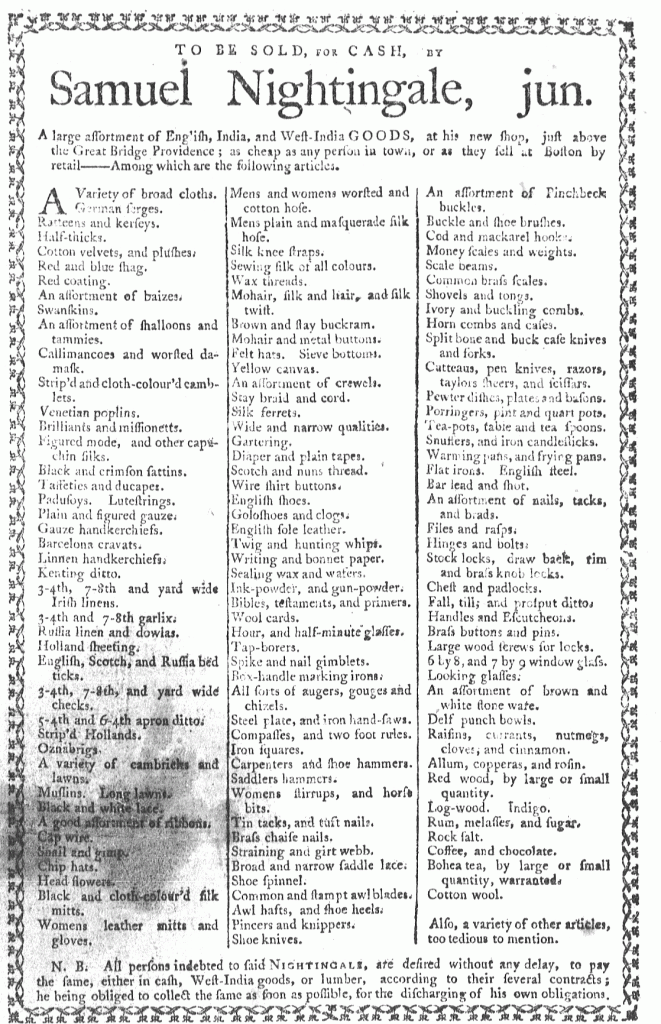
“TO BE SOLD, FOR CASH, BY Samuel Nightingale … Sealing wax and wafers.”

In this advertisement published in the Providence Gazette, Samuel Nightingale offered a wide assortment of goods in his “new shop.” Out of the many goods to choose to research, I decided to take a look at sealing wax and wafers.

Letters in colonial America were not placed into separate envelopes before being sent. Instead, the letters themselves were folded into hand-made envelopes and sealed closed with either sealing wax or wafers.[1] Using sealing wax involved melting a stick of wax over the folded letter with a candle. Before the wax dried, the writer pressed a stamp into the wax to form a seal. The process was messy and time consuming compared to the alternative method to seal letters: wafers. Wafers were pre-made seals that would stick to paper when they were wet.

Reading about the ways letters were sealed reveals a few issues of security and privacy involving mail in the colonies. In “The Meaning and Value of Privacy,” Daniel J. Solove writes, “In colonial America, mail was often insecure. Letters sealed only with wax, left many people concerned that they were far from secure.”[2] Solove goes on to say that Benjamin Franklin, who was a colonial postmaster general, required his post workers to take an oath that they would not open up other people’s mail. [3] We can infer from sealing wax and wafers that there was a certain lack of privacy that existed in the postal system in colonial America.

**********

ADDITIONAL COMMENTARY: Carl Robert Keyes

More than any other newspaper printers in the 1760s, Sarah Goddard and Company, the printers of the Providence Gazette, seem to have allowed advertisers to experiment with innovative graphic design. Goddard may have even suggested and encouraged innovative approaches to layout that distinguished individual advertisements from each other and her newspaper from others circulating in New England and beyond.

The Providence Gazette, established by William Goddard in 1762, ceased publication in May 1765. When it was resurrected by his mother in August 1766, issues almost immediately included oversized advertisements that spanned two columns and featured decorative borders. The Adverts 250 Project has already examined several of those advertisements, including notices by Thompson and Arnold and Benjamin and Edward Thurber and Samuel Nightingale, Jr. Although copies of Goddard’s Providence Gazette most certainly made their way to Boston and New York and beyond, neither advertisers nor printers in other cities were quick to adopt the unique layout that resembled a trade card superimposed on a page of the newspaper. Given that printers ultimately controlled the content and layout of their newspapers, it is possible that shopkeepers requested similar treatment for their advertisements only to meet resistance from printers who did not wish to disrupt the format of their publications.

Considering that the Providence Gazette was only recently revived and may not yet have had an extensive cohort of advertisers providing financial support for the endeavor, Goddard may have been more eager and willing to experiment with the graphic design elements of advertising as a means of filling space and possibly raising more interest among potential new advertisers. Whatever the reasons, advertisements of the type that Mary has selected for today appeared exclusively in the Providence Gazette during the summer and fall of 1766. Keep an eye open for next week’s entry featuring an advertisement from the Providence Gazette to see how Mary Goddard and Company and their advertisers continued to create attention-grabbing advertisements using innovative graphic design.

**********

[1] E. Jennifer Monaghan, Learning to Read and Write in Colonial America, (Amherst: University of Massachusetts Press, 2005), 284.

[2] Daniel H. Solove, “The Meaning and Value of Privacy,” in Social Dimensions of Privacy: Interdisciplinary Perspectives, ed. Beate Roessler and Dorota Mokrosinka (New York: Cambridge University Press, 2015), 75.

[3] Solove, “Meaning and Value of Privacy,” 76.