
What was advertised in a colonial American newspaper 250 years ago today?
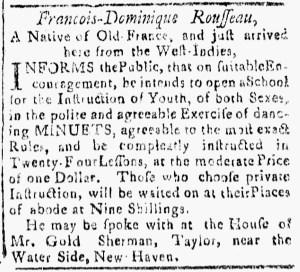
“A School for the Instruction of Youth … in the polite and agreeable Exercise of dancing MINUETS.”
Francois-Dominique Rousseau, a “Native of Old France,” arrived in New Haven by way of the West Indies in the summer of 1774. When he took up residence in the town, he placed an advertisement in the Connecticut Journal to inform the public that he “intends to open a School for the Instruction of Youth, of both Sexes, in the polite and agreeable Exercise of dancing MINUETS.” The dancing master further explained that he gave lessons “agreeable to the most exact Rules,” so his charges would be proficient when they completed their studies. Unlike other dancing masters who advertised in colonial newspapers, he specified how many lessons that would require, a total of twenty-four to be “compleatly instructed” for “the moderate Price of one Dollar.” For those who preferred private lessons rather than have their initial awkwardness on display in front of fellow students at the school, Rousseau offered to instruct them “at their Places of abode at Nine Shillings.”
The dancing master could have chosen to migrate to one of the largest urban ports, such as Boston or Charleston or Philadelphia, in search of a cosmopolitan clientele rather than take his chances in New Haven. Dancing masters frequently advertised in those cities. Yet Rousseau might have been confident that he would indeed find “suitable Encouragement” in New Haven. Perhaps he had even spoken with ship captains or merchants familiar with the town when they conducted business in the West Indies, getting a sense of his prospects before setting off for Connecticut. After all, other smaller towns in New England apparently had some demand for dancing masters. St. George de Viart and Edward Hackett, for instance, operated dancing academies and gave private lessons in New Hampshire. Viart had even left Portsmouth for Philadelphia, but returned to New England after a short time. He must have considered his prospects in the smaller town more favorable. Perhaps he faced too much competition from other dancing masters in the larger city. That could have been why Rousseau chose New Haven over New York. Just as the goods associated with the consumer revolution found their way to even the smallest towns in the colonies, not just major urban centers, so did admiration for the skill and gracefulness exhibited through genteel pastimes like dancing. Rousseau likely encountered prospective students just as eager for instruction in New Haven as any in larger cities.
