October 8

What was advertised in a revolutionary American newspaper 250 years ago today?
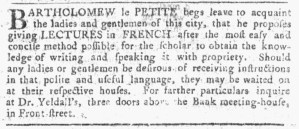
Pennsylvania Evening Post (October 8, 1776).

“He proposes giving LECTURES in FRENCH after the most easy and concise method possible.”

Francis Daymon had competition.  For years the “MASTER of the French and Latin Languages” taught “the useful and polite French language in the newest and most expeditious method” to genteel residents of Philadelphia, the most cosmopolitan city in British North America.  He operated and frequently advertised a “FRENCH ACADEMY,” first at his house on Front Street, “nearly opposite the London Coffee-House,” and later “in the Library Room in Carpenters Hall.”  In addition, he offered private lessons to “Ladies and Gentlemen” who wished to be “instructed at their places of abode.”  On October 5, 1776, he advised readers of the Pennsylvania Evening Post that “he continues to instruct gentlemen in the French language in the most expeditious method, agreeable to the late improvements of the French academy.”  Pupils could now find him “on the south side of Market-street, the fifth door below Fourth-street.”

Three days later, Bartholomew le Petite ran his own advertisement in the Pennsylvania Evening Post, addressing the same readers who recently perused Daymon’s notice.  Le Petite informed “the ladies and gentlemen of this city, that he proposed giving LECTURES in FRENCH after the most easy and concise method possible for the scholar to obtain the knowledge and propriety of writing and speaking it with propriety.”  After all, those seeking to deploy their familiarity with the “polite and useful language” to demonstrate their sophistication wished to avoid the embarrassment of clumsy execution that would mark them as pretenders rather than truly genteel.  Le Petite did not make any mention of “the French academy” on the other side of the Atlantic, choosing not to burnish the same sort of credentials that Daymon so often incorporated into his advertisements.  Instead, he focused on making his lessons as accessible as possible via his “most easy and concise method.”  That may have been an attractive prospect to new students as well as students who had been frustrated when receiving lessons from Daymon or others.  Le Petite’s methods might prove the most effective.

Whether learning French for the first time, seeking to expand their vocabulary and improve their pronunciation, or desiring to brush up on their skills, students could compare advertisements from two instructors published within days of each other.  Those advertisements did more than merely announce that French lessons were available.  They played a role in guiding students to the instructors so they could make informed decisions about which one they wished to hire.

November 5

What was advertised in a revolutionary American newspaper 250 years ago this week?

Pennsylvania Evening Post (November 4, 1775).

“A NIGHT SCHOOL.”

“FRENCH ACADEMY.”

Two advertisements in the November 4, 1775, edition of the Pennsylvania Evening Post and its supplement offered opportunities for learning and self-improvement.  In the first notice, Matthew Maguire announced that he had opened a “NIGHT SCHOOL” for “youth of both sexes.”  The curriculum included “the various branches of READING, WRITING and ARITHMETIC,” subjects that both boys and girls typically learned.  Maguire also indicated that he taught “ACCOMPTS [or accounts] in all their different forms, after the latest and most approved methods,” though he did not mention whether he reserved that subject for male students.  Learning how to keep daybooks and ledgers may have been useful for some of the girls and young women who attended Maguire’s school, especially those that attended in the evening because they assisted in running the family business during the day.  Maguire also provided lessons during the day “as usual,” but he specified in a nota bene that he continued admitting “Young ladies only.”  In addition to giving female students a homosocial setting with fewer chances of disruptions, he may he reasoned that most boys and young men who would attend the school he kept in his house in Carter’s Alley did indeed have apprenticeships and other responsibilities during the day.

Supplement to the Pennsylvania Evening Post (November 4, 1775).

In the other advertisement, Francis Daymon, “MASTER of the French and Latin Languages” and “LIBRARIAN of the Philadelphia Public Library” (or the Library Company of Philadelphia), advised prospective pupils that he “HAS opened his FRENCH ACADEMY for the winter season.”  Classes began “punctually at seven o’clock every evening (Saturday excepted),” though it went without saying that he did not give lessons on Sundays.  Daymon delivered lessons “in the Library Room in Carpenters Hall,” the Library Company having moved to the second floor of that building from the Pennsylvania State House when it was completed in 1773.  He presumably admitted students of both sexes since he did not indicate otherwise in his advertisement.  He did note that “Ladies and Gentlemen may be instructed at their places of abode as usual,” an arrangement that allowed his pupils or their parents to determine who would be present.  Unlike Maguire, Daymon offered private lessons, likely setting rates for his students for the convenience of learning in their homes accordingly.

While some of the students who learned reading, writing, arithmetic, and accounts from Maguire could have also sought out French lessons from Daymon, the two schoolmasters cultivated different clienteles.  Maguire emphasized basic skills for everyday use by a wide range of colonizers, while Daymon’s French lessons appealed to genteel residents of Philadelphia and those aspiring to gentility.  With the Continental Association, a nonimportation and nonconsumption agreement, in effect, discourses about fashion had shifted.  Learning French gave some colonizers an alternate way to assert their status.

September 5

What was advertised in a colonial American newspaper 250 years ago today?

Pennsylvania Journal (September 5, 1771).

“The French academy.”

Francis Daymon, “Master of the FRENCH, LATIN,” placed newspaper advertisements to offer his services as a tutor to the “ladies and gentlemen” of Philadelphia.  His notice in the September 5, 1771, edition of the Pennsylvania Journalfocused primarily on teaching French.  Daymon declared that he taught “the useful and polite French language in the newest and most expeditious method.”  Furthermore, he utilized techniques “agreeable to the latest improvements of the French academy.”  He made these claims in order to convince prospective students that he provided effective instruction that incorporated methods approved by authorities in his field.

Daymon offered lessons in two settings.  Students could “choose to be instructed at their respective places of abode” during the day or they could “choose to attend his regular class” in the evenings.  He described that class as the “French academy,” though his students gathered at his house across the street from the London Coffee House on Front Street.  Those lessons had already commenced, but the tutor welcomed newcomers.  He had not yet booked private lessons during the day, but encouraged prospective students who desired individual instruction “speedily to apply” in order to hire his services “at convenient hours.”

In addition to lessons, Daymon also offered to sell books to his pupils.  Most schoolmasters and tutors did not mention that sort of ancillary service in their newspaper advertisements.  Daymon, on the other hand, devoted a nota bene to informing readers that “received by one of the last ships from London, a choice collection of French, &c. books, very suitable for his scholar.”  In addition, he expected another three hundred volumes to arrive soon via another vessel.  Prospective students did not need to visit booksellers seeking out books appropriate for Daymon’s curriculum.  Instead, he acquired and sold them as a convenience, one that made his lessons even more accessible for his scholars.

In his efforts to cultivate a clientele, Daymon promoted his methods of instruction, offered lessons in multiple settings to suit the preferences of his students, and supplied texts (at an additional fee) to aid his pupils in their studies.  He promoted these various resources so prospective students could envision successful language acquisition if they gave the French tutor a chance.