November 26

What was advertised in a colonial American newspaper 250 years ago today?
Providence Gazette (November 26, 1774).

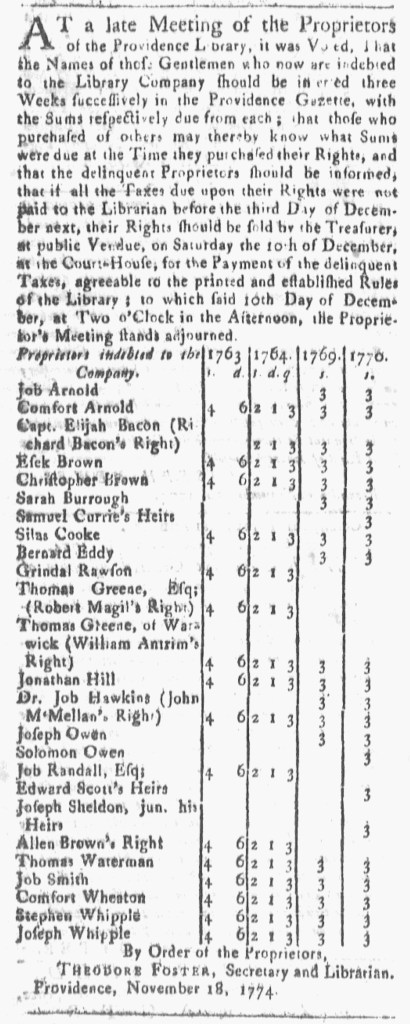
“Names of those Gentlemen who are now indebted to the Library Company should be inserted … in the Providence Gazette.”

The Providence Library Company, a private subscription library, conducted some of its business in the public prints in the eighteenth century.  Early in the fall of 1774, Theodore Foster, the librarian, ran an advertisement in the Providence Gazette, requesting that “All Persons … who have any Books belonging to the Library … return the same immediately” so they could be “examined and numbered.”  In addition to conducting an inventory of the collection, the librarian was “ready to settle with the delinquent Proprietors” who had not paid their subscriptions.

At the end of November, Foster published a new advertisement in the wake of a vote at a recent “Meeting of the Proprietors.”  They had decided that “the Names of those Gentlemen who are now indebted to the Library Company should we inserted three Weeks successively in the Providence Gazette, with the Sums respectively due from each.”  That list consisted of more than two dozen subscribers, most of them with debts going back more than a decade.  The proprietors in good standing determined that the grace period had extended long enough.  Accordingly, the advertisement also informed the delinquent subscribers that if they did not make payment before December 3 then “their Rights should be sold by the Treasurer” at a public auction on December 10.  They took that action “agreeable to the printed and established Rules of the Library.”  The advertisement first ran on November 19 and again on November 26.  It made its final appearance on December 3, the deadline for settling accounts.  Perhaps Foster offered a little more leeway, provided subscribers paid before the auction on December 10, but the advertisement made clear that overdue subscriptions would be addressed, one way or another, “By Order of the Proprietors.”  Their next meeting was scheduled for the day of the auction, an opportunity to assess the outcome of their efforts to get everything in good order.

As was often the case, advertisements like this one relayed local news to the readers of the Providence Gazette.  John Carter, the printer, selected which news and editorials to publish elsewhere in the newspaper, yet purchasing advertising space gave individuals and organizations opportunities to become editors who decided on some of the information presented to the public.
October 8

What was advertised in a colonial American newspaper 250 years ago today?

Providence Gazette (October 8, 1774).

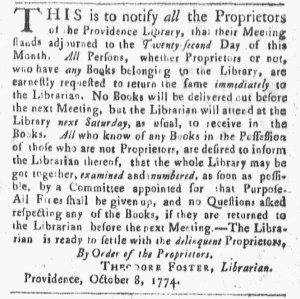
“The whole Library may be got together, examined and numbered, as soon as possible.”

Advertisements published in the Providence Gazette reveal some of the work undertaken in administering the Providence Library Company.  In 1753, prominent residents founded this subscription library, believing that “a Collection or Library of Usefull and Edifying Books will most certainly tend to the Benefit and Instruction of the Inhabitants of this Town and County of Providence and the Rising Generation thereto belonging.”  Two decades later, Theodore Foster held the post of librarian.  He took to the pages of the Providence Gazette to address “all the Proprietors” as well as “All Persons, whether Proprietors or not, who have any Books belonging to the Library.”  Foster instructed all of them to return their books “immediately.”

The librarian apparently intended to conduct an inventory of the collection.  He informed the public that “No Books will be delivered out before the next Meeting, but the Librarian will attend at the Library next Saturday, as usual, to receive in the Books.”  Furthermore, he sought to enlist the aid of others in successfully pursuing this project: “All who know of any Books in the Possession of those who are not Proprietors, are desired to inform the Librarian thereof.”  Foster intended to be complete and comprehensive, working with a committee tasked with “examin[ing] and number[ing]” the “whole Library … as soon as possible.”  Gathering the entire collection together was more important than assessing fines for overdue books or investigating where any of the books had been.  “All Fines shall be given up,” Foster declared, “and no Questions asked respecting any of the Books, if they are returned to the Librarian before the next Meeting.”  As an aside, Foster noted that he “is ready to settle with delinquent Proprietors” who had not paid their subscription fees.

The Providence Library Company had compiled and published a Catalogue of All the Books Belonging to the Providence Library as well as Rules for Governing the Proprietors of, and Institutions for Rendering Useful the Books Belonging to the Providence Library in 1768.  The Rules, adopted in 1762, outlined the procedures for borrowing books and the duties of the librarian.  They also specified that that a “Catalogue of all the books belonging to the Library be fairly written in the Register, in alphabetical order, … care being taken to leave Room under each Letter for inserting such Books, as may hereafter be purchased.”  Despite those best intentions, the librarian and the proprietors apparently considered a careful and complete inventory necessary to assess the status of the library’s holdings.  Beyond the annual meeting for the proprietors, Foster resorted to a newspaper advertisement to reach anyone who had information about any books belonging to the library.

September 2

What was advertised in a colonial American newspaper 250 years ago today?

Sep 2 - 9:2:1769 Providence Gazette
Providence Gazette (September 2, 1769).

“The PROPRIETORS of the Providence LIBRARY are hereby notified to meet.”

David S. Rowland was elected and served as librarian for the Providence Library Company (founded 1753) in the late 1760s and early 1770s. Late in the summer of 1769, he placed advertisements in the Providence Gazette to notify “PROPRIETORS of the Providence LIBRARY” of a meeting scheduled for September 4. He also published an outline of the agenda. The proprietors would gather “to concert Measures for the necessary Repairs of said Library, and to conclude whether or not Provision shall be made for the annual Enlargement of the Library, and transact other Affairs relative to its Wellbeing.”

All of this business was to be undertaken by the proprietors for the benefit of members of the Providence Library Company. The “Providence LIBRARY” was not open to the general public; instead members paid annual subscriptions for the privilege of using the library. Those subscriptions paid for the “Repairs,” “Enlargement” of the collection of books, and “other Affairs” that Rowland mentioned in his advertisement. The Providence Library Company was not alone in adopting this model for its operations. Indeed, this was standard practice for early American libraries, including the Library Company of Philadelphia (1731), the Company of the Redwood Library (Newport, 1747), the Charleston Library Society (1748), and the New York Society Library (1754).

The annual fees distinguished these subscription libraries, as they are known, from modern public libraries that open their doors to all users free of charge. Subscription libraries were not supported by the local municipalities for the benefit of all colonists, but rather by associations of readers and members who saw to their affairs and gained access only after pledging financial support. Many subscription libraries founded in the colonial era continue to operate today as research libraries patronized by scholars and others interested in early American history and culture. The Providence Library Company continues as the Providence Athenæum, incorporated in 1836. The new Providence Athenæum acquired the collections of both the Providence Library Company and an earlier Providence Athenæum (1831).

March 14

GUEST CURATOR: Daniel McDermott

What was advertised in a colonial American newspaper 250 years ago today”

Mar 14 - 3:14:1767 Providence Gazette
Providence Gazette (March 14, 1767).

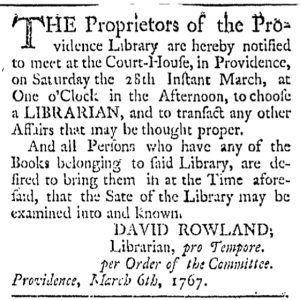
“THE Proprietors of the Providence Library are hereby notified to meet at the Court-House.”

David Rowland, “Librarian, pro Tempore,” placed this advertisement to notify “Proprietors” of the Providence Library Company (founded 1753) that a meeting was planned to elect a new Librarian on March 28. The advertisement also notified anyone who had books belonging to the library to return them.

The greatest change in libraries over time has been to access by general readers. Today, most town libraries are open to the public but require a library card to access their collection. These are the libraries used by most person. In eighteenth-century America, access to libraries was more restricted because most were based on a monthly or yearly paid membership.

According to William Burns, the two most popular types of libraries in the eighteenth century were circulating libraries and subscription libraries. Circulating libraries had lower subscription fees, paid weekly to borrow books. Subscription libraries normally had higher membership rates and were associated with reading societies.

The Junto, Benjamin Franklin’s discussion group in Philadelphia, created one of the most famous subscription libraries. It still exists today as the Library Company of Philadelphia. By the middle of the nineteenth century, the library was one of the five largest in the United States. The Library Company of Philadelphia is a good example of how libraries are valued in our society: some last multiple centuries. Over time, other libraries that give open access to the public have joined them. Although Americans did not expect to find libraries open to all in the eighteenth century, many valued libraries and the access to knowledge and entertainment they provided.

**********

ADDITIONAL COMMENTARY: Carl Robert Keyes

Printers and booksellers frequently advertised their wares in eighteenth-century newspapers, sometimes listing dozens of titles, sometimes promoting a particular book, and sometimes seeking subscribers as a means of gauging interest in books they intended to publish (provided the public responded with sufficient demand in advance). A reading revolution took place in the eighteenth century as consumers purchased greater numbers of books and their reading habits shifted from intensive reading of bibles, devotional texts, and almanacs to extensive reading from an array of genres.

The reading revolution also included the founding of private lending libraries by civic organizations, including the Library Company of Philadelphia (1731), the Charleston Library Society (1748), and the Providence Library Company (1753). Daniel has already provided a brief sketch of two models for operating libraries – subscription libraries and circulating libraries – that gave colonists greater access to books than most would have been able to purchase on their own.

As Daniel notes, subscription libraries and circulating libraries charged different rates to access their collections. In exchange for paying the fees, readers received different benefits. Members of subscription libraries paid annual fees for unlimited borrowing privileges, giving them broad access to the library company’s collections. Nonsubscribers could also borrow books, paying variable fees based on the size of the book (the dimensions of the pages – folio, octavo, duodecimo – not the length of the text) and the length of time they kept the book. On the other hand, circulating libraries did not usually have annual subscription fees. Instead, they charged by the week, which allowed patrons to keep expenses down by choosing how often to check out books. Circulating libraries also limited access to one book at a time.

Circulating libraries facilitated the reading revolution. A significant aspect of the shift from intensive to extensive reading involved the rise of the novel and reading for pleasure, especially by women. Subscription libraries tended not to obtain novels, but, as William Burns notes, novels “were the lifeblood of the circulating library.” Furthermore, “women comprised about half the membership of the circulating libraries,” but subscription libraries did not admit female readers (though that did not prevent men from checking out books for female relatives and friends).

Despite differences in membership, collections, and operating structure, both subscription libraries and circulating libraries emerged exclusively in cities in the eighteenth century, pointing to another important distinction between libraries then and now. Daniel notes that public libraries operated by local municipalities have greatly expanded access to information and services. Organizations like the Providence Library Company played an important role in that process as they allowed early Americans greater access to books than they previously experienced.