June 9

What was advertised in a colonial American newspaper 250 years ago today?
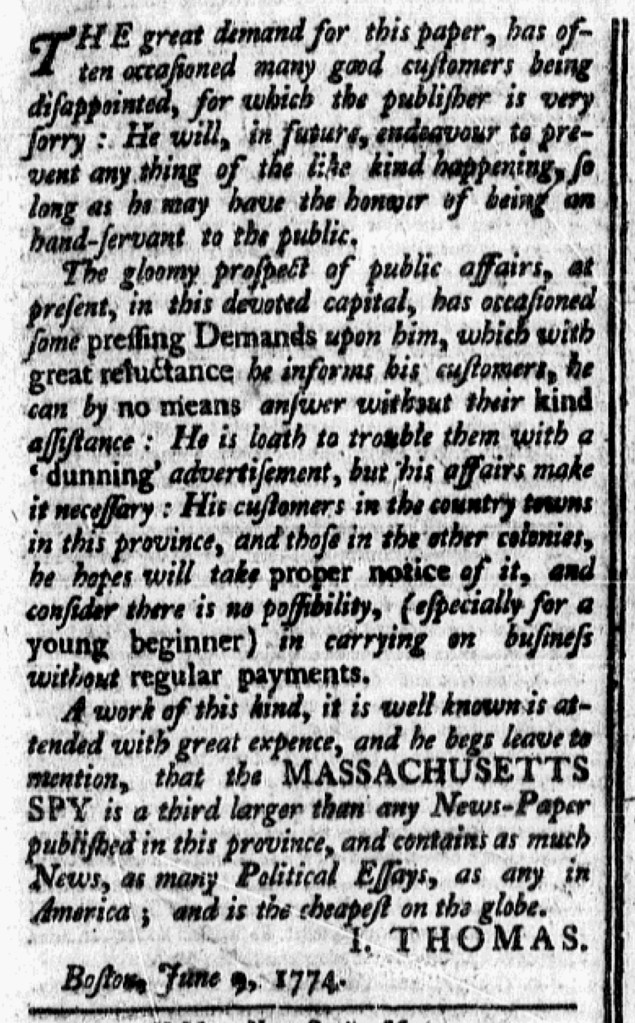
Massachusetts Spy (June 9, 1774).

Contains as much news, as many Political Essays, as any in America.”

Printers and other entrepreneurs often published notices calling on customers and associates to settle accounts.  Isaiah Thomas, the printer of the Massachusetts Spy, did so in June 1774, though he confessed that he “is loath to trouble them with a dunning advertisement.”  Still, “his affairs make it necessary.”  Many printers threatened legal action against those who did not submit payment, but Thomas opted for a different strategy.  His “‘dunningadvertisement” focused primarily on the service to the public he provided in publishing the Massachusetts Spy, especially considering the “gloomy prospect of public affairs, at present.”  Readers knew, of course, that he referred to the Boston Port Act that initiated a blockade of the harbor and halted trade at the beginning of the month as well as a series of troubling events over the past decade.

Zechariah Fowle and Thomas commended publishing the Massachusetts Spy in July 1770, four months after the Boston Massacre.  At the age of twenty-one, Thomas became the sole proprietor just a few months later.  In the four years that the newspaper had been published, the young printer sought to establish its reputation in Boston and beyond.  When he asked subscribers to pay what they owed, he underscored that “the MASSACHUSETTS SPY is a third larger than any News-Paper published in this province.”  That distinguished it from the Boston Evening-Post, the Boston-Gazette, the Massachusetts Gazette and Boston Post-Boy, and the Massachusetts Gazette and Boston Weekly News-Letter as well as the Essex Gazette, published in Salem, and the Essex Journal, published in Newburyport.  At the time, no other city or colony had as many newspapers, which meant that Thomas faced significant competition for subscribers and advertisers. Furthermore, Thomas’s newspaper “contains as much News, [and] as many Political Essays, as any in America,” making it a valuable resource for readers far and wide.  Thomas also asserted that the Massachusetts Spyis the cheapest on the globe,” making it a good value that merited support (and payment) from readers.

In return for “the honour of being an hand-servant to the public,” Thomas requested the “kind assistance” of his customers.  He asked that they “take proper notice” of his appeal, warning that “there is no possibility … in carrying on business without regular payments.”  The June 9 edition of his newspaper featured extensive coverage of the “PROCEEDINGS in the HOUSE of COMMONS” from April, including an “Authentic account of Tuesday’s Debate on the Motion for repealing the Tea-Duty in America,” and editorials “To the FREE and BRAVE AMERICANS” from “AN AMERICAN” and “To the ADRESSERS of the late Governor HUTCHINSON” from “A MODERATE MAN.”  Thomas compiled and circulated such news and opinion as a service, but could not afford to continue that endeavor without receiving subscription fees from his customers.  Rather than an explicit threat to take them to court to force them to pay what they owed, Thomas made a much more subtle insinuation about what they would lose if they did not settle accounts.  By his accounting, no other newspaper compared to the Massachusetts Spy.
March 30

What was advertised in a colonial American newspaper 250 years ago today?

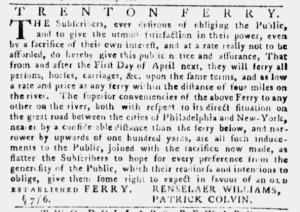
Pennsylvania Gazette (March 30, 1774).

“The superior conveniencies of the above Ferry.”

Rensselaer Williams and Patrick Colvin provided a public service.  At least that was how they wanted prospective clients to think about the “TRENTON FERRY” that they operated.  They opened their advertisement in the March 30, 1774, edition of the Pennsylvania Gazette with a declaration that they were “ever desirous of obliging the Public, and to give the utmost satisfaction in their power.”  To that end, they even set prices (or so they claimed) “by a sacrifice of their own interest, and at a rate really not be afforded.”  Williams and Colvin hoped such proclamations would attract attention in advance of opening for business on “the First Day of April next.”

At that time, they pledged to “ferry all persons, horses, [and] carriages” at “as low a rate and price as any ferry within four miles on the river.”  They certainly had in mind unnamed competitors that they expected were already familiar to prospective clients.  To make their service even more attractive, Williams and Colvin asserted that the “superior conveniencies” of their ferry compared to “any other on the river” included “its direct situation on the great road between the cities of Philadelphia and New-York,” a well-travelled corridor between the two largest cities in British mainland North America.  They emphasized that their location was “nearer by a considerable distance than the ferry below,” once again alluding to the competition.  Prospective clients might even consider passage on Williams and Colvin’s ferry faster and safer since the Delaware River was “narrower by upwards of one hundred yards” at their location.

This advertisement, along with others for ferries and stages, helps in mapping the transportation infrastructure in place in the colonies on the eve of the American Revolution.  Advertisements for almanacs frequently included descriptions of roads among the contents of those annual volumes.  Rather than relying on maps as they traveled from place to place, colonizers instead took into account general knowledge acquired through word of mouth as well as printed sources that included newspaper advertisements and almanacs.  Williams and Colvin certainly anticipated that merchants, travelers, and others would share with others what they read about the “TRENTON FERRY,” what they heard about it, and their own experiences hiring the service.

December 30

What was advertised in a colonial American newspaper 250 years ago today?

Pennsylvania Gazette (December 30, 1772).

“The threatening destruction of orchards by catterpillars.”

Rudolph Hains and Jacob Hains operated a tree nursery “near the Red Lion, in Uwchland township, Chester county,” about twenty-five northwest of Philadelphia, in the early 1770s.  In an advertisement in the December 30, 1772, edition of the Pennsylvania Gazette, they related their story of having “for many years past, followed the business of raising young apple-trees, of grafted fruit, of divers sorts, for sale.”  Throughout that time, they “planted many orchards, both for themselves and others.”

Yet the Hains did not place this notice merely to make a sale pitch.  Instead, they framed it as a public service announcement, stating that through their long experience they “found that Catterpillars are some of the worst enemies to Orchards.”  Indeed, the headline for the advertisement proclaimed, “To DESTROY CATTERPILLARS,” inviting readers to peruse it for advice and guidance.  Along the way, prospective customers learned a little more about the Hainses and their business, including Rudolph’s nearly thirty years of experience.  In telling their story, the Hainses warned that “they find a far greater number of [caterpillar] eggs this fall, than either of them ever seen before.”  The problem was so severe that just days earlier Rudolph “gathered upwards of 300 of such Lumps of Eggs” in his orchard in the course of just a few hours.  As a result of a widespread infestation, the Hainses anticipated that “much more damage will be done by them next summer, if not by some means prevented.”  As a remedy, they recommended that readers “pull or cut off their eggs with some instrument for that use … and burn them.”  This required inspecting trees, but the eggs “are easy to be seen sticking on the small limbs of the tree.”

The Hainses offered this advice “for the good of the public” in general as well as for “their customers in particular, who have bought trees of them, or may yet buy.”  There the sales pitch became more blatant.  The Hainses announced that they “purpose to continue said business.”  This public service announcement enhanced their visibility to prospective customers.  It also suggested that customers could depend on an additional service, consultation and advice from the Hainses beyond the initial transaction.  The Hainses concluded their advertisement by asserting that “they thought it their duty to publish this” in order to avoid “the threatening destruction of orchards by catterpillars.”  They invited readers to contact them directly for more information, while also noting that a “sample of the EGGS maybe seen at the New Printing-Office, in Market-street,” where the newspaper that carried the advertisement was published.  This notice served the interests of the entire community.  The Hainses, savvy marketers, hoped that their public service announcement would generate customers for their tree nursery.

August 11

What was advertised in a colonial American newspaper 250 years ago this week?

Massachusetts Gazette and Boston Weekly News-Letter (August 8, 1771).

“The first Person that ever set up, and regularly maintain’d a Stage Carriage in New-England.”

John Stavers was not pleased when a competitor set up stagecoach service between Boston and Portsmouth in 1771.  In July, he placed an advertisement in the New-Hampshire Gazette to promote his “Stage-Coach, Number One,” proclaiming that “several Years” experience of transporting passengers, mail, and newspapers meant that his drivers provided superior service.  Stavers also suggested that the “Difficulty, Expence, Discouragements, and very little, if any profit” associated with operating the stagecoach for so many years meant that the public should “give his Coach the Preference” over a newcomer “big with Importance” yet lacking experience.

He placed a similar advertisement in the Massachusetts Gazette and Boston Weekly News-Letter, hoping to draw the attention of prospective passengers at the other end of the line.  Stavers declared that he “was the first Person that ever set up, and regularly maintain’d a Stage Carriage in New-England.”  Regardless of the weather and other conditions, operations continued “at all Seasons” for a decade.  In recognition of both the “Marks of Approbation” he received from prior clients and the “Utility” of the service he provided, he stated that he “therefore humbly hopes that his Carriages will still continue to be prefer’d to any other, that may set up in Opposition to them.”  For those who needed more convincing, Stavers asserted that “his Carriages are universally allow’d to be as convenient, genteel, and easy, and his Horses as good (if not better) than any that have as yet travelled the Road.”  In addition, he promised that “the greatest Care will be taken of all Bundles and Packages.”  For passengers who needed food and lodging upon arriving in Portsmouth, Stavers offered “Good Entertainment at the Earl of Halifax Tavern … equal to any on the Continent,” including any in Boston.  Stavers also listed prices for transporting passengers “in the most genteel and expeditious Manner” from Boston to Portsmouth and Boston to Newburyport so prospective customers could compare rates if they wished.

Stavers never named his competitor in either advertisement, but he did make it clear that he believed his experience resulted in better service for passengers traveling between Boston and Portsmouth.  In addition, he apparently felt that the investment he made operating a stagecoach along that route entitled him to the patronage of travelers who might otherwise choose his rival.  He deployed a carrot-and-stick approach in his marketing efforts, alternating between the describing the benefits associated with his coaches and constructing a sense of obligation for selecting his services.

July 19

What was advertised in a colonial American newspaper 250 years ago today?

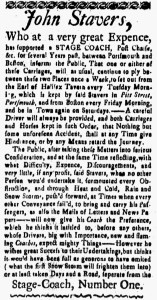
New-Hampshire Gazette (July 19, 1771).

“Stage-Coach, Number One.”

John Stavers faced competition for clients … and he did not appreciate it.  In the late 1760s and early 1770s, Stavers operated a stagecoach between Portsmouth and Boston.  For a time, he enjoyed a monopoly on the route, but he tried to convince the public that did not necessarily amount to an unfair advantage.  Instead, Stavers contended, he provided an important service to the community “at a very great Expence” to himself when no one else did.  In an advertisement in the July 19, 1771, edition of the New-Hampshire Gazette, he asked prospective customers to take into account the “Difficulty, Expence, Discouragements, and very little, if any profit” he experienced “when no other Person would undertake” the route.  He did so in service not only to his passengers but also to deliver “the Mails of Letters and News Papers.”

Stavers depicted that as a heroic effort.  His stagecoach had already “surmounted every Obstruction, and through Heat and Cold, Rain and Snow Storm, push’d forward, at Times when every other Conveyance fail’d.”  Regardless of any kind of difficulty, his operation previously ran like clockwork … and would continue to do so.  The stagecoach set off from Stavers’s tavern in Portsmouth on Tuesday morning and departed Boston for the return trip on Friday mornings.  Stavers hired a “careful Driver” and kept the carriage and horses “in such Order, that Nothing bit some unforeseen Accident, shall at any Time give Hindrance, or by any Means retard the Journey.”  Through experience, Stavers was prepared for any obstacle.

Accordingly, he felt “intitled to” the patronage of travelers now that he faced an upstart who challenged him for business.  Stavers requested that the public “now give his Coach the Preference” rather than hire a competitor “whose Drivers, big with Importance, new and flaming Coaches, expect mighty Things.”  Stavers made clear that he did not believe the competition could live up to its promises, especially in the face of “the first Snow Storm” when the seasons changed. Moreover, he felt annoyed that his rival plied the same route and schedule.  Stavers feigned best wishes for the competition, but simultaneously declared his enterprise “Stage-Coach, Number One,” seeking to establish a ranking to influence prospective clients.  Simultaneously, he asked those prospective clients to take his past successes and sacrifices into consideration when choosing which stagecoach service to hire for trips between Portsmouth and Boston.