March 10

What was advertised in a revolutionary American newspaper 250 years ago this week?

Constitutional Gazette (March 9, 1776).

“The surest means to acquire a speedy sale … is to make them of full quality at a moderate charge.”

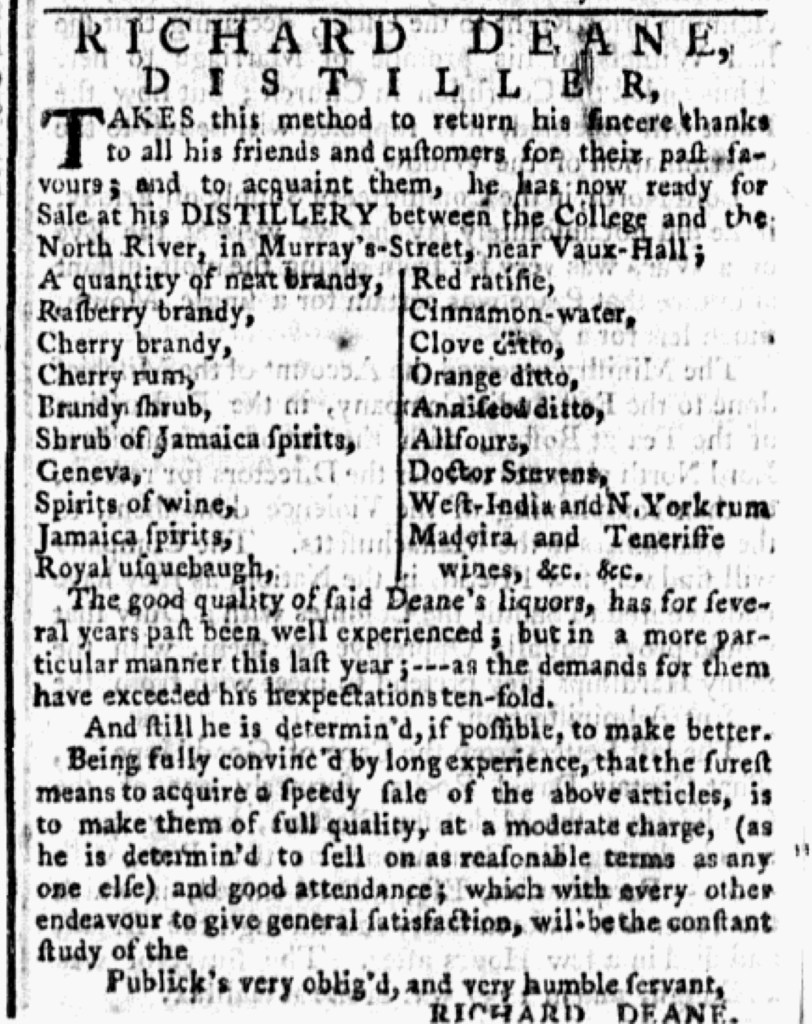
In March 1776, Richard Deane, a distiller in New York, took to the pages of the Constitutional Gazette to promote the spirits that he “has now ready for sale at his distillery between the College and the North Rover, in Murray Street, near Vaux-Hall.”  He listed a variety of products, including “Cherry Brandy,” “Shrub of the best quality,” “Royal Usquebaugh,” and “Cinamon water.”  Deane expressed confidence in the reputation his spirits earned in the early 1770s.  “The good quality of said DEANE’s liquors,” he proclaimed, “has for several years past been so well experienced, mostly throughout this continent, that they need no other recommendation.”  Consumers far beyond New York, he suggested, had enjoyed the spirits produced at his distillery.  Not content to rest on his laurels, however, Deane declared that “still he is determined, if possible, to make better.”  If customers liked the liquors he previously produced, then they would be even more satisfied with his current and future endeavors.

As part of this promotion, Deane shared his business philosophy, an aspect of his marketing that may have been familiar to readers who had encountered his advertisements in the New-York Gazette and Weekly Mercury and the New-York Journal over the years.  “Being fully convinced by long experience,” the distiller confided, “that the surest means to acquire a speedy sale of the above articles, is to make them of full quality at a moderate charge.”  Accordingly, he was “determined to sell on as reasonable terms as any one else” and give “good attendance” or customer service to “all his Friends and Customers.”  Such pledges became more powerful through repetition.  Deane built his brand by publishing his business philosophy often so consumers would associate the combination of experience, quality, and reasonable prices with him and his distillery.  He apparently considered it an effective marketing strategy since he published advertisements with the same content in multiple newspapers over the course of several years.

April 16

What was advertised in a colonial American newspaper 250 years ago this week?

Rivington’s New-York Gazetteer (April 13, 1775).

“Being fully determined not to be undersold by any person whatever.”

A “NEW ADVERTISEMENT BY RICHARD DEANE, Distiller,” ran in the April 13, 1775, edition of Rivington’s New-York Gazetteer.  Even though it had a dateline from two months earlier, “Feb. 10, 1775,” and had been running for several weeks, it still merited being called a “NEW ADVERTISEMENT” because it displaced another advertisement that Deane regularly placed in New York’s newspapers for many months.

The distiller took to the pages of the newspaper with some fanfare to inform “the public, my friends and customers” that he would not be undersold by any of his competitors who marketed their own “brandy, Geneva, and cordials.”  He believed that he had lost some customers to other distillers, prompting him to proclaim that he “can afford to sell said liquors on as cheap terms as any others can theirs, of an equal quality.”  Moreover, he deserved special consideration because “it cannot be denied, that I was the first distiller that ever made brandy and geneva, for sale in this province, … introducing a business, whereby the country saves annually large sums of money, that must otherwise have gone to foreign parts.”  Consumers should purchase his liquor, he asserted, to support local industry and, especially, the entrepreneur who took the risk of establishing the trade in the colony.  In turn, they could depend on what they spent supporting the local economy.

At the same time, Deane made appeals to quality.  He declared that even though he lowered his prices considerably, he still made “brandy and geneva of a full quality, and a high proof, as usual.”  He also pledged that he would not “diminish the goodness of my cordials, in any respect whatever.”  Furthermore, the “great demand for my liquors in most parts of North-America … is sufficient proof of their excellence.”  Consumers should trust existing customers, the distiller reasoned.  To encourage them to do so, he offered a price match guarantee.  He listed the prices the prices per gallon of brandy, gin, and several cordials, but also declared “that if any other person sells liquors of an equal quality with mine, cheaper than the rates underneath, I will immediately sell at the same price, being fully determined not to be undersold by any person whatever.”  Deane recognized that he lost customers because other set lower prices, but he aimed to win them back and gain new ones in the process.

April 4

What was advertised in a colonial American newspaper 250 years ago today?

New-York Gazette and Weekly Mercury (April 4, 1774).

“West-India and New-York rum.”

Delia Lee, a student in my Revolutionary America class, selected advertisements placed by local distillers in the April 4, 1774, edition of the New-York Gazette and Weekly Mercury to feature today.  Richard Deane frequently placed advertisements in the public prints.  The Adverts 250 Project previously examined one of his advertisements that he ran in the New-York Journal in 1772.  Philip Kissick, “DISTILLER and VINTNER,” on the other hand, is making his first appearance among on the Adverts 250 Project.

New-York Gazette and Weekly Mercury (April 4, 1774).

Delia, who was enrolled in business courses at the same time she was studying Revolutionary America, was interested in the production, distribution, and consumption of alcohol in early America.  When she set about her research, she consulted W.J. Rorabaugh’s overview of “Alcohol in America” in the OAH Magazine of History.[1]  According to Rorabaugh, “By 1770 Americans consumed alcohol, mostly in the form of rum and cider, routinely with every meal.”  Deane and Kissick stood ready to meet that demand.  Both included “West-India and New-York rum” among the lists of spirits that they sold.  Rorabaugh also notes that each colonizer “consumed about three and a half gallons of alcohol per year.”  Deane asserted that demand for his “Rasberry brandy,” “Cherry rum,” “Shrub of Jamaica spirits,” and other products “exceeded his expectations ten-fold,” suggesting a brisk market, especially for his wares.

Over the next couple of decades, the American Revolution and its aftermath “drastically changed drinking habits.  When the British blockaded the seacoast and thereby cut off molasses and rum imports, Americans looked for a substitute.”  Whiskey, distilled by Scot-Irish immigrants on the western frontier, replaced rum at the end of the eighteenth century “since the British refused to supply it and the new federal government began to tax it in the 1790s.”  Neither Deane nor Kissick included whiskey among the many spirits they advertised on the eve of the American Revolution.  Their advertisements provide a snapshot of the alcohol industry in the colonies at that time, an industry that politics and war would soon alter in significant ways.

**********

[1] W.J. Rorabaugh, “Alcohol in America,” OAH Magazine of History 6, no. 2 (Fall 1991): 17-19.

October 4

What was advertised in a colonial American newspaper 250 years ago this week?

New-York Journal (October 1, 1772).

“The surest Means to acquire a speedy Sale … is to make them of full Quality, at a moderate Charge, and good Attendance.”

Richard Deane, “DISTILLER, from “LONG-ISLAND,” considered experience one of the best markers of quality for the spirits that he sold in New York.  He stocked “a Quantity of neat Brandy, Geneva, Spirits of Wine, and Cordials of different Sorts” as well as “the very best Quality” shrub and New York rum.  In an advertisement in the October 1, 1772, edition of the New-York Journal, he attempted to leverage a precursor to name recognition or brand recognition, stating that the “good Quality of said DEANE’s Brandy, Geneva, and Cordials, has for several Years past been well experienced” by satisfied customers.  In turn, he redoubled his efforts “to excel in that particular Branch of Business” to further enhance his distillery’s reputation.

Deane elaborated on his business philosophy in a note that concluded his advertisement, confiding that he was “fully convinced by long Experience, that the surest Means to acquire a speedy Sale of the above Articles, is to make them of full Quality, at a moderate Charge, and good Attendance, which, with every other Endeavour to give Satisfaction, will be the constant Study, of the Public’s very obliged humble Servant.”  A manicule drew attention to the distiller’s promise to combine high quality, reasonable prices, and excellent customer service.  In many ways, Deane’s marketing strategy anticipated those deployed by breweries and distilleries today.  Many modern companies link their beers and spirits to traditions that date back to previous centuries, invoking a heritage their founders passed down through generations.  They invoke “long Experience” to encourage consumers to feel as though they participate in customs of significance when they imbibe beverages from their breweries or distilleries.  That “long Experience” also testifies to quality.  After all, breweries and distilleries would not remain in business so long if generations of customers did not appreciate their beers and spirits.  The philosophy that Dean expounded at the conclusion of his advertisement in the New-York Journal is the type of historical record that modern advertising executives would love to exploit in connection to the products they market.