What was advertised in a revolutionary American newspaper 250 years ago today?
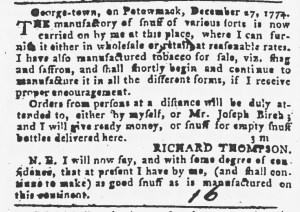
“THE manufactory of snuff of various sorts is now carried on by me at this place.”
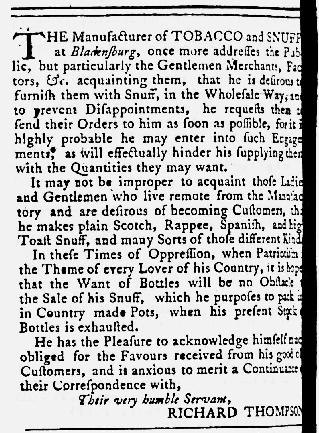
On the eve of the American Revolution, Richard Thompson attempted to establish a market for snuff produced in Virginia. In “The Beginnings of Tobacco Manufacture in Virginia,” Jacob M. Price argues that “there is not even a hint of a local manufacture” of snuff in Virginia from the middle of the 1730s through the late 1760s. Most of the snuff came from Great Britain with occasional “bottles, boxes, and kegs of snuff … appear from time to time in notices of arriving cargoes from Antigua, Boston, New York, and Salem.” According to Price, Thompson “moved his business from Bladensburg [Maryland] to the falls of the Potomac and tried to crash the Virginia market in 1772,” placing a lengthy advertisements in the October 8 edition of William Rind’s Virginia Gazette. “Little more is known,” Price continues, “of this early Maryland industrial pioneer and of his seemingly premature efforts to introduce a ‘patriotic’ tobacco and snuff manufacture into the Chesapeake.”[1]
An advertisement in the June 29, 1775, edition of the Maryland Gazette, published in Annapolis, reveals that Thompson continued to produce snuff at “George-town, on the Potowmack” at that time. The “manufactory of snuff of various sorts is now carried on by me at this place,” Thompson proclaimed, “where I can furnish it either in wholesale or retail, at reasonable rates.” In addition, Thompson had “manufactured tobacco for sale, viz. shag and saffron, and shall shortly begin and continue to manufacture it in all the different forms, if I receive proper encouragement.” According to the date on the advertisement, Thompson first asked for that encouragement on December 27, 1774, no doubt hoping that the Continental Association, a nonimportation agreement devised by the First Continental Congress in response to the Coercive Acts, created favorable conditions for snuff produced in the colonies. Patriotic colonizers had an obligation to support his enterprise, to give him that “proper encouragement,” but they did not have to settle for a product inferior to snuff produced elsewhere in the colonies. In a nota bene, Thompson declared, “I will now say, and with some degree of confidence, that at present I have by me, (and shall continue to make) as good snuff as is manufactured on this continent.” Even if his business got off to a rocky start, as Price suggests, Thompson asserted that he made improvements over time. He composed his advertisement less than a month after the Continental Association went into effect (and a notation, “3m,” indicated that it would appear in the Maryland Gazette for three months), yet apparently decided that the time was right to revive it more than six months later after learning of the battles at Lexington and Concord. Those battles and the events that followed meant that friends of the American cause, after all, had even more reason to support his endeavor.
**********
[1] Jacob M. Price, “The Beginnings of Tobacco Manufacture in Virginia,” Virginia Magazine of History and Biography 64, no. 1 (January 1956): 9, 12, 14.