
What was advertised in a colonial American newspaper 250 years ago today?
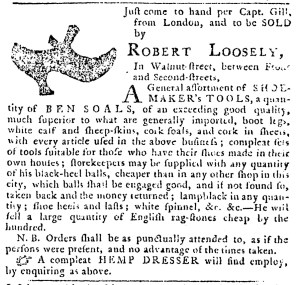
“No advantage of the times taken.”
In the early 1770s, Robert Loosely sold “SHOEMAKER’s TOOLS” and materials at his shop on Walnut Street in Philadelphia. In an advertisement he ran in the Pennsylvania Chronicle in May 1772, he advised the public that he “served his apprenticeship in England, and for some years carried on a considerable trade there.” During that time, he “became acquainted with the most reputed manufacturers of tools and leather.” After migrating to Philadelphia, he put his knowledge and connections to good use in importing and selling only the highest quality items connected to that trade.
Loosely did not rehearse that history when he advertised in the Pennsylvania Journal in December 1774. Perhaps he believed that prospective customers were familiar enough with his reputation that he no longer needed to do so. He did, however, continue to make appeals to quality and even offered a money-back guarantee for some of his wares. He described his tools and soles as “exceeding good quality,” even “much superior to what are generally imported. When it came to “black-heel balls” used to blacken the edges of heels and soles, Loosely told shopkeepers that they “may be supplied with any quantity … cheaper than in any other shop in this city.” Furthermore, those items “shall be engaged good, and if not found so, taken back and the money returned.” He trusted that his confidence would entice prospective customers to purchase from him over his competitors.
In a nota bene, Loosely encouraged customers to send orders rather than visiting his shop, declaring that they “shall be as punctually attended to, as if the persons were present.” In addition, he assured readers, “no advantage of the times taken.” He referred to the Continental Association, a nonimportation agreement enacted by the First Continental Congress in response to the Coercive Acts. With imported goods curtailed after December 1, he could have raised prices, yet he abided by the ninth article that asserted, “Venders of Goods or Merchandise will not take Advantage of the Scarcity of Goods that may be occasioned by this Associacion, but will sell the same at the Rates we have been respectively accustomed to do for twelve Months last past.” Politics and commerce interested in Loosely’s marketing efforts in the final days of 1774.
