September 1

What was advertised in a revolutionary American newspaper 250 years ago today?
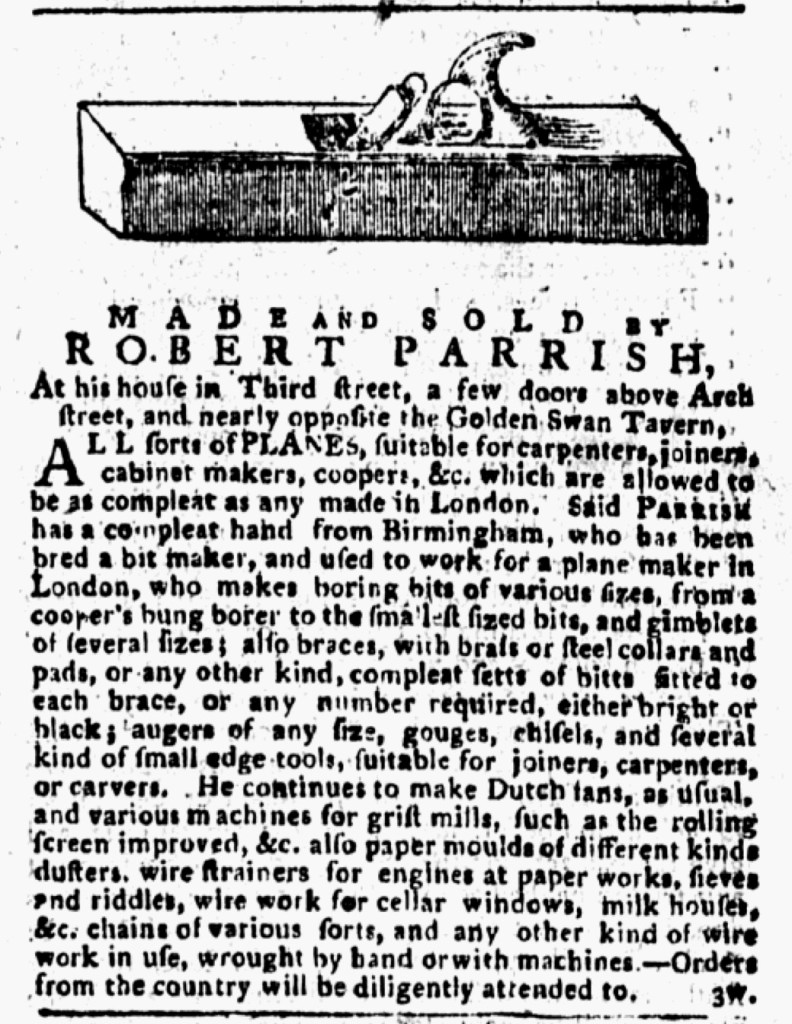
Story and Humphreys’s Pennsylvania Mercury (September 1, 1775).

“ALL sorts of PLANES, suitable for carpenters.”

When Robert Parrish published an advertisement adorned with a woodcut depicting a carpenter’s plane in the August 26, 1775, edition of the Pennsylvania Ledger, it was the first of several appearances that image would make in newspapers printed in Philadelphia over the course of eight weeks.  It next appeared in Story and Humphreys’s Pennsylvania Mercuryon September 1 as part of an advertisement with identical copy.  Perhaps Parrish had clipped his advertisement from the Pennsylvania Ledger and delivered it to Story and Humphreys’s printing office along with the woodcut that he retrieved from the Pennsylvania Ledger.

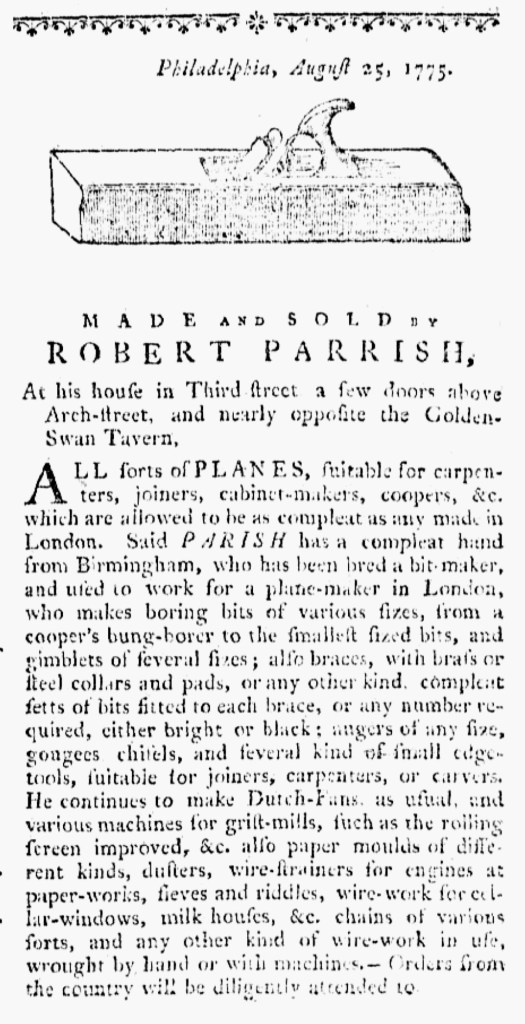
Having commissioned only one woodcut constrained Parrish’s schedule for publishing his advertisements.  Story and Humphreys’s Pennsylvania Mercury came out on Fridays and the Pennsylvania Mercury on Saturdays.  That did not leave enough time to transfer the woodcut back and forth between the two printing offices and have the compositors in each include them in the new issues when they set the type and laid them out.  Compositors, after all, sought to streamline that process as much as possible.  To that end, the initial insertion of Parrish’s advertisement in the Pennsylvania Ledgerincluded a dateline, “Philadelphia, August 25, 1775,” above the woodcut, but the compositor did not include it with subsequent insertions (even though advertisements often ran with their original dates for weeks or months).  It was much easier to retain the copy for the main body of the advertisement without worrying about a header that ran above the woodcut.

Parrish’s advertisement first ran in the Pennsylvania Ledger on a Saturday (in the first week of his advertising campaign) and then in Story and Humphreys’s Pennsylvania Mercury the following Friday (in the second week of his advertising campaign).  It did not appear in the Pennsylvania Ledger the next day.  Instead, it ran in that newspaper a week later (in the third week of his advertising campaign).  In the fourth week, the woodcut returned to Story and Humphreys’s printing office and Parrish’s advertisement appeared in their newspaper once again on September 15.  It did not run in either newspaper the following week but instead found its way to yet another newspaper, the Pennsylvania Journal published on Wednesday, September 27.  That allowed enough time to get the woodcut back to the Pennsylvania Ledger for its September 30 edition (during the sixth week of Parrish’s advertising campaign).  Parrish returned to alternating between the two original newspapers during the next two weeks.  His advertisement with the woodcut went back to Story and Humphreys’s Pennsylvania Mercury for the October 6 issue and then ran in the Pennsylvania Ledger on October 14.

Investing in a woodcut increased the chances that prospective customers would take note of an advertisement, but Parrish and other advertisers had limits to how much they would spend.  He apparently considered it worth it to commission a single woodcut but not more than one.  Instead, he arranged to transfer that woodcut from printing office to printing office to printing office over the course of many weeks.
August 27

What was advertised in a revolutionary American newspaper 250 years ago this week?

Pennsylvania Ledger (August 26, 1775).

“ALL sorts of PLANES … as compleat as any made in London.”

Robert Parrish inserted an advertisement in the August 26, 1775, edition of the Pennsylvania Ledger to advise the public that he made and sold “ALL sorts of PLANES, suitable for carpenters, joiners, cabinet-makers, coopers,” and other artisans at “his house in Third-street, a few doors above Arch-street, and nearly opposite the Golden-Swan Tavern” in Philadelphia.  Parrish was no stranger to advertising in the public prints.  He previously ran an advertisement for “DUTCH FANS” and “ROLLING SCREENS,” both used for separating wheat from chaff, in the Pennsylvania Chronicle.

That notice featured two images, one of each kind of equipment that Parrish made and sold.  A woodcut also accompanied his new advertisement, this one depicting a carpentry plane.  It almost certainly drew attention to his advertisement since it was the only image of any sort, except for the coat of arms of Great Britain that always appeared in the masthead, in that issue of the Pennsylvania Ledger.  Parrish stated that “continues to make Dutch-Fans, as usual, and various machines for grist-mills, such as the rolling screen improved,” yet he did not include either of the images that accompanied his previous advertisement.  Perhaps he never reclaimed them from the printing office when William Goddard ceased publishing the Pennsylvania Chronicle in 1774 … or maybe he considered it too expensive to purchase the necessary space to feature two images.  His copy, after all, was significantly longer than in that earlier advertisement.

Parrish insisted that the planes made and sold at his shop were “as compleat as any made in London,” an assurance that the quality of construction matched imported tools.  American artisans frequently made such claims, though such promises had even greater significance with the Continental Association in effect.  The First Continental Congress devised that nonimportation and nonconsumption agreement in response to the Coercive Acts.  It also called for producers and consumers to support domestic manufactures, goods produced in the colonies, as alternatives to imported items.  Parrish signaled that he did his part to support the American cause by supplying carpenters, joiners, cabinetmakers, and coopers with the tools they needed to earn their livelihoods.

July 22

What was advertised in a colonial American newspaper 250 years ago today?

Pennsylvania Chronicle (July 22, 1771).

“DUTCH FANS, upon different constructions.”

Yesterday’s entry featured an advertisement for “ROLLING SCREENS for Cleaning Wheat or Flax-seed” placed in the July 18, 1771, edition of the Pennsylvania Journal by Christian Fiss.  That advertisement was notable for the image that accompanied it, a woodcut depicting a winnowing fan (better known as a “DUTCH FAN” in the eighteenth century) for separating the wheat from the chaff.  Printers provided several stock images of ships, horses, houses, indentured servants, and enslaved people for advertisers to incorporate into their notices, but not other images with more limited usage.  Instead, advertisers like Fiss commissioned woodcuts specific to their businesses when they wanted to draw greater attention to their newspaper notices.

At the same time that Fiss included an image of a winnowing fan in an advertisement in the Pennsylvania Journal, one of his competitors, Robert Parrish, pursued the same strategy in the Pennsylvania Chronicle.  Fiss divided the space in his advertisement more or less evenly between image and text, but Parrish devoted more space to images than to his description of the “various kinds of wire work” he made.  In addition to a woodcut depicting a winnowing fan, he included a second woodcut of a rolling screen.  That represented even greater expense for his marketing efforts, but Parrish presumably believed that investing in such images would result in more sales and the woodcuts would pay for themselves in the end.

Parrish previously included his woodcut depicting a winnowing fan in an advertisement in the October 29, 1770, edition of the Pennsylvania Chronicle.  He may have chosen to resume running advertisements that included that image upon seeing Fiss publish advertisements with a similar image.  Having made the initial investment, he did not want to lose any advantage once a competitor commissioned a woodcut of his own.  Not long after that, he collected his woodcuts from the Pennsylvania Chronicle and delivered them to the Pennsylvania Gazette to include in an advertisement with identical copy on October 15.  Unlike the stock images that printers provided, such specialized images belonged to the advertisers, who could choose to insert them in more than one newspaper.  Parrish sought to increase the exposure, achieve a greater return on his investment, and ward off a rival by inserting the images in more than one newspaper.