October 26

What was advertised in a revolutionary American newspaper 250 years ago today?

Rivington’s New-York Gazetteer (October 26, 1775).

“We think proper to notify the public, that the charge against us is wholly and totally false.”

Rumors and misrepresentations spread in conversation and in print when the imperial crisis intensified and hostilities between the colonies and Britain commenced.  Upon finding themselves the subjects of gossip that damaged their reputations, Abraham Hatfield and William Lounsbery published a newspaper advertisement to set the record straight.  It started with an entry in the October 5, 1775, edition of the New-York Journal.  Among the news received from correspondents in the city,  John Holt, the printer, inserted this report: “We understand from North Castle, that on last Saturday night, Abraham Hatfield, Esq; of the White Plains, and Lieutenant William Lownsburry, of Mamaroneck, were discovered in the very act of endeavouring to cut down a Liberty Pole, which was so well fortified with iron that it occasioned their being found out, and for that time disappointed in their loyal attempt.”

Whether or not they held Tory sentiments, Hatfield and Lounsbery vigorously denied that they had acted on them by attempting to cut down the liberty pole.  In the next issue of Rivington’s New-York Gazetteer, published on October 12, they inserted an advertisement that identified the allegations and dismissed them as fabrications.  “WE the subscribers” (or undersigned) “having understood that Mr. Holt has inserted in his last week’s paper, a piece charging us with being concerned, and of even being detected in the fact of attempting to cut down a Liberty-pole – we think proper to notify the public, that the charge against us is wholly and totally false.”  It ran twice more, on October 19 and 26.  Hatfield and Lounsbery disseminated their denial that they had anything to do with the incident multiple times in their effort to combat an accusation made in the public prints just once.

Why didn’t they submit a correction to Holt or place a similar advertisement in the New-York Journal since that newspaper carried the piece that spread what they claimed was misinformation?  Perhaps they did, but Holt, a Patriot printer, felt confident enough in the source of the report that he declined to publish anything submitted by Hatfield and Lounsbery.  Alternately, they may have been so upset with Holt that they did not wish to give him the satisfaction of acknowledging the allegations in his newspapers (or contributing to his advertising revenue) that they instead opted for another newspaper, one with a circulation that rivaled or exceeded the New-York Journal.  Whatever the case, they did not allow the accusation that they were Loyalists who had attempted to cut down a liberty pole go unanswered.

The same issue of the New-York Journal that featured the report that identified Hatfield and Lounsbery as the culprits involved in the liberty tree incident in New Castle also carried letters addressed to Holt concerning rumors that colonizers had scalped a British soldier and cut off his ears after the battles at Lexington and Concord.  The correspondents believed that Holt could “serve the cause of truth and liberty” by publishing their accounts of the actual events, stating that they “buried the dead bodies of the king’s troops that were killed at the north bridge in Concord, on the 19th day of April, 1775,” and none of them “were scalped, not their ears cut off, as has been represented” by those who sought to “dishonour the Massachusetts people, and to make them appear to be savage and barbarous.”  In articles, letters, and advertisements, accusations and rebuttals about the misbehavior and even depravity of Patriots and Loyalists circulated in the public prints during the Revolutionary War.
July 13

Who was the subject of an advertisement in a revolutionary American newspaper 250 years ago today?

Maryland Gazette (July 13, 1775).

“An English servant man … intended to Boston to general Gage, who he understood would protect all servants who came to him.”

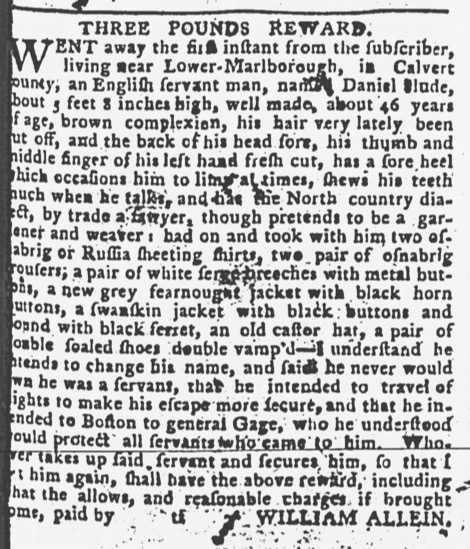
William Allein of Lower Marlborough in Calvert County turned to the Maryland Gazette to seek assistance in recovering an enslaved man and an indentured servant in the summer of 1775.  He ran two advertisements in the July 13 edition, one concerning Mial, an enslaved man who became a fugitive for freedom at the beginning of May, and Slude, an “English servant man” who “WENT away” in early July.  Allein expected newspaper readers to observe strangers to assess whether they matched the descriptions he published, offering rewards to those who participated in securing Mial and Slude and returning them to him.

Allein gave a physical description of Slude, including recent injuries (“his thumb and middle finger on his left hand fresh cut” and “a sore heel which occasions him to limp at times”) that could make him easier to recognize, and detailed the clothing that Slude wore or took with him.  His “North country dialect” also distinguished the indentured servant.  According to Allein, Slude was “by trade a sawyer, though he pretends to be a gardener and weaver.”  He would engage in other subterfuge as well, changing his name and traveling by night to avoid detection.

Compared to many of his counterparts who placed other advertisements for runaway indentured servants, apprentices, and convict servants and enslaved people who liberated themselves, Allein was well informed about where Mial and Slude were likely headed.  “I have heard that [Mial] proposed going towards Alexandria in Virginia,” Allein declared.  As for Slude, “I understand that … he intended to Boston to general Gage, who he understood would protect all servants who came to him.”  Current events influenced Slude when he planned the route for making his escape; he apparently relied on rumors, hoping for their veracity.  Word of the battles at Lexington and Concord and the ensuing siege of Boston quickly spread throughout the colonies, as did news of the Battle of Bunker Hill.

Yet not all the news was always accurate, not even the accounts printed in newspapers.  The confusion created openings for men like Slude to embrace the reports that they wanted to believe.  In the end, however, Mial may have been more successful in eluding Allein than Slude was.  The advertisement describing Mial ran for many weeks, but the notice about Slude appeared only once.  The indentured servant heading to Boston may have been recognized and captured shortly after it appeared, prompting Allein to discontinue the advertisement.  If Mial made it to Virginia and managed to avoid capture until November, he might have joined Lord Dunmore, the royal governor, when he issued a proclamation that offered freedom to enslaved people and indentured servants “appertaining to Rebels” if they joined “His MAJESTY’s Troops” in “reducing this Colony to a proper Sense of their Duty.”

October 19

What was advertised in a colonial American newspaper 250 years ago today?

Pennsylvania Gazette (October 19, 1774).

“I … am really sorry that my Fellow-Citizens should be so unfriendly to me.”

Tensions rose in the fall of 1774 as the harbor in Boston remained closed and blockaded due to the Boston Port Act and the rest of the Coercive Acts went into effect as punishment for the Boston Tea Party.  Yet that port was not the only place that experienced discord.  John Head’s advertisement, published in both the Pennsylvania Gazette and the Pennsylvania Journal on October 19, revealed his frustration with rumors and accusations that he sought to take advantage of the situation through unscrupulous business practices.

He reported that “a Number of unkind People have industriously propagated through this City, Philadelphia, “I made it my Business to purchase a large Quantity of several Sorts of dry Goods, in order to sell them again at an advanced Price.” Head, like many other colonizers, anticipated that the First Continental Congress, meeting in Philadelphia at the time, would enact some sort of nonimportation agreement in response to the Coercive Acts.  His critics accused him of attempting to sidestep such measures by stocking up on merchandise in advance, thus not having to make the same sacrifices as truly patriotic merchants.  To make matters worse, they insinuated that once goods became scare because of a nonimportation agreement that Head would jack up his prices and gouge consumers who did not have the usual range of choices available to them.

Head vigorously denied those rumors.  That “Report,” he asserted, “I do declare to be false.”  Furthermore, he challenged “any Person to appear to my Face, and prove that I have bought to the Amount of One Shilling’s Worth of Goods from them, since the Arrival of said Ships.”  Continuing to make his case, Head declared that “on a cool Reflection, I cannot recollect that I have bought to the Amount of Fifty Pounds Worth of dry Goods on Speculation since I have been in Trade.”  He did not have a history of acquiring goods in large quantities, nor had he done so recently, despite whatever his adversaries claimed.  Head expressed his disappointment over the gossip that made it necessary to take to the public prints to defend his reputation.  He lamented that “my Fellow-Citizens should be so unfriendly to me, and unjust to themselves, as to propagate a Report of this Sort.”  In so doing, he positioned himself among the ranks of citizens and patriots, confirming his fidelity to their cause.

April 21

What was advertised in a colonial American newspaper 250 years ago today?

Rivington’s New-York Gazetteer (April 21, 1774).

“I will requit their kindness by making a bonfire of [the tea].”

The Boston Tea Party serves as the most memorable destruction of tea during the imperial crisis that eventually resulted in thirteen colonies declaring independence from Great Britain, but greater numbers of colonizers participated in bonfires of tea.  Benjamin Booth suggested that he would hold one of those bonfires if anyone in England had the audacity to designate him as the consignee of tea shipped to New York.

He made that bold declaration in an advertisement in the April 21, 1774, edition of the Rivington’s New-York Gazetteer, an advertisement that he felt compelled to place after becoming the subject of vicious rumors.  “[S]ome evil minded persons, with a wicked design no doubt,” he declared, “have reported that I lately received TEA concealed in bales and other packages.”  Booth considered such accusations “trouble enough already” before learning that he had been “appointed … consignee of the tea said to be daily expected, on board the ship London,” an appointment made without his knowledge or permission.  Yet Booth wanted nothing to do with importing tea and all the trouble brewing with it.  That prompted him to make a declaration “once for all” that he “never was, not ever will be knowingly concerned in any contraband goods.”  Furthermore, if anyone had concerns about which commodities he imported and exported, he invited them to examine “the custom-house books, which are PUBLIC RECORDS” to confirm for themselves that Booth “religiously abid[ed] by this determination.”  If that still was not enough to satisfy those who suspected him of operating against the public interest, he stated that “if any person England should treat me so ill, as to consign me any more tea, while the present obstacles remain,” referring to the duties that Parliament imposed, “I will requit their kindness by making a bonfire of it.”  To emphasize the point, he proclaimed that he would do so “in the most public part of the city,” for all to witness, “and with my own hands set fire to the pile.”

Booth was not the first colonizer to resort to an advertisement to communicate his position on tea as the issue reached a boiling point.  Jeremiah Cronin previously did so in the Massachusetts Spy, having a justice of the peace attest to the veracity of his assertions.  Thomas Walley, Peter Boyer, and William Thompson did the same.  Even an associate of John Hancock ran such an advertisement on behalf of the prominent merchant in the New-York Journal even before the Boston Tea Party.  In each of these instances, advertisements provided updates and contributed to the discourse around tea.  Those notices doubled as news items, helping to keep the public informed about developments that did not appear elsewhere in colonial newspapers.

November 17

What was advertised in a colonial American newspaper 250 years ago today?

Pennsylvania Journal (November 17, 1773).

“Mr. DOUGLASS’S concern for the peace of the Theatre prevented him from … confuting those falshoods … propagated against him.”

Something happened at the theater in Southwark on the outskirts of Philadelphia in November 1773, something that one of the actors, John Henry, believed he should address in the public prints.  Among the various advertisements in the November 17 edition of the Pennsylvania Journal, Henry inserted “A CARD” in which he “most respectfully assures the Town, that he has too great a deference for their opinion to wish to do any thing contrary to it.”  He did not elaborate on what had happened, nor did any of the newspapers published in Philadelphia at the time mention any controversy among the local news they printed that week, but conversation and gossip likely made any such coverage unnecessary.  If readers did not already know what happened, they could easily enough ask friends and acquaintances to learn more.

Henry made some references in his “CARD” that likely would have piqued the curiosity of readers and prompted some of them to make inquiries.  For instance, he indicated that a play had been canceled, but, if it had been performed as scheduled, he would have “addressed the Audience and submitted himself entirely to their judgment.”  However, “Mr. DOUGLASS’S concern for the peace of the Theatre prevented him from having an opportunity of evinceing that respect he has for the Public, and of confuting those falshoods that, he understands, have been propagated against him.”  Scandal!  What kinds of rumors circulated about Henry?  Henry’s “CARD” likely whetted the appetites of some readers to find out more about what kind of trouble the actor’s troubles.

An advertisement in the previous issue of the Pennsylvania Journal announced that the American Company would perform “A COMEDY called THE CLANDESTINE MARRIAGE,” first performed at Drury Lane in London in 1766, at the “Theatre in Southwark” for “POSITIVELY THE LAST WEEK.”  Douglass, the manager of the company, played the role of Sir John Melvile, while Henry played Lovewell.  Apparently, none of the rumors about Henry had circulated before the advertisement ran on November 10, at least not so widely to merit canceling any performances.  Whatever had conspired, Henry wanted a chance to address “those falshoods,” though the actor seemingly preferred to present his defense to an audience rather than in print.  He likely reasoned that he could more readily sway the sympathies of an audience who witnessed how he comported himself than readers who could not hear the tone of his voice or observe his demeanor.  In addition, he likely did not wish to commit some allegations to print.

That did not prevent him from making an earnest plea in his “CARD.”  Henry declared that had he been permitted to make an address that “his intention was to throw himself on the protection of an American Audience,—who, he was conscious, would not condemn him unheard.”  He believed this from experience, having been “Brought up to his profession on the American Stage, and having exerted his poor endeavours to please, for these seven years past.”  The Irish-born actor had previously performed in Dublin and London before migrating to Jamaica and, eventually, the mainland colonies.  He appeared in productions at the John Street Theatre in New York in 1767, later moving to the theater in Southwark.  In his “CARD,” he professed that American audiences “have hitherto honoured him with more marks of their indulgence than his small share of merit deserves.”  Given a chance, the actor was confident that “an American Audience, … from their known generosity, candour, and impartiality,” would have heard his story and accepted the explanation he gave.  Henry concluded by declaring that “it shall be his constant—his grateful study to deserve” the trust and approval of that audience.

Henry’s “CARD” did not tell the whole story, though it revealed more than appeared elsewhere in any of the newspapers published in Philadelphia at the time.  The truncated narrative delivered local news in its own way, while also prompting readers to seek out information from other sources to learn more about whatever scandal embroiled one of the actors at the Southwark Theatre.

October 30

What was advertised in a colonial American newspaper 250 years ago today?

South-Carolina Gazette and Country Journal (October 30, 1770).

“Said Report is FALSE.”

In late October 1770, Richard Clark, a watch- and clockmaker, took to the pages of the South-Carolina Gazette and Country Journal to address a rumor circulating in Charleston.  “[I]t hath been reported by some MALICIOUS PERSONS,” Clark lamented, “That I was going to leave the Province.”  That was not the case at all.  “I therefore acquaint the PUBLIC,” he continued, “that said report is FALSE, as I never had such an Intention.”

Why would others have traded in such gossip?  Was it an attempt by a competitor to undermine Clark’s business by pulling away customers who thought he was leaving the colony?  Did disgruntled acquaintances seek to cause him financial difficulty if Clark’s associates demanded that he pay his debts in advance of his departure?  Did something else occur?  Clark did not speculate beyond ascribing the false reports to “MALICIOUS PERSONS” responsible for the mischief, though that does not mean that he did not have suspicious that he left unspoken.

The watchmaker took the opportunity to promote his business at the same time he corrected the record.  He “return[ed] Thanks to all those who have been pleased to favour me with their Custom,” establishing that he had a clientele who availed themselves of his services.  He invited them and others to visit his shop on King Street, where he cleaned and repaired watches and clocks “in the neatest Manner, and greatest Dispatch.”  He promised quality and efficiency to his customers, two standard appeals in newspaper advertisements placed by artisans.

Clark competed for customers in a crowded marketplace, one sometimes shaped in part by innuendo and rumor that appeared in print or passed from person to person by word of mouth.  For more than a year and a half, clock- and watchmakers John Simnet and Nathaniel Sheaff Griffith engaged in vicious sparring matches in their advertisements in the New-Hampshire Gazette.  Even if it was not a competitor who spread the false reports of Clark’s supposed plans to leave the colony, the watchmaker had to deal with the consequences of gossip that could damage his livelihood.  He turned to the public prints to address the calumnious reports and provide reassurances that he remained in business.

October 12

What was advertised in a colonial American newspaper 250 years ago today?

Oct 12 - 10:12:1769 Massachusetts Gazette and Boston Weekly News-Letter
Massachusetts Gazette and Boston Weekly News-Letter (October 12 1769).

“We have suffered much by the generous Sacrifice of the Mercantile Interest to the public Freedom and Happiness.”

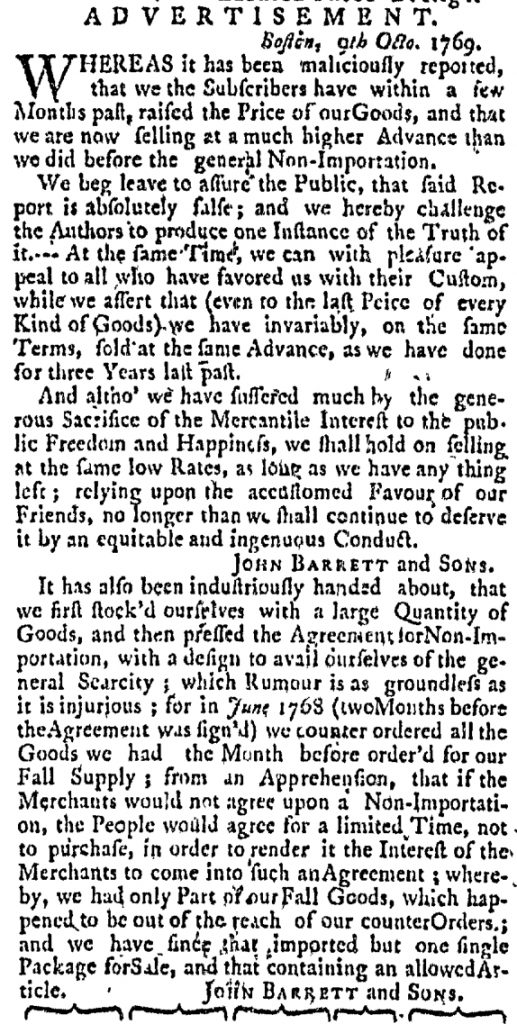
This “ADVERTISEMENT” by John Barrett and Sons most likely was not a paid notice but rather a letter to the editor of the Massachusetts Gazette and Boston Weekly News-Letter. Either the Barretts or the printer used the word “advertisement” to mean a notification or a written statement calling attention to something, common usage in the eighteenth-century but chiefly historical today. Unlike most paid notices that ran for multiple weeks, this “ADVERTISEMENT” appeared only once, suggesting that the printer did indeed insert it as an article of interest for readers. Still, this “ADVERTISEMENT” appeared immediately above a paid notice for consumer goods. It testifies to some of the discourse that animated the appeals made in paid notices that promoted consumer goods and services.

Barrett and Sons sought to address rumors that dogged their business in the midst of the nonimportation agreement. Others had “maliciously reported” that they engaged in price gouging, charging much more than they did “before the general Non-Importation” to take advantage of the perceived scarcity of goods. The Barretts assured readers, both their customers and the general public, that they had “invariably, on the same Terms” sold their wares at the same prices “as we have done for three Years last past.” Just as significantly, they had accepted the ramifications to their business for doing so, indicating that they had “suffered much by the generous Sacrifice of the Mercantile Interest to the public Freedom and Happiness.” They pledged to continue “selling at the same low Rates” as to support the cause. The prospects for their business and their personal interests mattered less than virtuously participating in the nonimportation agreement for the benefit of all colonists.

That being the case, Barrett and Sons addressed a second rumor that accused them of ordering surplus stock ahead of the nonimportation agreement going into effect in order to have plenty of merchandise to continue selling to colonial consumers. The Barretts argued that was exactly the opposite of what happened: the “Rumour is as groundless as it is injurious.” Instead, in June 1768, two months before the merchants of Boston signed the nonimportation agreement, Barrett and Sons cancelled their orders for fall goods. They feared that the merchants would not reach agreement on nonimportation and, if that happened, the general public would then assume adopt nonconsumption as an alternative strategy, refusing to purchase imported goods. The Barretts expected that a broad nonconsumption movement by colonists would sway merchants, convincing them to overcome their hesitation about nonimportation. That had not become necessary, but Barrett and Sons informed the public (and prospective customers) that they envisioned the possibility of such a plan going into effect.

The politics of commerce and consumption tinged every word in this “ADVERTISEMENT” by Barrett and Sons. They defended their reputation to the general public, presenting a narrative of their own actions in relation to nonimportation and nonconsumption intended to enhance, rather than merely rehabilitate, their standing in the community. They sought to convince their fellow colonists that they were savvy but not unscrupulous traders who simultaneously tended their own business interests and promoted the public good … and when the two came into conflict, they opted for the public good over their own enterprises. Civic virtue imbued the decisions they made about their business.

September 15

What was advertised in a colonial American newspaper 250 years ago today?

Sep 15 - 9:15:1769 New-London Gazette
New-London Gazette (September 15, 1769).

Some evil minded Person or Persons have wickedly and falsely spread a Report, that I put Soap Suds and Pot-Ash in my Bread.”

As summer turned to fall in 1769, Christopher Smieller took to the pages of New-London Gazette to defend his reputation and mitigate damage already done to his business. The baker had become aware of a vicious rumor about his bread. In a lengthy nota bene at the conclusion of even lengthier advertisement, he expressed his outrage that “some evil minded Person or Persons have wickedly and falsely spread a Report, that I put Soap Suds and Pot-Ash in my Bread.” Smellier could not let this slander pass unremarked. Instead, he offered “a Reward of Two Dollars to any Person who will inform me of such Defamers that they may be prosecuted according to law.” In order to rehabilitate his standing in the community, he also made provision for witnesses to observe him as he went about his business: “I will permit any two or three honest Men to stay with me 24 Hours, who may inspect every Article put into my Bread.”

Combatting gossip circulating about unsavory additions to his bread may have prompted Smieller to insert other aspects of his lengthy advertisement. It opened like many other advertisements for consumer goods, listing his wares. Smieller also advanced an appeal to price, stating that he sold loaf and ship bread, gingerbread, cakes, and pies “as cheap as in any of the neighbouring Governments.” In other words, his prices in New London were as good as prospective customers could find in Massachusetts, New York, or Rhode Island. He doubled down on this assertion later in the advertisement, proclaiming the he baked ship bread “as good and as cheap as in any Part of America.”

Smieller tied the prices he charged for bread to the prevailing prices for flour. He made allusion to “sundry Persons who call themselves Bakers” who had been overcharging the residents of New London and making it unaffordable for them to buy bread. To demonstrate that he charged fair prices, Smieller specified how much a loaf of bread weighed and the corresponding price at the current price for flour. He explained that he would adjust the price per loaf as his own costs for flour fluctuated, but that he would hold his profit consistent. He hoped current and prospective customers would patronize his business out of appreciation for his commitment to keeping prices low by earning “so very small” profits on his bread. Smieller might not otherwise have outlined the expenditures and profits for his business, but defending himself against the rumor that he put soap and potash in his bread may have motivated him to devise other methods of convincing the people of New London to purchase from him.