October 4

What was advertised in a colonial American newspaper 250 years ago today?
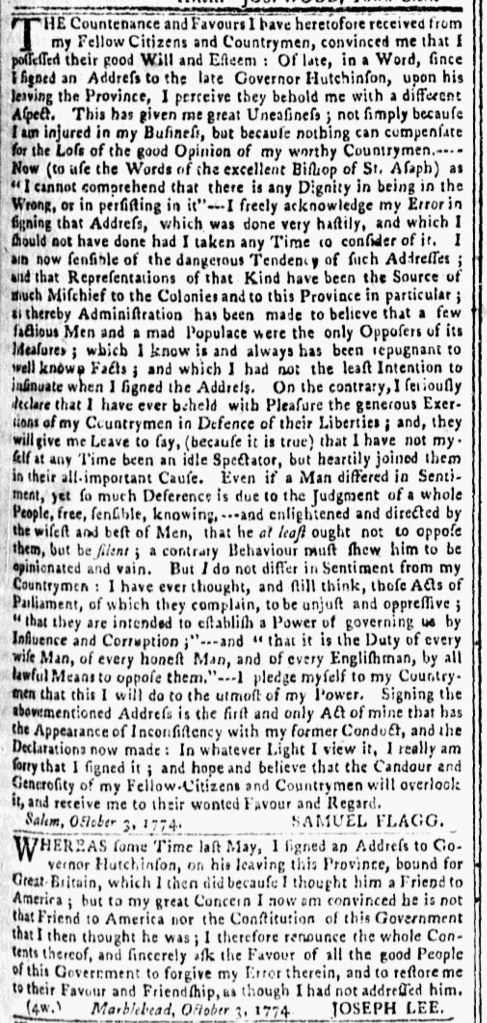
Essex Gazette (October 4, 1774).

“Forgive my Error [and] restore me to their Favour and Friendship.”

Samuel Flagg of Salem and Joseph Lee of Marblehead needed to do damage control and rehabilitate their reputations after signing “an Address to Governor Hutchinson, on his leaving this Province” in May 1774.  Like Thomas Kidder had done in July, they took to the public prints to confess their error and beg for the forgiveness of their friends and neighbors who believed they did not support the American cause.  The reaction they experienced became so overwhelming that they recanted a position that they claimed they never firmly held.  Lee, for instance, stated that he signed the address because at the time he “thought [Hutchinson] a Friend to America,” yet he had since reconsidered.  He expressed “great Concern” while confessing that “I am now convinced he is not that Friend to America nor the Constitution of this Government that I then thought he was.”  To that end, Lee renounced the entire address and “sincerely ask[ed] the Favour of all the good People of this Government to forgive my Error therein, and to restore me to their Favour and Friendship.”  His plea, dated October 3, first appeared in the October 4 edition of the Essex Gazette, with a notation that it would run for four weeks.  Rather than submitting a letter to the printer that might get printed once, Lee paid to run an advertisement that would present his story and his apology to readers multiple times.

Lee’s notice was brief compared to the one that Flagg inserted on the same day.  He had formerly been in good standing in the community, having the “good Will and Esteem” of his “Fellow Citizens and Countrymen,” but perceived “they behold me with a different aspect” after he signed an address in honor of the Governor Hutchinson upon his return to England.  Flagg confessed that this “has given me great Uneasiness; not simply because I am injured in my Business, but because nothing can compensate for the Loss of the good Opinion of my worthy Countrymen.”  Flagg acknowledged that his livelihood had suffered; apparently customers refused to shop at his store in Salem.  Yet participating in the marketplace was not the only or even the primary reason that Flagg wished to correct the record.  He desired the “Favour and Regard” that he had once enjoyed in relationships with other colonizers, plus he wanted to assure the public that he indeed supported the patriot cause.  He admitted his error while disavowing the address as “the Source of much Mischief to the Colonies and to this Province in particular,” but did not end there.  “I seriously declare,” he wrote, “that I have ever beheld with Pleasure the generous Exertions of my Countrymen in Defence of their Liberties.”  Furthermore, Flagg claimed that “I have note myself at any Time been an idle Spectator, but heartily joined them in their all-important Cause.”  In his advertisement for an “Assortment of ENGLISH and INDIA GOODS” on the next page, he indicated that he “is determined not to import any more Goods at Present,” signaling his support for nonimportation agreements as a means of protesting the Coercive Acts.

Beyond his confession and apology, Flagg incorporated an editorial into his advertisement seeking forgiveness from his “Fellow Citizens and Countrymen.”  He asserted, “I do not differ in Sentiment from my Countrymen; I have ever thought, and still think, those Acts of Parliament, of which they complain, to be unjust and oppressive.”  To demonstrate that point, he inserted quotations that made familiar arguments: “‘that they are intended to establish a Power of governing us by Influence and Corruption’” and “‘that it is the Duty of every wise Man, of every honest Man, and of every Englishman, by all lawful Means to oppose them.’”  Flagg thus had a duty to fulfill, prompting him to “pledge myself to my Countrymen that this I will do to the utmost of my Power.”  He reiterated that he regretted signing the “abovementioned Address,” insisting that it was “the first and only Act of mine that has the Appearance of Inconsistency with my former Conduct, and the Declarations now made.”  He apologized once again, requesting the “Candour and Generosity” of others in overlooking the entire incident.

Signing the address to Governor Hutchinson had been a lapse in judgment; at least that was how some of those who signed it depicted their actions when they repeatedly encountered hostile reactions.  Both Flagg and Lee sought to remedy the damage done to their reputations by placing advertisements in which they confessed their error.  Flagg did even more: he spilled a lot of ink in support of the American cause, hoping that doing so would convince the public of his sincerity and return him to their good graces.  News and editorials could not contain the politics of the period. Instead, advertisements became sites for participating in debates and controversies as the imperial crisis intensified in 1774.
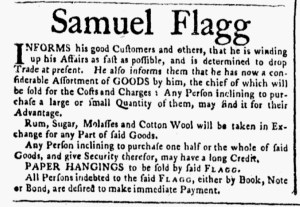
June 7

What was advertised in a colonial American newspaper 250 years ago today?

Essex Gazette (June 7, 1774).

“He is winding up his Affairs as fast as possible, and is determined to drop Trade.”

It was a going out of business sale by another name.  As summer approached in 1774, Samuel Flagg took to the pages of the Essex Gazette to inform residents of Salem and nearby towns that “he is winding up his Affairs as fast as possible, and is determined to drop Trade at present.”  That meant that he needed to get rid of his existing inventory, “a considerable Assortment of GOODS.”  For bargain hunters or any consumers looking for good deals, this was quite an opportunity since Flagg pledged to sell his wares “for the Costs and Charges” without significant retail markup.  He attempted to entice customers with promises that they “may find it for their Advantage” to purchase “a large or small Quantity” of his remaining goods.  Flagg also presented his decision to “drop Trade” as favorable to other retailers, suggesting that they might be interested in acquiring “one half or the whole of said Goods.”  Provided that they “give Security,” Flagg was willing to allow “a long Credit” for payment.

Flagg had a history of publishing colorful advertisements in the Essex Gazette, commenting on the marketing strategies deployed by some of his competitors, and it was not the first time that he announced plans to liquidate his merchandise.  A year earlier, he asserted “his present Determination is to go home to London in the Fall; he is therefore determined to sell off the whole of his Goods.”  The entrepreneur made bold claims that he would part with his goods “as low as they can be bought at any Store on the Continent, without any Exception.”  His “Determination” did not result in returning to London in the fall of 1773, but it may have resulted in some good deals for consumers who took advantage of his intentions.  Those who benefited from that sale might have been especially eager to examine Flagg’s goods this time, though others who did not consider the savings all that significant likely would have been wary of renewed promises.  Today, consumers become skeptical of retailers who repeatedly hold going out of business sales yet do not close their doors, realizing that liquidation prices are just their everyday prices.  Flagg risked the same response if he resorted to this marketing strategy too many times.

June 15

What was advertised in a colonial American newspaper 250 years ago today?

Essex Gazette (June 15, 1773).

“His present determination is to go home to London in the Fall; he is therefore determined to sell off the whole of his Goods … at the very lowest Rate.”

In the summer of 1773, Samuel Flagg took to the pages of the Essex Gazette to promote the “general Assortment of English and India GOODS” that he recently received via “the last Shops from London and Bristol.”  He directed prospective customers interested in “Hosery of all sorts,” “men’s and boys felt Hats of all sizes,” “a good assortment of Paper Hangings,” “an assortment of Ship-Chandlery,” and “almost every other Article usually enquired for” to visit his shop “two Doors below the Town-House” in Salem.

To entice consumers, Flagg declared that he parted with his imported goods “as low as they can be bought at any Store on the Continent, without any Exception.”  It was a bold claim.  The merchant not only compared his prices to prices set by competitors in Salem and nearby Boston but also to prices found anywhere in Britain’s mainland colonies.  To back up this claim, Flagg explained that “his present Determination is to go home to London in the Fall.”  Accordingly, “he is therefore determined to sell off the whole of his Goods … at the very lowest Rate, by Wholesale and Retail.”  Flagg sought to demonstrate that he did not make idle promises about his prices.  Instead, his plans to return to London motivated him to liquidate his merchandise over the course of the next several months.

Although he did not deploy the same phrases that marketers would come to use in the twentieth and twenty-first centuries, Flagg experimented with a strategy eventually known as a liquidation sale, selling his inventory at a significant discount in order to generate cash in advance of closing his business.  At the same time, he encouraged former customers and other associates indebted to him to settle accounts “for the above Reason,” departing for London, so he would be ready to travel in the fall.

Other advertisers offered their wares “very cheap for Cash or short Credit” or “at the very lowest Rate,” but did not provide assurances or explanations.  Nathaniel Sparhawk declared that he sold his imported goods “as cheap for Cash or short Credit as at any Store in this Town (without Exception),” but did not offer any comments about why prospective customers should trust that proclamation.  In the June 15 edition of the Essex Gazette, only James Grant took an approach that resembled Flagg’s strategy, declaring that he “will sell for the sterling Cost and Charges,— as he intends going into some other Business.”  In colonial Salem, some entrepreneurs experimented with marketing strategies, such as liquidation sales, that became much more common more than a century later.

December 29

What was advertised in a colonial American newspaper 250 years ago today?

Essex Gazette (December 29, 1772).

The Publick would only laugh … at so many flashy Advertisements as weekly present themselves to their View.”

The introduction to Nathaniel Sparhawk’s advertisement listing an array of goods available at his shop in Salem was typical of those that appeared in the Essex Gazette and other newspapers in the early 1770s: “Just imported in the last Ships, Captains Scott and Lyde from London, and Smith from Bristol, A great Variety of English and India GOODS, suitable for the Season, All or any of which will be sold extremely cheap for Cash or short Credit.”  Sparhawk had good reason for including each detail, all of them standard elements of marketing consumer goods in the eighteenth century.  In a nota bene, he made additional appeals concerning price: “As said Sparhawk proposes to quit his present Business (as soon as he can without Loss) to pursue some other Brach; all his good Customers, and others, may depend on being served with good Pennyworths, determining to sell at a very low Advance, or for very small Profits.”

Samuel Flagg did not think much of any of those methods, or so he claimed.  In contrast to the kinds of introductions offered by Sparhawk and others, Flagg simply stated that he “has the following Articles, which he would be glad to sell.”  After an extensive catalog of his merchandise, the shopkeeper inserted a lengthy diatribe about advertising practices then in fashion.  “The said FLAGG,” he proclaimed, “don’t mean to make such a Parade, nor furnish the Publick with so many pompous Promises (as have lately been exhibited) of Goods being so amazingly cheap, but would rather convince them of the Cheapness of his Goods and of his Integrity in dealing, whenever they may please to call and favour him with their Custom.”  Flagg managed to make his own appeal to low prices while also mocking the pronouncements so often published by his competitors.  He confided to readers that they all knew proclamations about offering the lowest prices or not being undersold were hyperbole.  Rather than perpetuate that kind of marketing, he promised prospective customers that he would be an honest broker.

To that end, Flagg acknowledged that “he could very easily tell them a Story, about where his Goods were made, who shipped them, what Ship brought them, who trucked them, how much they cost, how much cheaper they were than ever imported before, and how much he held himself obliged to the good People for looking at them, without buying.”  While composing his advertisement, Flagg could have gone through Sparhawk’s notice to identify and address each detail to denigrate.  He considered all those details and insinuations about why one shopkeeper’s prices and inventory were supposedly the best rather foolish … and he believed that readers shared his view.  Flagg concluded his tirade with an assertion that “the Publick would only laugh at” such stories,” as they must do, at so many flashy Advertisements as weekly present themselves to their View, with no more true Meaning than the above recited Story would contain.”

His disdain for such stories did not prevent Flagg from resorting to one very popular marketing strategy.  He listed scores of goods, demonstrating to consumers how many choices he made available to them at his shop.  Several of his competitors also listed dozens of items, but none named as many as Flagg did in his notice.  In addition, that notice occupied more space on the page than any other advertisement in the December 29, 1772, edition of the Essex Gazette, even without the jeremiad about marketing that concluded it.  Flagg certainly had some views about what he considered negative developments in advertising, but he was not immune to adopting one of the most prevalent strategies for attempting to entice readers to become consumers.