September 2

What was advertised in a colonial American newspaper 250 years ago today?
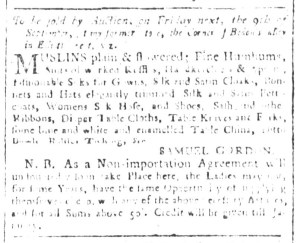
South-Carolina and American General Gazette (September 2, 1774).

“A Non-importation Agreement will undoubtedly soon take Place here.”

A week in advance of an auction to be held on September 9, 1774, Samuel Gordon took to the pages of the South-Carolina and American General Gazette to promote the various items up for bids.  The sale would include “MUSLINS plain & flowered; Fine Humhums, … fashionable Silks for Gowns, Silk and Satin Cloaks, Bonnets and Hats elegantly trimmed, Silk and Satin Petticoats, Womens Silk Hose, and Shoes, [and] Sash and other Ribbons.”  In addition, Gordon listed “Table Cloths, Table Knives and Fork, [and] some blue and white and enamelled Table China.”  He concluded with “&c.” (an abbreviation for et cetera) to indicate that consumers could acquire a variety of other wares at the auction.

Gordon appended a nota bene to his notice: “As a Non-importation Agreement will undoubtedly soon take Place here, the Ladies may not, for some Years, have the same Opportunity of supplying themselves cheap, with any of the above necessary Articles.”  The auctioneer referred to measures under consideration in response to the Boston Port Act, the Massachusetts Government Act, and the other Coercive Acts passed by Parliament in retaliation for the Boston Tea Party.  Throughout the colonies, patriots came to the defense of Massachusetts, rallying to determine common measures to address infringements on their liberty and rights as English subjects.  At the moment that Gordon published his advertisement, delegates were already arriving in Philadelphia for what would become known as the First Continental Congress.  Their deliberations would result indeed result in the Continental Association, a trade boycott intended as political leverage.  Colonizers had previously adopted similar nonimportation agreements in response to the Stamp Act and the duties on certain goods levied in the Townshend Acts.

Gordon encouraged readers to draw on their memories of the conditions during those boycotts or imagine what would likely happen when another nonimportation agreement went into effect.  He stoked fear and anxiety that goods would become scarce and, as a result, much more expensive.  Colonizers needed to acquire textiles and housewares while they were available and while they were affordable.  To facilitate that, he offered credit until January for purchases that exceeded fifty pounds.  That suggests that even though he addressed “Ladies,” the colonizers so often accused of the vice of luxuriating in consumption in newspaper editorials of the era, that he actually anticipated that it would be merchants and retailers, most of them men, who would make bids and purchase this merchandise with the intention of selling it once again.  Still, readers considered Gordon’s warning as they perused the many other advertisements for imported goods in the newspaper.  The auctioneer committed to print what many colonizers were likely thinking about their prospects for purchasing goods in the coming months and years.

November 17

What was advertised in a colonial American newspaper 250 years ago today?

South-Carolina Gazette and Country Journal (November 17, 1772).

“A large and valuable Assortment of Goods.”

Samuel Gordon promoted the “large and valuable Assortment of Goods” he sold at the “IRISH LINEN WARE-HOUSE” in an advertisement in the November 17, 1772, edition of the South-Carolina Gazette and Country Journal.  Contrary to the name of his store, Gordon’s inventory extended far beyond textiles.  To aid prospective customers in perusing his notice, he identified more than two dozen categories of merchandise, including “MILLINARY,” “SHOES,” “HOSIERY,” “CHINA,” “GLASS,” “LOOKING-GLASSES,” “STATIONARY,” and “PEWTER.”  Each of those categories appeared in capitals, indented to form a new paragraph, and followed by a short description or list of goods.  The format likely made Gordon’s advertisement easier for readers to navigate than others that featured dense blocks of text.  Alexander Gillon’s advertisement, for instance, occupied a similar amount of space and included a similar number of items, but nothing about the format differentiated any of the goods from others.

In contrast, Gordon deployed short passages that invited prospective customers to engage with the various kinds of merchandise he stocked.  For “HATS,” he had a “choice of mens fine fashionable hats, felt ditto, ladies riding ditto.”  He did not go into greater detail, but instead encouraged readers to imagine the choices and then visit his store to see for themselves.  The “STATIONARY” items included a “great choice of pocket-books, quills, wax, wafer, paper of different qualities, and a complete set of large books, viz. ledger, journal, and waste-book.”  Gordon composed a longer blurb for “CUTLERY,” mentioning a “great choice of knives and forks, ditto in cases, razors, ditto in cases, … carving-knives, pen-knives,” and related items.  He repeatedly used the word “choice” to signal to prospective customers that they ultimately made decisions according to their own taste and budget rather than settling for whatever happened to be on the shelves.  Similarly, he used variations that included “large assortment,” “different sorts,” “large quantity,” and “variety.”  Many blurbs concluded with “&c.” (an abbreviation for et cetera), suggesting that far more choices awaited those who entered Gordon’s store.

Gordon did not rely on choice alone in marketing his wares.  He also offered a discount to “Merchants who may want any of the above articles.”  He extended credit, while promising a “discount of Ten per cent” to merchants who paid their accounts in January.  Gordon likely intended that the carefully formatted list of wares would spark interest and then the discount in the nota bene would seem like too good of a bargain for merchants to ignore.  The design of the advertisement suggests that Gordon carefully considered his marketing strategy rather than simply publishing an announcement that he had imported goods for sale.

January 7

What was advertised in a colonial American newspaper 250 years ago today?

South-Carolina Gazette and Country Journal (January 7, 1772).

“They will be put up in small Lots for the better Conveniency of private Families.”

Samuel Gordon planned to leave South Carolina in February 1772.  In advance of his departure, he advertised that he would sell a variety of goods at auction on January 10.  To entice bidders, he listed many of those items, including “a great Variety of blue and white enameled Dishes and Plates,” “a great Number of Tea, Coffee, and Chocolate Cups and Saucers,” “Decanters and Wine Glasses,” and “an Assortment of Table Knives and Forks.”  He concluded the list with “&c.” (the abbreviation for et cetera commonly used in the eighteenth century) to indicate far more choices awaited those who attended the auction.

Gordon did not want prospective bidders to assume that he was attempting to get rid of merchandise that had lingered on the shelves at his “IRISH LINEN WARE-HOUSE” in Charleston.  He asserted that he had recently imported the goods “in the HEART-OF-OAK, who arrived here the Twentieth of December Instant, from LONDON.”  In other words, he acquired his inventory three weeks before the auction.  Colonizers had an opportunity to purchase new goods shipped from the cosmopolitan center of the empire for bargain prices at auction.

Yet they did not need to wait until the day of the auction if any of the textiles, housewares, and other items interested them.  In a nota bene, Gordon stated that he “continues to sell any of the above Goods at a very low Advance, till the Day of the Sale.”  He invited customers to visit his warehouse to examine the merchandise and select what they wished to purchase rather than take chances bidding against others at auction.  He offered low prices to make this option as attractive as the prospects of a good deal at auction.  Gordon also explained that any remaining inventory that went to auction “will be put up in small Lots for the better Conveniency of private Families.”  That meant that items would be bundled together.  Consumers who wished to purchase only specific items needed to buy them before the auction.

In his efforts to liquidate his merchandise before leaving the colony, Gordon sought to incite interest in new goods recently received from London.  He scheduled an auction for colonizers hoping for deep discounts via low bids, but also continued sales at his warehouse for others who wanted the security of making purchases without bidding against competitors.  Offering colonizers both means of acquiring his goods had the advantage of maximizing his revenue while also clearing out his inventory.