July 6

What was advertised in a revolutionary American newspaper 250 years ago today?
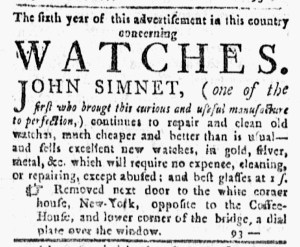
New-York Journal (July 6, 1775).

“Removed next door to the white corner house … a dial plate over the window.”

John Simnet, a cantankerous watchmaker who frequently advertised in New York’s newspapers in the early 1770s, once again took to the pages of the New-York Journal in the summer of 1775.  In this notice, he announced that he “continues to repair and clean old watches … and sells new watches.”  He took a neutral tone in that notice compared to the derogatory declarations he sometimes made about his competitors in other advertisements.  Simnet did state that he cleaned and repaired watches “much cheaper and better than is usual,” comparing the price and quality of his services to those offered by other watchmakers, but he did not denounce any competitors by name or launch into a diatribe about the general incompetence of those who followed an occupation he often claimed as solely his own.  He also described himself as “one of the first who brought this curious and useful manufacture to perfection,” but limited that comment to promoting his own work rather than denigrating other watchmakers.

Perhaps Simnet was more interested in drawing attention to his new location.  He moved from a shop “at the Dial, next Beekman’s Slip, in Queen Street” to a shop “next door to the white corner house, New-York, opposite to the Coffee-House, and lower corner of the bridge.”  Detailed directions were necessary.  Neither New York nor any other town had standardized street numbers in the 1770s, though some of the largest port cities would begin assigning them by the end of the century.  Sinnet resorted to landmarks to direct customers to his shop.  Like many other entrepreneurs, he also marked his location with a device that represented his business, “a dial plate over the window.”  It may have been the same “Dial” that had adorned his previous location.  If Simnet did transfer the “dial plate” from one shop to another, he maintained a consistent visual image for customers and others to associate with his business.  Other entrepreneurs who placed advertisements in the July 6, 1775, edition of the New-York Journal also used images to mark their locations, including James Wallace, a lacemaker and tailor “At the SIGN of the HOOD,” and William Pearson, a clock- and watchmaker “At the Dial, in HANOVER-SQUARE.”  That a competitor displayed a dial made Simnet’s elaborate directions imperative.  He did not want prospective customers stopping by another shop by mistake.
June 11

What was advertised in a colonial American newspaper 250 years ago today?

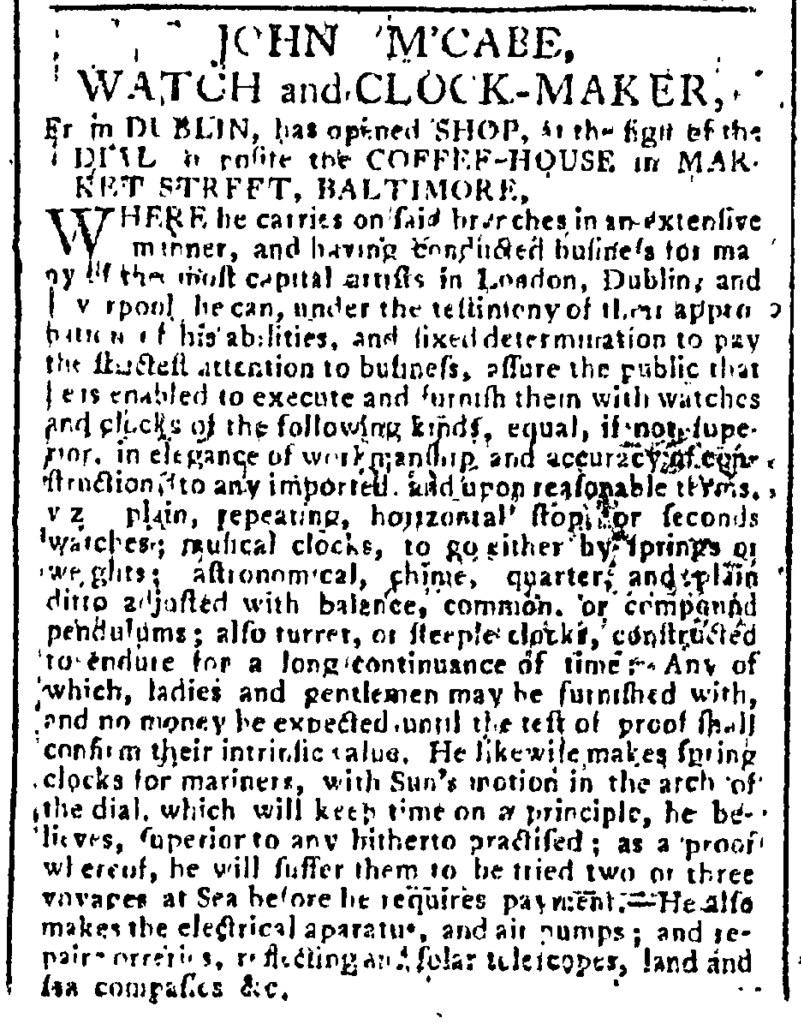
Maryland Journal (June 11, 1774).

“No money be expected until the test of proof shall confirm their intrinsic value.”

When he set up shop “at the sign of the DIAL” in Baltimore, John McCabe, a “WATCH and CLOCK-MAKER, From DUBLIN,” deployed a marketing strategy commonly undertaken by artisans who migrated across the Atlantic to the colonies.  In an advertisement in the June 11, 1774, edition of the Maryland Journal, he sought to establish his reputation in a town that did not have firsthand knowledge of his skill.  Instead, he relied on an overview of his experience, asserting that he had “conducted business for many of the most capital artists in London, Dublin, and Liverpool.”  Having worked in the most exclusive shops in urban centers, especially the cosmopolitan center of the empire, gave the newcomer a certain cachet, enhanced even more by the “testimony of their approbation of his abilities” that he claimed he could produce.

Yet McCabe did not rest on such laurels that were not immediately apparent to readers.  Instead, he simultaneously declared that his “fixed determination to pay the strictest attention to business.”  Underscoring his industriousness also came from the playbook developed by other artisans, a familiar refrain in their advertisements.  Prospective customers who might have been skeptical of McCabe’s credentials could judge for themselves whether he made clocks and watches “equal, if not superior, in elegance of workmanship and accuracy of construction to any imported.”  They could acquire such timepieces “upon reasonable terms,” getting the same style and quality as watches and clocks from London without paying exorbitant prices.

Even though the initial portions of his advertisement resembled notices placed by other artisans, McCabe, he did include an offer not made nearly as often: allowing a trial period for customers to decide if they wished to purchase or return watches and clocks from his shop.  The enterprising artisan declared that “ladies and gentlemen may be furnished” with any of the variety of clocks and watches listed in his advertisement and “no money be expected until the test of proof shall confirm their intrinsic value.”  McCabe did not explicitly state that customers could return items they found lacking, so confident was he that they would indeed be satisfied with his wares during the trial.  He extended a similar offer for “spring clocks for mariners … which keep time on a principle, he believes, superior to any hitherto practised.”  Customers could make that determination for themselves: “he will suffer them to be tried two or three voyages at Sea before he requires payment.”  Such arrangements would have required some negotiation about the amount of time and the length of those voyages, but allowing for such trials before collecting money from customers did not put McCabe at a disadvantage in the eighteenth-century commercial culture of extending extensive credit to consumers.  Prospective customers likely expected credit, so McCabe gained by transforming the time that would elapse between purchase and payment into a trial, giving those customers the impression that they received an additional benefit from doing business with him.  For some, that may have been the more effective marketing strategy than any claims about his experience working in the best shops in London, Dublin, and Liverpool.

December 10

What was advertised in a colonial American newspaper 250 years ago today?

New-London Gazette (December 10, 1773).

“Forward their Watches to me … by applying to Mr. JOSEPH KNIGHT, Post-Rider.”

Thomas Hilldrup, “WATCK-MAKER from LONDON,” continued his advertising campaign in the fall of 1773.  Having settled in Hartford the previous year, he first set about cultivating a local clientele with advertisements in the Connecticut Courant, that town’s only newspaper.  Over time, he expanded his marketing efforts to include the Connecticut Journal and New-Haven Post-Boy and the New-London Gazette.  That meant that he advertised in every newspaper published in Connecticut at the time.  In an advertisement that ran for several months, Hilldrup declared that he had been “IMbolden’d by the encouragement receiv’d from the indulgent public” to move to a new location “now distinguish’d by the sign of the Dial.”  In other words, business had been good, customers had entrusted their watches to the enterprising newcomer for cleaning and repairs, and that demand for his services meant that others should engage him as well.

To that end, Hilldrup presented instructions for sending watches to his shop.  He appended a nota bene to his advertisement in the New-London Gazette, stating that the “Gentlemen of New-London, or adjacent, that are inclined to forward their Watches to me, may depend on having them done as well and as cheap as in Boston or New-York.”  In addition, Hilldrup offered speedy service, promising to return watches “the next Week.”  Clients could take advantage of these services, including a one-year warranty, “by applying to Mr. JOSEPH KNIGHT, Post-Rider.”  Knight did far more than deliver letters and newspapers from town to town.  He also contracted with various entrepreneurs to facilitate their businesses.  In addition to transporting watches for Hilldrup, Knight also sold “An ORATION, Upon the BEAUTIES of LIBERTY,” a popular political tract, in collaboration with Timothy Green, the printer of the New-London Gazette, and Nathan Bushnell, Jr., another post rider.  In forming a partnership with Knight, Hilldrup established an infrastructure for transporting watches to and from his shop, one that he could promote to prospective clients who might have otherwise been anxious about sending their watches over long distances.  Enlisting an associate already familiar in several towns in Connecticut, Hilldrup marketed an approved and secure method for sending watches to him to restore “to their pristine vigour.”

July 23

What was advertised in a colonial American newspaper 250 years ago today?

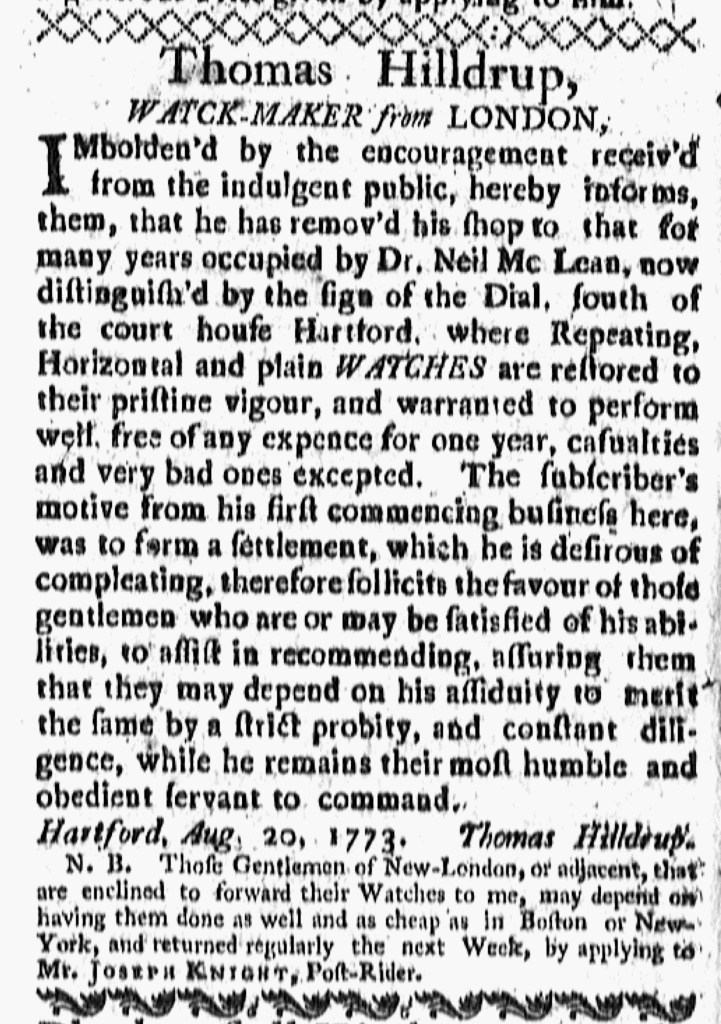
Connecticut Journal and New-Haven Post-Boy (July 23, 1773).

WATCHES are restored to their pristine vigour, and warranted to perform well, free of any expence for one year.”

Though dated “Hartford, July 20, 1773,” Thomas Hilldrup’s advertisement in the July 23 edition of the Connecticut Journal and New-Haven Post-Boy had been composed much earlier.  The same copy first ran in Connecticut Courant, published in Hartford, on May 25.  It appeared in each issue of that newspaper since then, though Hilldrup dropped a short nota bene carried over from his previous advertisement after two insertions.  In this latest advertisement, Hilldrup, a “WATCH MAKER from LONDON,” declared that he had already met with so much success during his brief time in Connecticut, that he had been so “IMbolden’d by the encouragement receiv’d from the indulgent public,” that he “remov’d his shop” to a new location.  Prospective customers could find him at “the sign of the Dial” in the shop formerly occupied by Dr. Neil McLean near the courthouse in Hartford, “where Repeating, Horizontal and plain WATCHES are restored to their pristine vigour, and warranted to perform well, free of any expence for one year.”

After publishing this promotion in the Connecticut Courant for two months, Hilldrup extended that guarantee to readers of the Connecticut Journal.  It was not the first time, however, that the watchmaker took to the pages of a newspaper printed in another town in his efforts to build a large enough clientele to allow him to settle permanently in Hartford.  His advertising campaign commenced in the Connecticut Courant in the fall of 1772, but eventually expanded to the Connecticut Journal and New-Haven Post-Boy and the New-London Gazette during the winter months.  The newcomer ran advertisements in every newspaper published in the colony at the time, making it clear that local watchmakers who already established their reputations among prospective customers faced some new competition.  Placing an advertisement in the Connecticut Journal and New-Haven Post-Boy the first time may have been an experiment for a watchmaker who recently arrived in Hartford.  Opting to place another advertisement in that newspaper six months later, however, indicated that he believed the first one had been effective in generating business beyond clients served primarily by Hartford’s Connecticut Courant.  Even then, he did not consider merely announcing his presence in Hartford sufficient to draw clients to his shop.  Instead, he offered a one-year guarantee on repairs to convince prospective customers to give him a chance over his competitors.