March 7

What was advertised in a colonial American newspaper 250 years ago today?
South-Carolina Gazette and Country Journal (March 7, 1775).

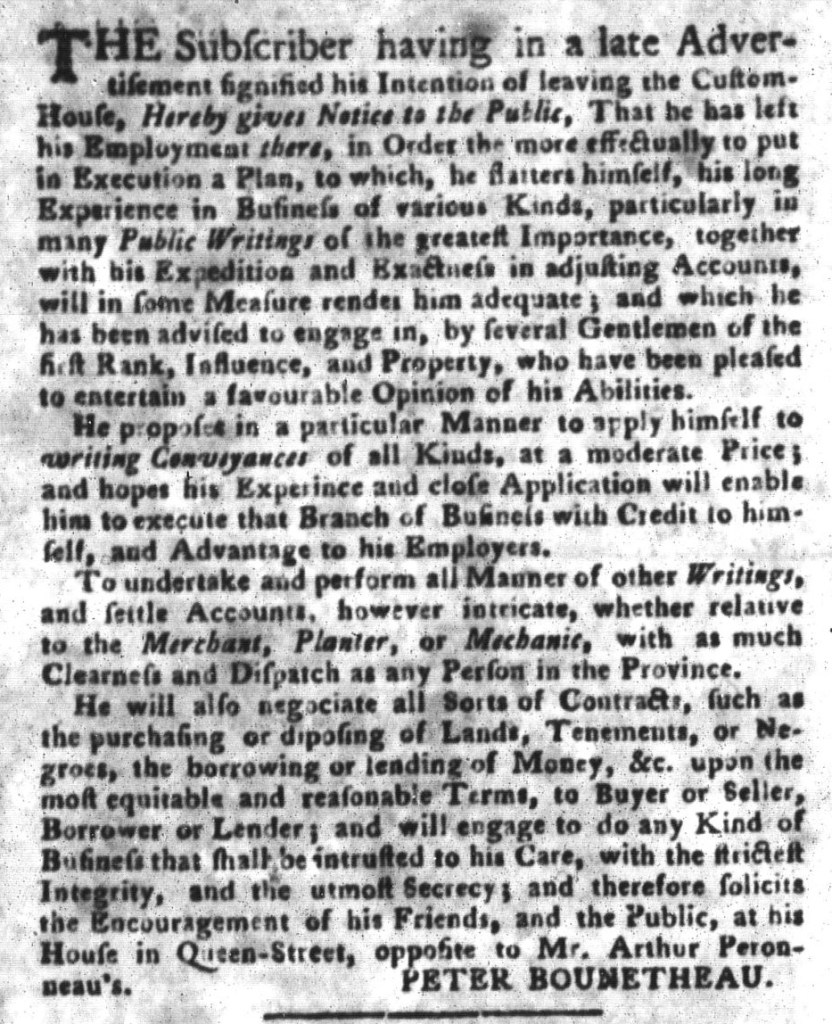
“He proposes … to apply himself to writing Conveyances of all Kinds.”

On the eve of the American Revolution, Peter Bounetheau left his job at the custom house in Charleston and established his own business for “writing Conveyances of all Kinds” and negotiating “all Sort of Contracts, such as the purchasing or disposing of Lands, Tenements, or Negroes [and] the borrowing or lending of Money.”  He claimed that he had done so on the advice of “several Gentlemen of the first Rank, Influence, and Property, who have been pleased to entertain a favourable Opinion of his Abilities.”  In addition to that endorsement, he emphasized “his long Experience in Business of various Kinds, particularly in many Public Writings of the greatest Importance, together with his Expedition and Exactness in adjusting Accounts.”

By the time his advertisement ran in the March 7, 1775, edition of the South-Carolina Gazette and Country Journal, Bounetheau had been in business for several months.  He had established himself well enough to attract clients that accounted for twelve other advertisements of various lengths on the same page.  A couple concerned real estate and a couple hawked commodities like mustard and olives, yet most of them offered enslaved people for sale.  Six of those advertisements enumerated three enslaved men, ten enslaved women, and six enslaved women that Bounetheau sought to sell on behalf of others.  A seventh advertisement listed “Several NEGROES,” but did not specify how many beyond “a complete boatman and jobbing carpenter” and “a complete washer and ironer.”  The others were “field slaves.”

Bounetheau’s enterprise meant good business for Charles Crouch, the printer of the South-Carolina Gazette and Country Journal.  Week after week, the broker placed multiple advertisements, representing significant revenues for the printing office.  In the March 7 edition, his notices filled an entire column and nearly half of another out of twelve total columns in a standard issue of four pages consisting of three columns each.  That meant that Bounetheau generating ten percent of the content.  Another broker, Philip Henry, inserted fifteen advertisements that occupied the same amount of space, though he focused more on real estate than enslaved people.  Still, he offered “TWENTY-TWO young and healthy NEGROES, that have been used to a Plantation” in one notice and “ELEVEN NEGROES, chiefly Country born” in another.  These brokerage firms likely increased the number of advertisements that ran in the South-Carolina Gazette and Country Journal and other newspapers published in Charleston in the 1770s.  Such endeavors included greater dissemination of advertisements that contributed to perpetuating the slave trade.
September 20

Who was the subject of an advertisement in a colonial American newspaper 250 years ago today?

South-Carolina Gazette and Country Journal (September 20, 1774).

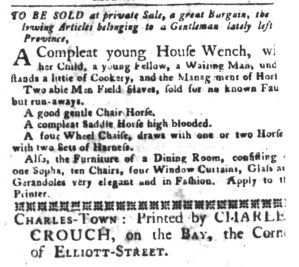
“TO BE SOLD … Two able Men Field Slaves … Apply to the Printer.”

On behalf of a customer, “a Gentleman lately left the Province,” Charles Crouch, the printer of the South-Carolina Gazette and Country Journal, advertised a variety of “Articles” available “at private Sale, a great Bargain.”  Those articles included horses, a carriage with two sets of harnesses and “the Furniture of a Dining Room, consisting of one Sopha, ten Chairs, four Window Curtains, Glass and Gerandoles.”  Crouch informed interested parties that they should “Apply to the Printer,” taking on the role of broker and intermediary.

In addition to the horses and housewares, the “Articles” for sale also include people treated as commodities.  The list commenced with a “compleat young House [Woman], with her Child, a young Fellow, a Waiting Man, understands a little of Cookery, and the Management of Horses” and “Two able Men Field Slaves, sold for no known Fault but run-aways.” Crouch, the printer, facilitated the sale of those enslaved people, perhaps even earning a commission.  He certainly generated revenue from running the advertisement in his newspaper, along with more than a dozen advertisements concerning enslaved people in the September 20, 1774, edition of the South-Carolina Gazette and Country Journal.  Peter Bounetheau and Jacob Valk, brokers of “LANDS, HOUSES, NEGROES, and other Property,” placed many of the others, making them good customers for the newspaper.  In this instance, however, Crouch acted as a slave broker, assuming responsibilities beyond printing and disseminating the advertisement.  The placement of the colophon underscored that was the case.  It appeared immediately below the advertisement: “CHARLES-TOWN: Printed by CHARLES CROUCH, on the BAY, the Corner of ELLIOTT-STREET.”

Two days ago, the Slavery Adverts 250 Project, a companion to the Adverts 250 Project, marked eight years of identifying, remediating, and republishing advertisements about enslaved people originally published in American newspapers 250 years ago that day.  To date, the project includes more than 27,000 advertisements place for various purposes, such as enslaved people for sale, enslaved people wanted to purchase or hire, and descriptions of enslaved people who liberated themselves by running away from their enslavers (as two of the enslaved men in today’s advertisement had done at some point, perhaps captured and returned to slavery as a result of the surveillance encouraged by a newspaper advertisement).  In many instances, advertisements offering enslaved people for sale incorporated some variation of “enquire of the printer.”  From New England to Georgia, printers like Crouch provided an information infrastructure for perpetuating slavery and the slave trade and even served as agents who brokered sales of enslaved men, women, and children.

August 9

What was advertised in a colonial American newspaper 250 years ago today?

South-Carolina Gazette and Country Journal (August 9, 1774).

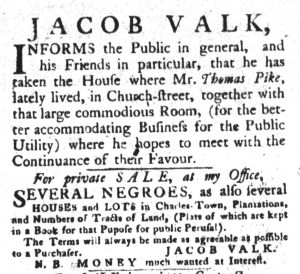
“That large commodious Room, (for the better accommodating Business for the Public Utility).”

Jacob Valk continued to do well as a broker for “Lands, Houses, and Negroes” in Charleston in the summer of 1774.  He attracted so many clients that the advertisements he placed on their behalf filled two of the three columns on the first page of the August 9, 1774, edition of the South-Carolina Gazette and Country Journal.  In addition to that publication, he regularly bought a significant amount of space in the South-Carolina Gazette and the South-Carolina and American General Gazette.  His investment in advertising testified to his belief in its effectiveness, while the number of advertisements demonstrated the extensive demand for his services.

Such success prompted him to move his brokerage office to a new location.  He announced that he “has taken the House where Mr. Thomas Pike, lately lived … together with that large commodious Room, (for the better accommodating Business for the Public Utility).”  Pike had recently departed the city after offering dancing and fencing lessons to its residents for a decade.  He hosted an annual ball for his students to display their talents, most recently in the “New-Assembly Room” where Valk now conducted business.  Even while he was still in town, Pike had rented the room for “Public Sales, of Estates, Negroes, [and] Dry Goods.”  With Valk on the scene, the space only occasionally used for the buying and selling of enslaved men, women, and children now became a site dedicated to perpetuating the slave trade.

Immediately below his note about his new location, Valk advertised “SEVERAL NEGROES” available “For private SALE, at my Office.”  In the subsequent advertisements that filled those two columns, he also sought buyers for “two very valuable Negro Shoemakers” and “TWO or three exceeding good SEAMSTRESSES, and some young Negro Fellows, capable of all Work.”  He also put out a call for a “good Negro CARPENTER,” seeking an enslaver interested in selling a skilled artisan.  Although most of these enslaved people did not need to appear in the “New-Assembly Room” for Valk to broker the sales, that “large commodious Room” did lend itself to putting enslaved people on display.  Colonizers who sought Valk’s services buying and selling enslaved people did conduct business in the space formerly used for dancing lessons.  Some of them had likely socialized there during Pike’s annual balls before buying and selling enslaved people in the same space after the dancing master’s departure from the city.  Valk seamlessly moved his brokerage office there, a testament to how slavery was so deeply enmeshed in daily life in colonial Charleston and other urban centers.

September 10

What was advertised in a colonial American newspaper 250 years ago today?

Massachusetts Spy (September 10, 1772).

“The New Auction-Room and Intelligence-Office.”

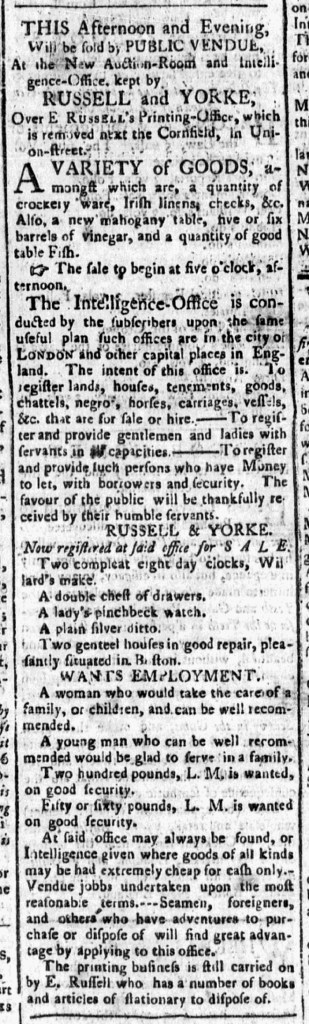
The partnership of Russell and Yorke operated the “New-Auction-Room and Intelligence-Office” in Boston in 1772.  In the September 10 edition of the Massachusetts Spy, they explained to prospective clients that the intelligence office “is conducted … upon the same useful plan such offices are in the city of LONDON and other capital placed in England.”  Russell and Yorke served as agents who registered real estate, commodities, livestock, and other items “for sale or hire.”  They also introduced colonizers with money to invest to borrowers who could provide “security.”  In addition, they offered employment services, keeping a roster of colonizers seeking employment in order to “provide gentlemen and ladies with servants in all capacities.”  In the auction room, they conducted sales “upon the most reasonable terms” for clients who entrusted them to sell “goods of all kinds.”  Their advertisement included sections for items “Now registered at said office for SALE” (including “A lady’s pinchbeck watch” and “Two genteel houses in good repair, pleasantly situated in Boston”) and people who “WANT EMPLOYMENT” (including “A woman who would take the care of a family, or children, and can be well recommended”).

Russell and Yorke listed “negros” among the commodities they registered and sold at the intelligence office, acknowledging that slavery and the slave trade were enmeshed in commerce and daily life in Boston during the era of the American Revolution.  One of the partners, Ezekiel Russell, also ran a printing office.  For less than six months, from late November 1771 through early May 1772, he published a combination political magazine and newspaper called The Censor.  That publication occasionally included a supplement for advertising, but did not attract many advertisers during its short run.  No advertisements offering enslaved people for sale or offering rewards of the capture and return of enslaved people who liberated themselves by running away from their enslavers appeared in extant issues, differentiating The Censor from other colonial newspapers.  That does not seem, however, to have been the result of a principled stand by Russell but rather an outcome grounded in failing to recruit advertisers for a publication with low circulation numbers during its brief existence.  Just a few months after The Censor folded, the printer advertised his services as an agent who registered “negros” at the intelligence office “Over E. RUSSELL’s Printing-Office” in Boston.  While other printers in the city acted as slave brokers when they disseminated “enquire of the printer” advertisements in their newspapers, Russell promoted the services he provided as a slave broker at his new intelligence office.  In printing offices and intelligence offices alike, facilitating the buying and selling of enslaved men, women, and children was one of many services available to colonizers.