June 30

What was advertised in a revolutionary American newspaper 250 years ago today?
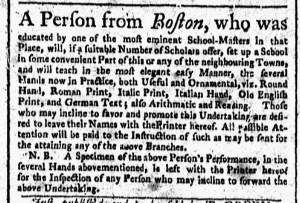
Connecticut Gazette (June 30, 1775).

“A Person from Boston … will teach … the several Hands now in Practice.”

A “Person from Boston” sought to open a school in southwestern Connecticut in the summer of 1775.  He placed an advertisement in the Connecticut Gazette in hopes of reaching prospective pupils and their families, stating that he would commence instruction in New Haven “or any of the neighbouring Towns” if a sufficient number of “Scholars” signed up for lessons.  In addition to reading and arithmetic, he taught “the several Hands now in Practice, both Useful and Ornamental,” including “Round Hand, Roman Print, Italic Print, Italian Hand, Old English Print, and German Text.”

The schoolmaster did not give his name, instead merely identifying himself as a “Person from Boston, who was educated by one of the most eminent School-Masters in that Place.”  He asked that those “who may incline to favor and promote this Undertaking … leave their Names with the Printer” of the Connecticut Gazette.  Timothy Green, the printer, likely did more than keep a list of names of interested students.  He served as a surrogate for the anonymous schoolmaster.  Even though residents of New Haven and the vicinity did not know the “Person from Boston,” they did know Green and could ask him for his impressions of the man, whether he seemed reputable and capable of the instruction he proposed. Furthermore, the unnamed schoolmaster left “A Specimen of the above Person’s Performance, in the several Hands mentioned” at the printing office “for the Inspection of any Person who may incline the forward the Undertaking.”  Anyone who visited the printing office for that purpose could chat with Green about the “Person from Boston” as they examined the “Specimen.”

They might have learned that he was a refugee from Boston who left the city following the battles at Lexington and Concord.  When the siege of Boston commenced, Governor Thomas Gage and the Massachusetts Provincial Congress negotiated an agreement that allowed Loyalists to enter the city and Patriots and others to depart.  Other refugees from Boston resorted to newspapers advertisements to attract customers and clients after taking up residence in new towns.  It may have been a similar situation for the “Person from Boston” who found himself in New Haven at the beginning of the Revolutionary War.

January 14

What was advertised in a colonial American newspaper 250 years ago today?

Jan 14 - 1:14:1768 Pennsylvania Gazette
Pennsylvania Gazette (January 14, 1768).

“He hath a medallion in clay … as a specimen of his abilities.”

In addition to marketing a “Neat assortment” of ceramics and hardware, Joseph Stansbury also used his advertisement in the January 14, 1768, edition of the Pennsylvania Gazette to “acquaint the public, he is well versed in designing and executing any kind of ornaments in stucco, for cielings or walls of rooms, basto relievo’s, &c.” He offered his services as an artisan to colonists interested in sprucing up the interior architecture of their homes according to the prevailing styles and tastes.

Stansbury did not expect prospective clients merely to take him at his word that he was “well versed in designing and executing” those decorative elements. Instead, he presented an opportunity for them to examine a sample of his work and determine for themselves whether he possessed the level of skill he claimed. Interested parties could visit his shop on Market Street where “he hath a medallion in clay, of the present King of Poland, executed here from his coronation medal … which he will shew to the curious, as a specimen of his abilities.” This sample likely had some cachet among genteel colonists. According to Richard Butterwick, in 1764 the Polish king’s coronation medal had been “struck in England by Thomas Pingo, who had earlier struck the medal for George III’s coronation.”[1] As early as 1765 descriptions of the medal, supplemented by engraved images, circulated in magazines published in England and Ireland, which may have been Stansbury’s source for his clay specimen.[2]

Stansbury did not consider newspaper advertising alone sufficient to entice potential clients to commission his services. Advertisements acted as an opening salvo that informed colonists of the services he offered, but the specimen he displayed may have been the more powerful marketing tool. No matter how elaborate the description of his work he might publish, words could not compare to the opportunity to examine, by sight and by touch, a sample that demonstrated his abilities.

Jan 14 - Engraving
Detail of engraving of coronation medal for Stansilaw II from Gentleman’s and London Magazine (March 1765).

**********

[1] Richard Butterwick, Poland’s Last King and English Culture: Stanislaw August Poniatowski, 1732-1798 (Oxford: Clarendon Press, 1998), 221.

[2] Gentleman’s and London Magazine; or Monthly Chronologer (Dublin: John Exshaw, March 1765), 156 and leaf between 156 and 157.