May 15

What was advertised in a colonial American newspaper 250 years ago today?

New-London Gazette (May 15, 1772).

“A STAGE-WAGGON … from Sagharbour on Long-Island, to New-York.”

Newspaper advertisements documented some of the transportation infrastructure established in the colonies in the early 1770s.  The May 15, 1772, edition of the New-London Gazette, for instance, carried an advertisement for a “STAGE-WAGGON” that operated between New York City and Sag Harbor, a village on Long Island, and an advertisement for “Passage-Boats” that connected New London and Norwich.

Samuel Stockwell and John Springer informed readers who needed to travel or transport goods along the Thames River between New London on the coast and Norwich in the interior of the colony that their boats “Continue to ply every Day, Wind and Weather permitting.”  They pledged to keep to their schedule as faithfully as possible.  Stockwell and Springer included images of two vessels in their advertisement, simultaneously suggesting their industriousness and the destinations they served.

A more extensive advertisement for the wagon between New York and Sag Harbor explained that the route “will greatly facilitate the travelling between the New England and Southern Provinces.  That was made possible by combining travel on the wagon with sailing on “a Passage-Boat kept by James Wiggins” that crossed Long Island Sound between Sag Harbor and New London twice a week.  The wagon service departed from both New York and Sag Harbor on Monday mornings.  When they met, they exchanged passengers.  Travelers arrived at their destination by Wednesday evening.  Conveniently, the boat for New London departed “every Thursday Morning, and returns again … on Saturdays.”  Passengers sailing that direction arrived in time to catch a wagon headed to New York on Monday morning.

These two advertisements provided sufficient information for readers to plan trips between Norwich and New York, their journey involving two boats and two wagons in a little less than a week.  In an advertisement for his own stagecoach service in the Connecticut Journal, Nicholas Brown asserted that “Gentlemen from the Southern Provinces, travelling to Boston … generally go by Water from New-York to Providence.”  The advertisements in the New-London Gazetteillustrate other routes available to travelers in New England and New York.

April 28

What was advertised in a colonial American newspaper 250 years ago today?

Connecticut Courant (April 28, 1772).

“Gentlemen willing to become adventurers … in said undertaking.”

In the fall of 1771, Nicholas Brown advertised his intention to operate a stagecoach between Hartford and New Haven.  He also expressed his hope that another stagecoach would connect Hartford and Boston, “encourage[ing] Gentlemen from the Southern Provinces” to pass through Connecticut on their way to Boston instead of traveling “by Water from New York to Providence.”  To help turn that idea into reality, Brown attempted to recruit donors and investors.  He requested that “all Gentlemen disposed to countenance the Undertaking to leave their Names at the Printing-Office in New-Haven, adding such Sum for him, as their Generosity shall dictate.”  For those unwilling to bestow an outright donation, he offered “to admit … into Partnership” anyone “disposed to share with him the Loss or Gain of the Undertaking.”

Brown’s advertisement apparently did not attract as many donors or investors as he hoped.  Several months later, he published a new advertisement, this one co-signed by Jonathan Brown.  They noted that they had “advertised in the public papers, that they should on proper encouragement, establish a STAGE COACH for the conveyance of passengers thro’ the upper post road, to and from New York and Boston.”  They planned to cover that distance in a single week, but determined that the enterprise “cannot be carried on without great expence.”  They lamented that thus far they had not gained “the encouragement from the public that they hoped for,” but reiterated “the usefulness and advantage … to the public” inherent in operating a stagecoach that connected New York and Boston.  Committed to making some progress on the venture, they scaled down their plans “to perform said journey once every fortnight only.”  Still, they sought others who were “willing to become adventurers … in said undertaking” by “supplying horses” or providing other support.

The Browns had an idea for a service they were wished to provide but did not have the resources to launch it on their own.  Harnessing an entrepreneurial spirit, they ran newspaper advertisements to generate interest in their proposal and recruit investors who also recognized its potential and the benefits to the community.  On occasion, newspapers carried brief advertisements seeking investors for unnamed ventures, indicating the amounts they needed but not giving other details.  The Browns offered significantly more information.  When the first round of advertising did not work, they tried again, taking another chance on the power of the press to achieve results.

September 13

What was advertised in a colonial American newspaper 250 years ago today?

Connecticut Journal (September 13, 1771).

“STAGE-COACH … to pass thro’ this Coolony.”

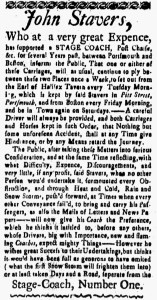
Nicholas Brown aimed to improve the infrastructure that connected the major towns in New England in the early 1770s, establishing his own stagecoach service between Hartford and New Haven to supplement other routes already in existence.  In the summer of 1771, for instance, John Stavers placed advertisements in the Massachusetts Gazette and Boston Weekly News-Letter and the New-Hampshire Gazette to promote “Stage-Coach, Number One” that ran between Boston and Portsmouth.  Stavers sought to ward off competition from a competitor who had only recently established service along the same route.

Brown, on the other hand, added a new route in hopes of better connecting the region.  To that end, he acquired “an elegant, and convenient Stage Coach and four Horses” to cover a route between Hartford and New Haven once a week. He anticipated that another operator would soon set up service from Hartford to Boston, allowing “Gentlemen from the Southern Provinces” to pass through Connecticut on their way to Boston rather than “go by Water from New-York to Providence” and then continue overland to Boston.  New routes meant more options for transporting passengers and freight.

In an advertisement in the September 13, 1771, edition of the Connecticut Journal, Brown framed his endeavor as an investment opportunity and a service that merited the support of local benefactors.  He mentioned “a low and moderate Price,” but did not specify which days his stagecoach ran between Hartford and New Haven or where to meet it in either town.  Instead, he focused primarily on the “great Expence” he already incurred, requesting that “all Gentlemen disposed to countenance the Undertaking” would leave their names and “such Sum … as their Generosity shall dictate” at the printing office.  In addition to accepting donations to make stagecoach service between Hartford and New Haven viable, Brown also invited “any Gentleman … disposed to share with him the Loss or Gain of the Undertaking” to join him as partners.  That first advertisement alerted prospective customers to a new “STAGE-COACH” route, but the proprietor also used it as a prospectus for gaining other kinds of support for his new enterprise.

August 11

What was advertised in a colonial American newspaper 250 years ago this week?

Massachusetts Gazette and Boston Weekly News-Letter (August 8, 1771).

“The first Person that ever set up, and regularly maintain’d a Stage Carriage in New-England.”

John Stavers was not pleased when a competitor set up stagecoach service between Boston and Portsmouth in 1771.  In July, he placed an advertisement in the New-Hampshire Gazette to promote his “Stage-Coach, Number One,” proclaiming that “several Years” experience of transporting passengers, mail, and newspapers meant that his drivers provided superior service.  Stavers also suggested that the “Difficulty, Expence, Discouragements, and very little, if any profit” associated with operating the stagecoach for so many years meant that the public should “give his Coach the Preference” over a newcomer “big with Importance” yet lacking experience.

He placed a similar advertisement in the Massachusetts Gazette and Boston Weekly News-Letter, hoping to draw the attention of prospective passengers at the other end of the line.  Stavers declared that he “was the first Person that ever set up, and regularly maintain’d a Stage Carriage in New-England.”  Regardless of the weather and other conditions, operations continued “at all Seasons” for a decade.  In recognition of both the “Marks of Approbation” he received from prior clients and the “Utility” of the service he provided, he stated that he “therefore humbly hopes that his Carriages will still continue to be prefer’d to any other, that may set up in Opposition to them.”  For those who needed more convincing, Stavers asserted that “his Carriages are universally allow’d to be as convenient, genteel, and easy, and his Horses as good (if not better) than any that have as yet travelled the Road.”  In addition, he promised that “the greatest Care will be taken of all Bundles and Packages.”  For passengers who needed food and lodging upon arriving in Portsmouth, Stavers offered “Good Entertainment at the Earl of Halifax Tavern … equal to any on the Continent,” including any in Boston.  Stavers also listed prices for transporting passengers “in the most genteel and expeditious Manner” from Boston to Portsmouth and Boston to Newburyport so prospective customers could compare rates if they wished.

Stavers never named his competitor in either advertisement, but he did make it clear that he believed his experience resulted in better service for passengers traveling between Boston and Portsmouth.  In addition, he apparently felt that the investment he made operating a stagecoach along that route entitled him to the patronage of travelers who might otherwise choose his rival.  He deployed a carrot-and-stick approach in his marketing efforts, alternating between the describing the benefits associated with his coaches and constructing a sense of obligation for selecting his services.

July 19

What was advertised in a colonial American newspaper 250 years ago today?

New-Hampshire Gazette (July 19, 1771).

“Stage-Coach, Number One.”

John Stavers faced competition for clients … and he did not appreciate it.  In the late 1760s and early 1770s, Stavers operated a stagecoach between Portsmouth and Boston.  For a time, he enjoyed a monopoly on the route, but he tried to convince the public that did not necessarily amount to an unfair advantage.  Instead, Stavers contended, he provided an important service to the community “at a very great Expence” to himself when no one else did.  In an advertisement in the July 19, 1771, edition of the New-Hampshire Gazette, he asked prospective customers to take into account the “Difficulty, Expence, Discouragements, and very little, if any profit” he experienced “when no other Person would undertake” the route.  He did so in service not only to his passengers but also to deliver “the Mails of Letters and News Papers.”

Stavers depicted that as a heroic effort.  His stagecoach had already “surmounted every Obstruction, and through Heat and Cold, Rain and Snow Storm, push’d forward, at Times when every other Conveyance fail’d.”  Regardless of any kind of difficulty, his operation previously ran like clockwork … and would continue to do so.  The stagecoach set off from Stavers’s tavern in Portsmouth on Tuesday morning and departed Boston for the return trip on Friday mornings.  Stavers hired a “careful Driver” and kept the carriage and horses “in such Order, that Nothing bit some unforeseen Accident, shall at any Time give Hindrance, or by any Means retard the Journey.”  Through experience, Stavers was prepared for any obstacle.

Accordingly, he felt “intitled to” the patronage of travelers now that he faced an upstart who challenged him for business.  Stavers requested that the public “now give his Coach the Preference” rather than hire a competitor “whose Drivers, big with Importance, new and flaming Coaches, expect mighty Things.”  Stavers made clear that he did not believe the competition could live up to its promises, especially in the face of “the first Snow Storm” when the seasons changed. Moreover, he felt annoyed that his rival plied the same route and schedule.  Stavers feigned best wishes for the competition, but simultaneously declared his enterprise “Stage-Coach, Number One,” seeking to establish a ranking to influence prospective clients.  Simultaneously, he asked those prospective clients to take his past successes and sacrifices into consideration when choosing which stagecoach service to hire for trips between Portsmouth and Boston.

December 4

What was advertised in a colonial American newspaper 250 years ago today?

Dec 4 - 12:4:1769 New-York Gazette or Weekly Post-Boy
New-York Gazette or Weekly Post-Boy (December 4, 1769).

“Stage-Waggons.”

Eighteenth-century newspapers featured few visual images. Many had some sort of device in the masthead, but usually delivered the news unadorned. Advertisements sometimes included images, but those were the exception rather than the rule. Those that did have woodcuts relied on stock images that belonged to the printer, primarily ships for notices about vessels preparing to depart, horses for advertisements about breeding, houses for real estate notices, and men or women fleeing for advertisements about apprentices and indentured servants who ran away or enslaved people who escaped. Such woodcuts were used interchangeably for advertisements from the appropriate genre. Other images that accompanied advertisements usually appeared because advertisers commissioned a woodcut specific to their business, either replicating their shop signs or depicting their most notable products.

When Joseph Crane and Josiah F. Davenport turned to the pages of the New-York Gazette or Weekly Post-Boy to advertise the stagecoach service they operated between New York and Philadelphia, they included a woodcut depicting a team of horses pulling a covered wagon. This was not one of the standard stock images, suggesting that Crane and Davenport had commissioned it for exclusive use in their advertisements. However, in their advertisements for “Stage-Waggons” that ran between New York and Philadelphia, John Mercereau and John Barnhill published what appeared to be the same image. This was not merely a case of using the woodcut in an advertisement that appeared on one page and then using it again in another advertisement on a page printed on the other side of the sheet. In the December 4, 1769, edition of the New-York Gazette or Weekly Post-Boy, Crane and Davenport’s advertisement featuring the woodcut ran on the same page as Mercereau and Barnhill’s advertisement featuring the woodcut. They had to have been printed simultaneously, indicating that James Parker, the printer, possessed more than one woodcut depicting horses pulling wagons, just as he had multiple woodcuts of ships and houses. It seems unlikely that Crane and Davenport or Mercereau and Barnhill would have commissioned a woodcut that looked so nearly identical to one used by a competitor as to be indistinguishable. Apparently Parker’s collection of stock images was at least a little bit larger than the frequent reiteration of the most common woodcuts suggested. That did not, however, significantly alter the frequency of visual images accompanying either news or advertising in his newspaper. His publication, like other colonial newspapers, consisted almost exclusively of text and a limited number of stock images. That made any visual image, but especially those seen infrequently, all the more notable.

Dec 4 - 12:4:1769 Woodcuts New-York Gazette or Weekly Post-Boy
New-York Gazette or Weekly Post-Boy (December 4, 1769).

December 1

What was advertised in a colonial American newspaper 250 years ago today?

Dec 1 - 12:1:1769 New-Hampshire Gazette
New-Hampshire Gazette (December 1, 1769).

“A Stage from Portsmouth to Boston.”

When Joseph S. Hart established “a Stage from Portsmouth to Boston,” he inserted an advertisement in the New-Hampshire Gazette to provide the particulars to prospective clients. He offered to carry passengers, but also acknowledged that he accepted freight as well. Hart included a schedule, informing readers that he departed Portsmouth for Boston on Fridays and then departed Boston for the return trip on Tuesdays. Each journey began at “about Eight o’Clock in the Morning” in order to allow for a full day of travel.

Although Hart’s stage began or ended each trip at either his house in Portsmouth or “Thomas Hubbart’s in King Street, Boston, at the Sign of Admiral Vernon,” he allowed for other destinations for the convenience of his clients. He pledged to deliver passengers wherever they wished to go. Similarly, those shipping “Bundles” could send them wherever they wished, rather than having to arrange for recipients to retrieve them from Hubbart at the Sign of Admiral Vernon. He did not, however, indicate that he picked up passengers or packages in Boston or Portsmouth, though that may have been negotiable upon contacting Hart to engage his services.

In addition to offering such convenience to passengers and other clients, Hart imbued his entire enterprise with an atmosphere of good service. He carried passengers and goods “with Dispatch” and promised that “All Persons who favour me with their Custom may depend upon being well used.” In making such assertions, Hart repeated sentiments often deployed in newspaper advertisements for consumer goods and services. Although he used formulaic words and phrases, he also communicated to prospective clients that he understood their expectations and that they should anticipate the same attention and quality service from him that they received from other entrepreneurs who had been established for quite some time. Indeed, for this new endeavor Hart assured prospective clients that he would deliver a pleasant experience as part of delivering them to their destinations.

August 22

What was advertised in a colonial American newspaper 250 years ago today?

Aug 22 - 8:22:1768 Massachusetts Gazette Green and Russell
Massachusetts Gazette [Green & Russell] (August 22, 1768).
Norwich Stage-Coach.”

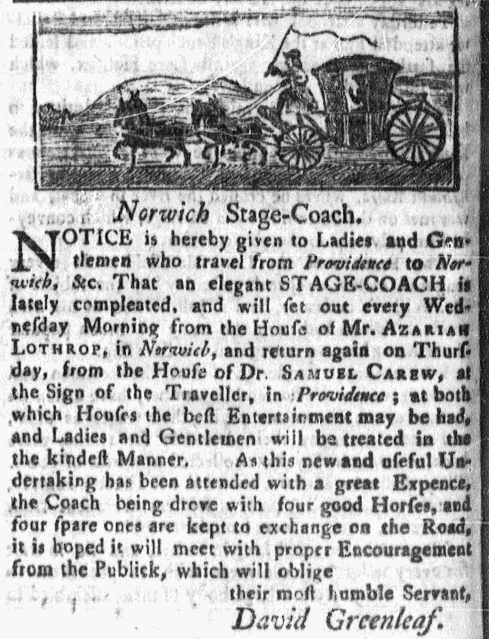
As the summer of 1768 drew to a close, David Greenleaf established a new “Stage-Coach” line between Norwich, Connecticut, and Providence, Rhode Island. The stagecoach made one trip each week, covering a distance of almost fifty miles in each direction. Passengers could depart “from the House of Mr. AZARIAH LOTHROP, in Norwich” on Wednesday mornings and arrive at “the House of Dr. SAMUEL CAREW, at the Sign of the Traveller, in Providence” later in the day. The stagecoach made the return trip on Thursdays. Greenleaf saw to the comfort of the travelers who availed themselves of this new service, providing an “elegant STAGE-COACH” drawn by “four good Horses.” To make the trip as speedy as possible, Greenleaf also arranged for “four spare ones … to exchange on the Road.” In addition, he carefully selected the terminals for this new stagecoach line. Lothrop and Carew both offered “the best Entertainment” for passengers while they waited to make the journey. Greenleaf made the entire journey an experience, promising that “Ladies and Gentlemen will be treated in the kindest Manner.”

Greenleaf made a significant investment in this venture. He implicitly said as much in his description of the new stagecoach and the many horses. He more explicitly made the point when he argued that since “this new and useful Undertaking has been attended with a great Expence” that he hoped “it will meet with proper Encouragement from the Publick.” Advertising in the Massachusetts Gazette added to his Greenleaf’s expenses, but he certainly expected a return on that investment. To increase the effectiveness of his advertisement, he needed to increase the likelihood that readers would notice it. To that end, he incurred the extra expense of commissioning a woodcut that depicted a stagecoach drawn by four horses. The image also included a driver with a whip guiding the horses and a passenger peering out from the stagecoach. Compared to other woodcuts that accompanied advertisements, Greenleaf’s image was detailed and well executed. The vignette would have been difficult for readers of the Massachusetts Gazette to overlook. The quality of his coach and service did not matter if prospective customers did not know that the “Norwich Stage-Coach” existed. Enhancing the advertisement with a notable woodcut helped to bring Greenleaf’s new venture to the attention of colonists who planned to travel between Norwich and Providence and beyond.

August 31

What was advertised in a colonial American newspaper 250 years ago today?

Aug 31 - 8:31:1767 Boston-Gazette
Boston-Gazette (August 31, 1767).

“Stage-Coach No. I. … SETS out on every Tuesday Morning.”

Thomas Sabin operated “Stage-Coach No. 1” between Boston and Providence. He had a flair for attracting attention to his transportation services, having advertised the previous summer that travelers would ride in “a most curious four wheeled Carriage, called the AETHERIAL VEHICLE.” Yet Sabin realized that generating business required more than just associating snappy names with the carriages that transported his passengers.

In particular, he advertised widely in both cities. His notice appeared week after week in the Providence Gazette, the only newspaper printed in that city in 1767. In addition, he placed advertisements in at least three out of four of the newspapers published in Boston. On August 31, the Boston Evening-Post, the Boston-Gazette, and the Boston Post-Boy carried identical notices, each with an impressive headline for “Stage-Coach No. 1.”

Sabin neglected only one newspaper, the Massachusetts Gazette, the only Boston newspaper distributed on Thursdays rather than Mondays. Here Sabin missed an opportunity to reach as many potential customers as possible by spreading out his advertisements in multiple newspapers. Or did he? Note the schedule for the Boston to Providence journey. His stagecoach departed on Thursdays. Perhaps Sabin did not consider advertising in the Massachusetts Gazette worth the investment since readers obtained their copies just as he left town. It may have made more sense to advertise widely on Mondays, giving potential passengers three days to make arrangements. He observed a similar schedule in Providence, where his advertisements appeared in a newspaper printed on Saturdays and clients had three days to book seats for departure on the following Tuesday.

Some eighteenth-century advertisers made efforts to maximize the number of potential customers exposed to their marketing efforts. In cities with multiple newspapers, they industriously placed the same notice in each of them. Sabin adopted this strategy, but adapted it to fit the particular circumstances of how his business operated.

August 23

What was advertised in a colonial American newspaper 250 years ago today?

Aug 23 - 8:23:1766 Providence Gazette
Providence Gazette (August 23, 1766).

“A most curious four wheeled Carriage, called the AETHERIAL VEHICLE.”

Thomas Sabin provided transportation between Providence and Boston “or elsewhere” for his clients, but he marketed an experience (not unlike modern car manufacturers and airlines). According to his advertisement, the important part of a trip was not necessarily arriving at the destination. Instead, enjoying the journey itself, including the amenities of his “AETHERIAL VEHICLE,” transformed getting from here to there into an event itself.

This was no ordinary “four wheeled Carriage,” Sabin proclaimed. A variety of factors, including its “wonderful and most elegant Construction,” merited an equally wonderful and most elegant name – the “AETHERIAL VEHICLE” – that distinguished it from any of the other carriages, coaches, chaises, phaetons, and, especially, stage wagons common in colonial America.

Sabin conjured up images of practically gliding from place to place, compared to the bumpy ride passengers experienced when using other wheeled vehicles. “It is airy, and more easy than any other Carriage,” he explained. “It would be almost impossible to describe it’s uncommon Machinery in Words, so as to give an adequate Idea of its Ease and Use.” Sabin implicitly challenged readers with doubts about the accuracy of this hyperbolic description to engage his services and judge for themselves, a crafty way to generate more business.

He also deployed another strategy to encourage the curious to become customers. “Those who are not inclined to ride in it, and desire to see it, shall be waited upon by the Owner to view it, when in his Coach House, gratis.” Once Sabin had potential customers in his “Coach House” and was able to speak to them directly, he could work on convincing them to hire his “AETHERIAL VEHICLE.” It’s difficult to know Sabin conducted himself in person, but it’s possible he could have given the same sort of hard sell that modern consumers encounter when they visit car dealerships.

At the very least, Sabin assured clients that they would receive special treatment when they rode the “AETHERIAL VEHICLE.” He promised that “besides the Satisfaction of being conveyed in so convenient a Machine,” customers “may depend upon the most ready Observance of their Desires, and punctual Compliance with their Commands.” For colonists, this would have been the equivalent of hiring a limousine or flying first class.