August 29

What was advertised in a revolutionary American newspaper 250 years ago today?
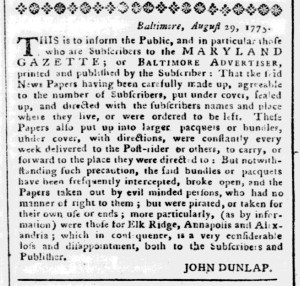
Dunlap’s Maryland Gazette (August 29, 1775).

“The Papers taken out by evil minded persons, who had no manner of right to them.”

Something went wrong.  John Dunlap, the printer of Dunlap’s Maryland Gazette, had a system for delivering his newspaper to subscribers who lived outside of Baltimore, but “evil minded persons” interfered with it.  In particular, disruptions occurred in Annapolis and Elk Ridge, both in Maryland, and Alexandria, Virginia.  That prompted Dunlap to run a notice in the August 29, 1775, edition, placing it immediately after local news and first among the advertisements to increase the likelihood that readers would see it.

The exasperated printer went into great detail about his delivery infrastructure, hoping to convince “the Public, and in particular those who are Subscribers” that he made every effort to follow through on his obligation to deliver the newspaper.  The correct number of copies had been “carefully made up, agreeable to the number of Subscribers, put under covers, sealed up, and directed with the subscribers names and place where they live, or were ordered to be left.”  Then, those newspapers were “also put up into larger pacquets or bundles, under cover, with directions” and “constantly every week delivered to the Post-rider or other, to carry, or forward to the place they were directed to.”  Despite such careful attention and “notwithstanding such precaution, the said bundles or pacquets have been frequently intercepted, broke open, and the Papers taken out by evil minded persons, who had no manner of right to them.”  Dunlap called this “a very considerable loss and disappointment, both to the Subscribers and Publisher.”  Advertisers may have also been frustrated upon learning that the notices they paid to insert in Dunlap’s Maryland Gazette did not circulate as widely as they expected.  The printer likely realized that could have an impact on revenue as well.

Dunlap declared that the missing newspapers “were pirated, or taken for their own use or ends” by the thieves.  Despite the consequences for subscribers, advertisers, and the printer, the motivation for taking the newspapers may not have been completely nefarious.  In the wake of recent events – the battles at Lexington and Concord, the Battle of Bunker Hill, the Second Continental Congress meeting in Philadelphia, colonial assemblies holding their own meetings, George Washington assuming command of the Continental Army as it besieged Boston – colonizers were eager for news.  Some may have resorted to unsavory means of getting the latest updates, taking newspapers that did not belong to them.  That did not justify what they did, but it does testify to the role of the early American press in disseminating information about the imperial crisis and the Revolutionary War.  Some colonizers became better informed because of the theft, while subscribers to Dunlap’s Maryland Gazette had to seek out other newspapers or rely on conversations and correspondence to learn the latest updates.

June 29

What was advertised in a colonial American newspaper 250 years ago today?

Essex Gazette (June 29, 1773).

“Our Customers are very willing their Papers should be read … by any Person who will be so kind as to forward them.”

Newspapers stolen before subscribers read them: the problem dates back to the eighteenth century … and probably even earlier.  It became such an issue in Massachusetts in the summer of 1773 that Samuel Hall and Ebenezer Hall, the printers of the Essex Gazette, inserted a notice addressing the situation.  The printers recognized that many subscribers who lived outside Salem “depend upon receiving their Papers by transient Conveyance” or by indirect means as postriders and others delivered bundles of letters and newspapers to designated locations, such as taverns or shops, with the expectation that members of those communities would then distribute the items to the intended recipients.

The Halls expressed their appreciation to “any Persons for their Favours in forwarding any Bundles to the respective Persons and Places that they are directed to.”  They also acknowledged that their “our Customers are very willing their Papers should be read, after the Bundles are opened, by any Person who will be so kind as to forward them to their Owners in due Season.”  However, all too often that did not happen.  Those who should have felt obliged to see that the newspapers reached the subscribers, especially after they read someone else’s newspaper for free, waited too long to do so or set them aside and forgot about them completely.  That being the case, the printers “earnestly” requested that “those who have heretofore taken up Paper only for their own Perusal, and afterwards thrown them by, or not taken any Care to send them to those who pay for them, would be so kind as not to take up any more.”  Instead, they should “leave them to the Care of those who are more kindly disposed” to see them delivered to the subscribers.

To make the point to those most in the need of reading it, the Halls declared that they “had the Names of some (living in Andover) … who, after having taken up and perused the Papers, and kept them several Days, were at last ashamed to deliver them to the Owners.”  The printers, as well the subscribers, considered this practice “very ungenerous.”  The Halls made a point of advising the culprits that they were aware of who read the newspapers without forwarding them to the subscribers.  They hoped that an intervention that did not involve naming names or directly contacting the perpetrators would be sufficient in altering such behavior.  They did not scold the offenders for reading the newspapers without subscribing.  Indeed, they framed that practice as something printers expected, but they did remind those readers that such generosity did not deserve the “very ungenerous” habit of hoarding and disposing of newspapers instead of forwarding them to the subscribers in a timely manner.  This was one of many challenges that colonial printers encountered in maintaining an infrastructure for disseminating information.

March 30

What was advertised in a colonial American newspaper 250 years ago today?

Mar 30 - 3:30:1770 New-Hampshire Gazette
New-Hampshire Gazette (March 30, 1770).

“The trifling expence of a News Paper.”

Colonists did not have to subscribe to newspapers to gain access to their contents.  Some subscribers passed along newspapers to friends and neighbors.  A single newspaper could change hands several times.  Proprietors of coffeehouses often subscribed to a variety of newspapers that they made available to their patrons, just one of the many amenities intended to make their establishments more cosmopolitan and attractive to customers.  Colonists sometimes read aloud from newspapers in taverns, sharing news and editorials with larger audiences than read the articles themselves.  Colonists did not need to subscribe in order to read or hear about the news.  They could gain access to newspapers in public venues … or they could steal them.

The theft of newspapers was a sufficiently chronic problem that Daniel Fowle and Robert Fowle, printers of the New-Hampshire Gazette, inserted a notice in the March 30, 1770, edition of the New-Hampshire Gazette.  The Fowles excoriated the “mean, lowliv’d Fellows, who have not Souls large enough to be at the trifling expence of a News Paper, yet are continually stealing their Neighbours, and others.”  The Fowles did not deliver the New-Hampshire Gazettedirectly to subscribers.  Instead, they dispatched copies from their printing office in Portsmouth to taverns “in the several Country Towns” with the intention that subscribers would pick them up or arrange for delivery by a local carrier.  Too many “lowliv’d Fellows,” however, interfered with the system by picking up newspapers that belonged to others and “never deliver[ing them] to the proper Owners.”

The Fowles were concerned about subscribers not receiving their newspapers, but they were just as worried about the impact this “vile and scandalous Practice” would have on their business.  Customers who regularly did not receive their newspapers were likely to discontinue their subscriptions.  Theft endangered another important revenue stream.  The Fowles lamented that the missing newspapers were “often a Damage on Account of Advertisements,” a twofold problem.  First, advertising represented significant revenue that made it possible to disseminate the news.  If prospective advertisers suspected that their advertisements did not reach the intended audiences then they might refrain from placing them.  Second, many advertisements, especially notices about public meetings, estate notices, and legal notices, delivered news that supplemented the articles, editorials, and letters that appeared elsewhere in the newspaper.  Advertisements underwrote the newspaper business while also informing readers of matters of public interest.

The situation reached a point that the Fowles called on their “good Customers” to inform them “of those Fellows Names” who had “abused both the Customers & Printers in this Way for Years past.”  The Fowles planned to publish a list of the offenders, a public shaming that included descriptions of “their proper Character,” as well as prosecute them “as the Law directs for stopping Letters, News Papers.”  Newspaper advertisements frequently reported the theft of consumer goods in eighteenth-century America, but this notice indicates that “lowliv’d Fellows” also stole newspapers and, by extension, access to information.