November 8

What was advertised in a revolutionary American newspaper 250 years ago today?
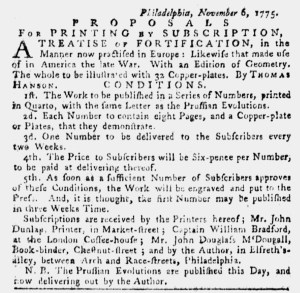
Pennsylvania Gazette (November 8, 1775).

“PROPOSALS FOR PRINTING BY SUBSCRIPTION, A TREATISE OF FORTIFICATION.”

Thomas Hanson announced a new project in the November 8, 1775, editions of the Pennsylvania Gazette and the Pennsylvania Journal.  For several months he had been engaged in soliciting subscribers for his Prussian Evolutions in Actual Engagements, a military manual that garnered the support of both officers and politicians.  With that book “published … and now delivering out by the Author,” Hanson distributed subscription proposals for printing “A TREATISE OF FORTIFICATION, in the Manner now practiced in Europe: Likewise that made use of in America the late War.”  The Prussian Evolutions included thirty copperplate engravings; similarly, this new endeavor would be “illustrated with 32 Copper-plates.”

Hanson adopted a different method for publishing the proposed treatise than he had for the Prussian Evolutions.  Rather than produce a single volume, he planned for the “Work to be published in a Series of Numbers, printed in Quarto, with the same Letter as the Prussian Evolutions,” “Each Number to contain eight Pages, and a Copper-plate or Plates, that they demonstrate,” and “One number to be delivered to the Subscribers every two Weeks.”  Eighteenth-century readers would have been familiar with such “CONDITIONS” for publishing books.  Hanson planned to use the type (“same Letter”) as his first book, giving the two works a similar appearance.  Instead of taking the entire book to press at one time, Hanson planned to print and distribute two sheets (“eight Pages”) and the corresponding illustrations once every two weeks.  Each sheet would have four pages on it, creating a quarto sized book when folded by the printer, bookbinder, or subscriber.  Subscribers paid six pence “per Number” or set of eight pages with corresponding illustrations upon delivery.

Hanson declared that “the Work will be engraved and put to the Press” once “a sufficient Number of Subscribers approves of these Conditions.”  Why did he opt to publish his treatise on fortifications in smaller parts rather than all at once?  Perhaps Hanson had grown frustrated with the delays in publishing the Prussian Evolutions.  In an earlier advertisement, he noted that he first published subscription proposals on May 3, shortly after learning about the battles at Lexington and Concord.  In July, he thought that the book would be completed “in three or four weeks,” yet more than three months passed before the volume was published and ready for delivery.  Printing and distributing a new “Number” every two weeks would keep the project moving forward and the revenues collected upon delivery would likely help as well.  Hanson expected that “the first Number may be published in three Weeks Time,” but it seems that he was disappointed once again.  It does not appear that this proposed project met with the same success as the Prussian Evolutions.  Even if some “Numbers” went to press, no complete volume of the proposed treatise survives today.  Most likely, Hanson did not entice a “sufficient Number of Subscribers.”  According to the American Revolution Institute of the Society of the Cincinnati, he faced a lot of competition.  Presses in Philadelphia produced more than thirty works on military subjects in 1775 and 1776, including Hanson’s Prussian Evolutions.

July 19

What was advertised in a revolutionary American newspaper 250 years ago today?

Pennsylvania Journal (July 19, 1775).

“PROPOSALS, For printing … The PRUSSIAN EVOLUTIONS In actual Engagements.”

The July 19, 1775 editions of the Pennsylvania Gazette and the Pennsylvania Journal carried “PROPOSALS, For printing by SUBSCRIPTION, The PRUSSIAN EVOLUTIONS In actual Engagements” by Thomas Hanson.  A synopsis indicated that the book included “all the different Evolutions and Manoeuvres in firing standing, advancing and retreating, which were exhibited before his present Majesty, May 8, 1769, and before John Duke of Argyle … in 1771; with some additions since that time, explained with thirty folio copper-plates.”  Three bonus images accompanied by descriptions depicted surveying, fortifications, and a gun and mortar.

The advertisement noted that the proposals “were first published May 3, 1775, by THOMAS HANSON, Adjutant for the Second Battalion.”  That means that Hanson proposed and marketed the work very shortly after receiving news of the battles at Lexington and Concord.  Such projects, however, took time.  “It is expected,” Hanson stated, that the “said work will be completed in three or four weeks from this date” or sometime in the middle of August.  To entice readers to reserve copies in advance, Hanson also promised that the “Subscribers names will be inserted, and those that choose to subscribe must do it speedily, otherwise their names will not be in the book.”  Prospective subscribers had an opportunity to demonstrate their support for the American cause and appear in the company of fellow Patriots, just as genteel advocates for improvements in architecture had their names listed in a recently published American edition of Abraham Swan’s British Architect.

Several prominent residents of Philadelphia lent their support to the work by collecting subscriptions on behalf of Hanson, including “John Dickinson, Esq; Thomas Mifflin, Esq; Daniel Roberdeau, John Cox, jun.[,] Samuel Meredith, and John Wilcocks, Merchants,” Benjamin Towne, printer of the Pennsylvania Evening Post; William Hall, David Hall, and William Sellers, printers of the Pennsylvania Gazette; William Bradford and Thomas Bradford, printers of the Pennsylvania Journal; Robert Bell, printer and bookseller; and Thomas Nevell, “at the sign of the Carpenter’s-Hall” (who simultaneously collected subscriptions for The Gentleman and Cabinet-Maker’s Assistant and an American edition of Swan’s Collection of Designs in Architecture).

George Washington had already joined the ranks of the subscribers to Prussian Evolutions by the time Hanson’s proposals ran in the Pennsylvania Gazette and the Pennsylvania Journal on July 19.  According to historians at Mount Vernon, Washington purchased eight copies of Hanson’s manual, “one of the earliest for the instruction of American officers,” on May 20 and “likely distribute[d] the copies among militia officers and other key figures preparing for the growing conflict.  Indeed, “His Excellency George Washington” appeared among the “LIST OF SUBSCRIBERS NAMES” inserted immediately after the “DEDICATION, TO THE PRESERVERS of LIBERTY,” with a notation that he ordered eight copies.  Other subscribers included “The Honourable John Adams,” “The Honourable Benjamin Franklin,” “The Hon. John Hancock,” “His Excellency Richard Henry Lee,” “The Hon. Peyton Randolph,” and “His Excellency Philip Schuyler.”  Washington was not alone in subscribing for multiple copies.  Captain Moore Furman subscribed for five, Lieutenant Colonel Abraham Hunt for six, Captain Joseph Moulder for two, Lieutenant John Patton for two, and Colonel Daniel Roberdeau for four.  The “Merchants” who collected subscriptions also appeared on the list, identified by their military ranks: “Col. John Dickinson, Esq,” “Quarter Master General, Thomas Mifflin,” “Major, John Cox,” “Major, Samuel Meridith,” and “Capt. John Wilcocks.”  Subscribers certainly found themselves in good company!