September 1

What was advertised in a colonial America newspaper 250 years ago today?
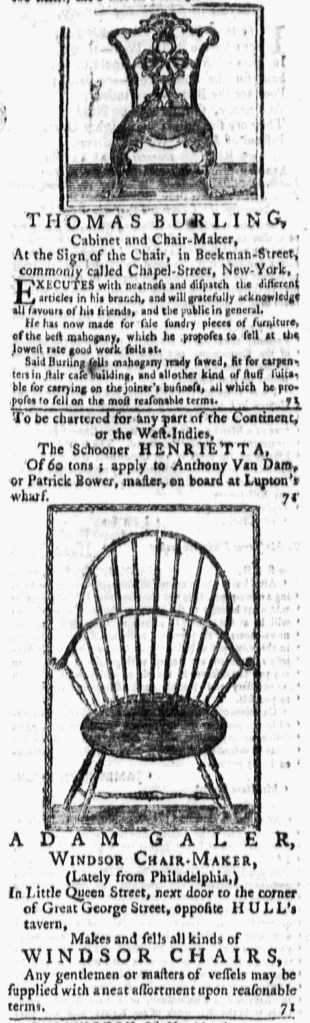
Rivington’s New-York Gazetteer (September 1, 1774).

“Cabinet and Chair-Maker, At the Sign of the Chair.”

A week ago, the Adverts 250 Project examined advertisements placed by Adam Galer, “WINDSOR CHAIR-MAKER,” and Thomas Burling, “Cabinet and Chair-Maker,” that happened to appear one after the other in the August 25, 1774, edition of Rivington’s New-York Gazetteer.  Galer adorned his advertisement with an image of a Windsor chair within a decorative border, the focal point of his notice, while Burling relied exclusively on copy in making his pitch to prospective customers.

Burling apparently did not like being outdone by Galer.  In the next issue of Rivington’s New-York Gazetteer his advertisement also featured a woodcut of a chair within a border.  Though the image was not as large as Galer’s image, the chair depicted in it was much more elaborate.  That represented the sorts of furniture, the “different articles in his branch,” that Burling produced in his shop, compared to Galer specializing in Windsor chairs.  The woodcut may have also replicated the “Sign of the Chair” that marked Burling’s location “in Beekman-Street, commonly called Chapel-Street.”  Once again, the two advertisements appeared in proximity to each other, though this time Burling’s came first and a short advertisement for chartering the schooner Henrietta separated them since colonial printers did not classify or organize advertisements by purpose or genre.

That Burling first published his advertisement without an image and then so quickly added one suggests that he consulted the newspaper to see his advertisement in print, perhaps to confirm its conclusion or perhaps out of pride to see his name and a description of his “neatness and dispatch” and “good work” in print.  He might have been quite surprised to discover that Galer upstaged him with an image and, adding to his frustration, that the two advertisements appeared together.  While the image drew attention to that portion of the page, increasing the chances that readers noticed Burling’s advertisement immediately below Galer’s, Burling might have felt that it reflected poorly on him that a chairmaker who made only Windsor chairs circulated the more striking notice.  To make his advertisement just as memorable, he added an image of a much more ornate chair at the first opportunity.
August 25

What was advertised in a colonial American newspaper 250 years ago today?

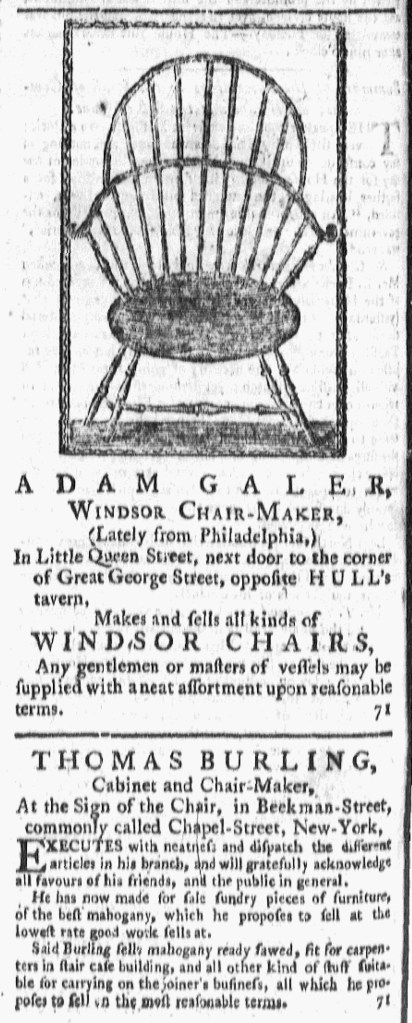
Rivington’s New-York Gazetteer (August 25, 1774).

“Sundry pieces of furniture, of the best mahogany.”

Both Adam Galer and Thomas Burling made and sold furniture in New York in the mid 1770s, yet they took different approaches when they advertised in Rivington’s New-York Gazetteer.  Their advertisements appeared one after the other in the August 25, 1774, edition, not by design but rather by coincidence since printers and compositors did not classify or organize paid notices by genre or purpose.  The proximity of the advertisements made the differences in their marketing efforts even more stark.

For his part, Galer, a “WINDSOR CHAIR-MAKER,” made an image of a Windsor chair within a decorative border the focal point of his advertisement.  That device filled about two-thirds of the space, immediately drawing attention.  Having recently arrived in New York from Philadelphia, Galer may have considered it worth the extra expense of commissioning the woodcut to enhance his visibility in the public prints.  In the copy, he gave his location and advised “gentlemen” and “masters of vessels” that they could acquire Windsor chairs “upon reasonable terms.”

Thomas Burling, on the other hand, relied exclusively on advertising copy without any images.  In that regard, his notice resembled the vast majority of newspapers advertisements.  He informed readers that they could find him “At the Sign of the Chair, in Beekman-Street, commonly called Chapel-Street,” indicating that he deployed visual images in other formats to promote his nosiness.  Burling, a “Cabinet and Chair-Maker,” produced a wider array of furniture than Galer, declaring that he “EXECUTES with neatness and dispatch the different articles in his branch.”  He reinforced his appeal to quality when he described the material, “the best mahogany,” and his own skill as an artisan.  He linked the latter to the price: “he proposes to sell at the lowest rate good work sells at.”

Burling may have benefited from the proximity of the two advertisements if readers took note of the image in Galer’s notice and then happened to continue reading the notice that followed.  Still, both artisans likely felt that they were in a better position than if they had not advertised at all.  Their direct competition in the public prints gave them an advantage over other competitors who did not advertise at all.