May 5

What was advertised in a revolutionary American newspaper 250 years ago today?
Story and Humphreys’s Pennsylvania Mercury (May 5, 1775).

“Specimens of our work may be seen at the printing offices of Alexander Purdie … and the Printers of this paper.”

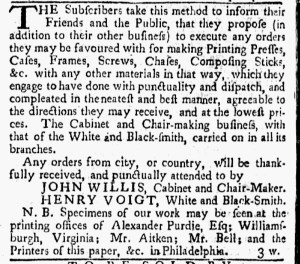
John Willis, a “Cabinet and Chair-Maker,” and Henry Voigt,” a “White and Black-Smith,” launched a new endeavor in the spring of 1775.  They took to the pages of Story and Humphreys’s Pennsylvania Mercury to advise “their Friends and the Public,” especially those in the printing trade, that they would “execute any orders they may be favoured with for making Printing Presses, Cases, Frames, Screws, Chases, Composing Sticks,” and other equipment.

Willis and Voight did not rely solely on their advertisement to market the printing equipment they produced.  They also bolstered their reputations by encouraging prospective customers to examine “Specimens” of their work “at the printing offices of Alexander Purdie, Esq; Williamsburgh, Virginia; Mr. Aitken; Mr. Bell; and the Printers of this paper, &c. in Philadelphia.”  Purdie commenced publishing his Virginia Gazette earlier in the year after dissolving his partnership with William Dixon.  Having started as a bookseller and bookbinder, Robert Aitken opened a printing office in 1774 and launched the Pennsylvania Magazine in January 1775.  Robert Bell, on the other hand, had several years of experience as a bookseller, printer, and publisher, one who advertised his projects widely in newspapers throughout the colonies.  Enoch Story and Daniel Humphreys, “the Printers of this paper,” had been publishing their newspaper for only a month when it carried Willis and Voight’s advertisement.  Both newcomers and veterans in the trade had turned to Willis and Voight to produce equipment they needed to operate their printing shops.

Although their names did not appear in the imprints of any books or pamphlets or in the colophons of any newspapers, Willis and Voight made their own contributions to the dissemination of news and information as the imperial crisis became a war for independence.  They did not refer to current events in their advertisement, but the timing suggests that they saw new opportunities when they heard about the battles at Lexington and Concord.  The cabinetmaker and the blacksmith likely anticipated an expanding market for the equipment necessary for printing the news, prompting them to advertise services “in addition to their other business.”
April 26

What was advertised in a revolutionary American newspaper 250 years ago today?

Pennsylvania Journal (April 26, 1775).

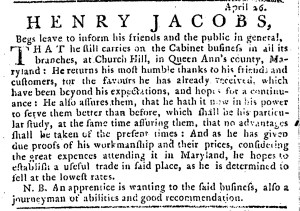
“He still carries on the Cabinet business … no advantages shall be taken of the present times.”

Henry Jacobs had confidence in the circulation of the Pennsylvania Journal when he placed an advertisement in the spring of 1775.  Addressing “his friends and the public in general,” he declared that he “still carries on the Cabinet business in all its branches, at Church Hill, in Queen Ann’s county, Maryland.”  That small town on the colony’s eastern shore was approximately eighty miles from Philadelphia, the bustling port where William Bradford and Thomas Bradford printed the Pennsylvania Journal, yet Jacobs considered advertising in that newspaper a sound investment.  He may not have expected to gain any customers in Philadelphia, but he realized that the Pennsylvania Journal served an extensive readership in Pennsylvania, New Jersey, Delaware, and Maryland.  That meant that “the public in general” in Queen Anne’s County might see his advertisement as copies of the Pennsylvania Journal circulated there.

Yet some of the language in his advertisement suggests that Jacobs did not yet have friends and customers in Maryland.  Near the end of his notice, he stated that he “hopes to establish a useful trade in said place,” indicating that he may have been a newcomer there.  Perhaps Jacobs relocated from Philadelphia.  When he announced that he “still carries on the Cabinet business … at Church Hill,” the “still” may have referred to pursuing his trade but not the location.  Jacobs’s advertisement might have been a moving notice, alerting customers that he left one town and opened a workshop in another.  He hoped to maintain at least some of his former clientele.  If that was the case, it also helps to explain why he chose to advertise in a newspaper published in Philadelphia rather than the Maryland Gazette printed in Annapolis.  Furthermore, he sought an apprentice and a journeyman “of abilities and good recommendation,” possibly seeking staff to assist him at his workshop in a new town.

Like many other colonizers who advertised goods and services, Jacobs expressed gratitude to “his friends and customers, for the favours he has already received.”  Doing so signaled to readers not familiar with him or his furniture that he was an established artisan.  He underscored his skill and experience when he trumpeted that he “has given due proofs of his workmanship.”  Jacobs intended to bolster his reputation, especially when he stated that customers previously placed orders “beyond his expectations.”  Such appeals could have resonated with customers in both Philadelphia and Queen Anne’s County.  The primary purpose of his advertisement, after all, was not to proclaim “his most humble thanks” but instead to drum up new business.  To that end, he asserted that he “hath it now in his power to serve [his customers] better than before,” though he did not explain what he meant when he gave those assurances.  If he had been in Church Hill for some time, perhaps he made improvements to his workshop or acquired new tools.  If he was new to town, he may have referred to his new workshop.  Whatever the case, he promised that “no advantages shall be taken of the present times.”  Jacobs likely had not heard about events at Lexington and Concord on April 19 when he composed his advertisement and submitted it to the printing office.  The “present times” became more complicated as the imperial crisis became a war.

September 1

What was advertised in a colonial America newspaper 250 years ago today?

Rivington’s New-York Gazetteer (September 1, 1774).

“Cabinet and Chair-Maker, At the Sign of the Chair.”

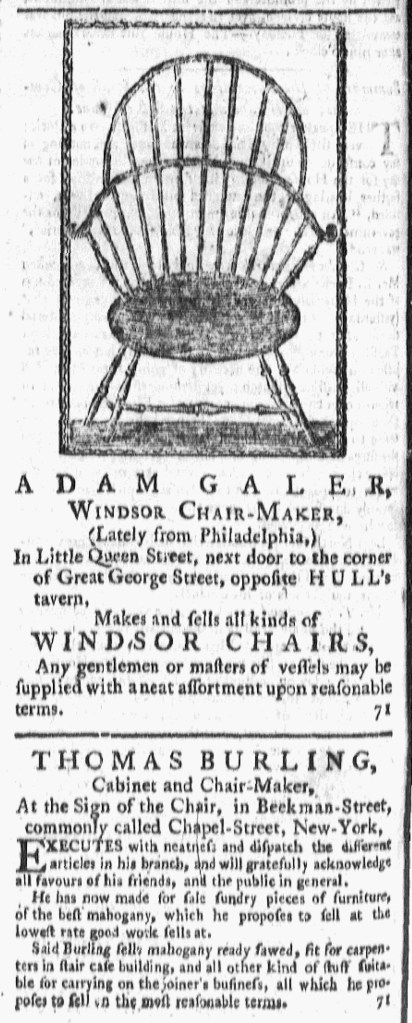
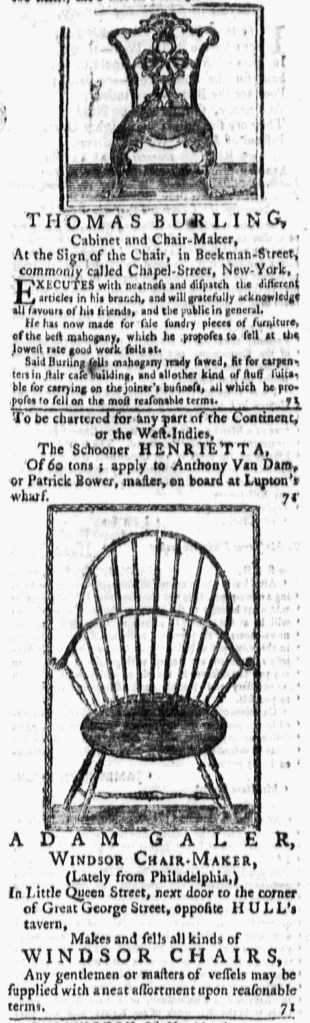
A week ago, the Adverts 250 Project examined advertisements placed by Adam Galer, “WINDSOR CHAIR-MAKER,” and Thomas Burling, “Cabinet and Chair-Maker,” that happened to appear one after the other in the August 25, 1774, edition of Rivington’s New-York Gazetteer.  Galer adorned his advertisement with an image of a Windsor chair within a decorative border, the focal point of his notice, while Burling relied exclusively on copy in making his pitch to prospective customers.

Burling apparently did not like being outdone by Galer.  In the next issue of Rivington’s New-York Gazetteer his advertisement also featured a woodcut of a chair within a border.  Though the image was not as large as Galer’s image, the chair depicted in it was much more elaborate.  That represented the sorts of furniture, the “different articles in his branch,” that Burling produced in his shop, compared to Galer specializing in Windsor chairs.  The woodcut may have also replicated the “Sign of the Chair” that marked Burling’s location “in Beekman-Street, commonly called Chapel-Street.”  Once again, the two advertisements appeared in proximity to each other, though this time Burling’s came first and a short advertisement for chartering the schooner Henrietta separated them since colonial printers did not classify or organize advertisements by purpose or genre.

That Burling first published his advertisement without an image and then so quickly added one suggests that he consulted the newspaper to see his advertisement in print, perhaps to confirm its conclusion or perhaps out of pride to see his name and a description of his “neatness and dispatch” and “good work” in print.  He might have been quite surprised to discover that Galer upstaged him with an image and, adding to his frustration, that the two advertisements appeared together.  While the image drew attention to that portion of the page, increasing the chances that readers noticed Burling’s advertisement immediately below Galer’s, Burling might have felt that it reflected poorly on him that a chairmaker who made only Windsor chairs circulated the more striking notice.  To make his advertisement just as memorable, he added an image of a much more ornate chair at the first opportunity.

August 25

What was advertised in a colonial American newspaper 250 years ago today?

Rivington’s New-York Gazetteer (August 25, 1774).

“Sundry pieces of furniture, of the best mahogany.”

Both Adam Galer and Thomas Burling made and sold furniture in New York in the mid 1770s, yet they took different approaches when they advertised in Rivington’s New-York Gazetteer.  Their advertisements appeared one after the other in the August 25, 1774, edition, not by design but rather by coincidence since printers and compositors did not classify or organize paid notices by genre or purpose.  The proximity of the advertisements made the differences in their marketing efforts even more stark.

For his part, Galer, a “WINDSOR CHAIR-MAKER,” made an image of a Windsor chair within a decorative border the focal point of his advertisement.  That device filled about two-thirds of the space, immediately drawing attention.  Having recently arrived in New York from Philadelphia, Galer may have considered it worth the extra expense of commissioning the woodcut to enhance his visibility in the public prints.  In the copy, he gave his location and advised “gentlemen” and “masters of vessels” that they could acquire Windsor chairs “upon reasonable terms.”

Thomas Burling, on the other hand, relied exclusively on advertising copy without any images.  In that regard, his notice resembled the vast majority of newspapers advertisements.  He informed readers that they could find him “At the Sign of the Chair, in Beekman-Street, commonly called Chapel-Street,” indicating that he deployed visual images in other formats to promote his nosiness.  Burling, a “Cabinet and Chair-Maker,” produced a wider array of furniture than Galer, declaring that he “EXECUTES with neatness and dispatch the different articles in his branch.”  He reinforced his appeal to quality when he described the material, “the best mahogany,” and his own skill as an artisan.  He linked the latter to the price: “he proposes to sell at the lowest rate good work sells at.”

Burling may have benefited from the proximity of the two advertisements if readers took note of the image in Galer’s notice and then happened to continue reading the notice that followed.  Still, both artisans likely felt that they were in a better position than if they had not advertised at all.  Their direct competition in the public prints gave them an advantage over other competitors who did not advertise at all.

June 5

What was advertised in a colonial American newspaper 250 years ago this week?

Norwich Packet (June 2, 1774).

“CABINETS, CHAIRS, and a variety of useful and ornamental FURNITURE.”

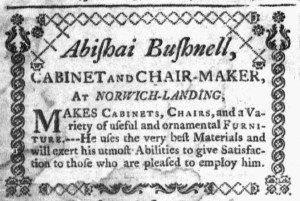
Alexander Robertson, James Robertson, and John Trumbull had been publishing the Norwich Packet for less than a year when Abishai Bushnell, “CABINET AND CHAIR-MAKER,” ran an advertisement with distinctive graphic design elements.  One of the printers or one of the compositors who worked in the printing office enclosed Bushnell’s copy within a border comprised of decorative ornaments.  That set it apart from other content, both news and advertising, in the Norwich Packet.  Bushnell may have also arranged to have his advertisement printed separated to use as labels for the “CABINETS, CHAIRS, and a variety of useful and ornamental FURNITURE” he made in his shop.

Except for the packet ship carrying letters from one port to another depicted in the masthead, the Norwich Packet did not usually feature visual images, neither to accompany news nor to adorn advertisements.  That included woodcuts of ships, houses, horses, indentured servants, and enslaved people, stock images that many printers made available to advertisers.  Yet the compositors did make liberal use of printing ornaments to indicate where one news item or editorial ended and another began and, especially, to separate advertisements from each other.  An intricate border also enclosed the first letter of the first word in the first article on the first page of each edition of the Norwich Packet, a design that changed every few weeks.  The masthead also made use of decorative type above and below the date of the newspaper, though that was a more recent innovation as the compositor experimented with the appearance of the front page.

Apparently, that was enough to convince Bushnell that Robertson, Robertson, and Trumbull could produce an advertisement that would attract attention with an ornate border that made it unlike anything else that appeared in the pages of the Norwich Packet.  The cabinetmaker almost certainly placed a special order or gave specific instructions about how he wished his advertisement to look.  After all, even though the compositor incorporated a lot of decorative type into each edition of the newspaper, no other advertisements received such treatment.  Bushnell did not opt for a woodcut of a chair or other piece of furniture representing his trade, but he did find a way to make his advertisement more visible and more memorable.

Decorative borders enclosing the first letter of the first word in the first item on the first page of the Norwich Packet (left to right: March 24, 1774; April 21, 1774; April 28, 1774; May 5, 1774; May 12, 1774).

January 19

What was advertised in a colonial American newspaper 250 years ago today?

Pennsylvania Journal (January 19, 1774).

JEDIDIAH SNOWDEN … carries on his business of Cabinet and Windsor Chair-Making … The MILLINARY BUSINESS is carried on as usual, by ANN SNOWDEN.”

Jedidiah Snowden and Ann Snowden pursued different lines of business, but they placed a joint advertisement in the January 19, 1774, edition of the Pennsylvania Journal.  Jedidiah informed the public that he moved from Market Street to Front Street, “where he carries on his business of Cabinet and Windsor Chair-Making, and sells them at the most reasonable rates.”  For her part, Ann declared that the “MILLARY BUSINESS is carried on as usual” and she “has imported a large and general assortment of MILLINARY.”  She then listed dozens of items among her inventory, including “a genteel assortment of figured and plain ribbands,” “mens, womens, boys and girls white and coloured gloves,” “pearl, French and English white wax necklaces,” and “India, ivory, bone, and black fans.”

The Snowdens did not specify their relationship to each other in their advertisement.  Most likely they were husband and wife, though they could have been father and daughter, mother and son, brother and sister, cousins, or some other relations.  Whatever the case, Jedidiah was the head of household, so his name and information about his business came first.  Although Ann’s name ran in the same size font as Jedidiah’s name, “Cabinet and Windsor Chair-Making” appeared as a secondary headline, also in a larger font than the rest of the advertisement, while “MILLINARY BUSINESS” merely appeared in capital letters integrated into the regular copy rather than treated as another headline.  Still, Ann’s portion of the advertisement occupied the most space on the page, approximately four times as much as Jedidiah’s portion.  The Snowdens made a much larger investment in promoting Ann’s “MILLINARY BUSINESS” than Jedidiah’s “Cabinet and Windsor Chair-Making.”  Perhaps Jedidiah believed that he had established such a reputation for his work that he did not need to provide more details beyond telling readers that he had moved and sold the furniture he made “at the most reasonable rates.”  Ann, on the other hand, competed with merchants, shopkeepers, and milliners who constantly imported new wares and updated their advertisements in the several newspapers published in Philadelphia.  Demonstrating that she offered the same selection of merchandise as her competitors may have been imperative to the milliner.  Advertisements jointly placed by husbands and wives or other male and female relations rarely listed the female entrepreneur first, but no matter their format they did reveal that both advertisers contributed to the household economy through their participation in the marketplace.

December 5

What was advertised in a colonial American newspaper 250 years ago today?

South-Carolina and American General Gazette (December 5, 2020).

“Will sell by vendue … a neat assortment of CABINET-WORK.”

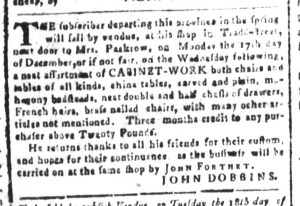
John Dobbins, a cabinetmaker, operated a shop on Tradd Street in Charleston in 1770.  As the year came to a close, he inserted an advertisement in the South-Carolina and American General Gazette to alert the public that he planned to leave the colony in the spring.  In preparation for his departure, he planned a vendue or auction for December 17.  His inventory consisted of “a neat assortment of CABINET-WORK,” including “chairs and tables of all kinds, china tables, carved and plain, mahogany bedsteads, neat double and half chests of drawers, French [c]hairs, brass nailed chairs,” and “many other articles not mentioned.”  Dobbins sought to liquidate his wares.  In effect, he ran a going-out-of-business sale.  Prospective customers stood to acquire better bargains by buying at auction.  The cabinetmaker faced improved prospects of finding purchasers for the array of furniture that remained in stock.

In his effort to attract bidders to the auction, Dobbins offered “Three months credit to any purchaser above Twenty Pounds.”  Providing such flexibility likely increased the number of prospective customers who considered attending the vendue.  After all, the cabinetmaker’s first goal was to get people through the door.  The number and amount of sales depended on the crowd that gathered, so announcing that he extended credit – and set the threshold at twenty pounds – was a savvy tactic for encouraging attendance and participation at the auction.

Dobbins also took the opportunity to express his appreciation to his customers for their patronage during the time he made and sold furniture at his shop on Tradd Street.  Although he was leaving the colony, the business would continue at the same location.  Dobbins endorsed his successor, John Forthet, asking “his friends … for their continuance as the business will be carried on at the same shop.”  As one last service to his customers, he offered a recommendation and a transition to another artisan who made and sold furniture.  As part of maintaining good relationships during the time that he remained in the colony, he prepared for a smooth departure that included bargains at auction, credit for preferred customers, an expression of gratitude, and recommending a successor.