July 3

What was advertised in a revolutionary American newspaper 250 years ago today?
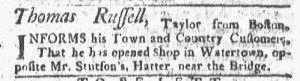
Boston-Gazette (July 3, 1775).

“Thomas Russell, Taylor from Boston … has opened Shop in Watertown.”

Benjamin Edes, a Patriot printer, moved the Boston-Gazette to Watertown following the battles at Lexington and Concord.  He was not the only colonizer on the move during the siege of Boston at the beginning of the Revolutionary War.  General Thomas Gage, the governor, and the Massachusetts Provincial Congress negotiated an agreement that allowed Loyalists to enter the city and Patriots and others to depart.  Each could take whatever effects they could transport, except for firearms and ammunition.  Many residents of Boston left the city for other towns and cities, some of them placing advertisements to introduce themselves to their new communities and announce their occupations to prospective clients and customers.  In the late spring and summer of 1775, the description “from Boston” took on new meaning.

While some of those refugees headed to other colonies, Thomas Russell, a “Taylor from Boston,” moved only a short distance to Watertown.  Upon arriving, he placed an advertisement in the Boston-Gazette to inform “his Town and Country Customers, That he has opened Shop in Watertown, opposite Mr. Stutson’s, Hatter, near the Bridge.”  Although framed as an update for his current customers, Russell’s advertisement also signaled to all readers that he considered himself a “Steady Friend to America,” as Edes described a correspondent in the column to the left of the notice, rather than a Tory who embraced the protection of British regulars and supported the policies enacted by Parliament.  Just above that piece, Edes relayed an account from New York about a colonizer taken into custody “who it is said had been privately inlisting men to serve under General Gage, against their country.”  Russell, in contrast, had refused to remain in Boston and lend any kind of support to the general and his officers or the residents who approved of them.  Instead, he hoped that his “Town” customers who had also departed the city would seek his services in Watertown.  Similarly, he hoped that “Country Customers,” whether they previously hired him or not, would visit his shop.

April 2

What was advertised in a colonial American newspaper 250 years ago today?

Providence Gazette (April 2, 1774).

“Genteel Boarding, FOR Gentlemen, Strangers and others.”

Thomas Russell provided “Genteel Boarding … at the House lately occupied by Mr. Benjamin Bagnall, deceased, near the State-House” in Boston.  He did not, however, place his advertisement in the Boston-Gazette or the Massachusetts Spyor any of the several other newspapers printed in that city.  Instead, he ran it in the Providence Gazette for six weeks in the spring of 1774.  For “Gentlemen, Strangers and others” who planned to visit Boston, Russell presented an option for accommodations and made planning their journey that much easier.

To convince prospective guests that his establishment was a good choice, he assured readers that the house was “a very noted Place for this Business” as well as “well known to be a large and commodious House.”  For anyone not familiar with its reputation, including those who lived any distance from Boston, they “have only to apply, to be convinced how agreeably they can be accommodated.”  Russell’s hospitality and the amenities he offered, he suggested, would become immediately apparent upon meeting.

Boston and other American towns had not yet adopted standardized street numbers, so Russell provided travelers with general directions to get them to the vicinity of the house and enough information to find it once they spoke with some locals.  Anyone who made their way to the “State-House” could then ask anyone they encountered about Russell’s boarding house, though they might more efficiently find it by invoking Benjamin Bagnall’s name since Russell apparently only recently acquired the property.  Describing the landmark according to local knowledge would get guests to Russell’s door.

In promoting his boarding house, Russell joined entrepreneurs who ran taverns and inns who advertised in newspapers published in other cities.  While they certainly welcomed local custom, they believed that marketing their establishments in publications in other towns would generate additional business.  Russell seemed certain enough of it that he invested in advertising in the Providence Gazette for six weeks rather than starting with the standard three-week run for his advertisement.  With the arrival of spring, he likely anticipated more travelers from Providence and its environs making their way to Boston.  Russell stood ready to provide them with lodgings.